
AI-generated
Sachertorte — chocolate cake with apricot preserves
Log in or create a free account to save recipes.
Source: https://recipheon.com/en/recipes/desserts/sachertorte-chocolate-cake-with-apricot-preserves
About this recipe
Sachertorte combines buttery chocolate cake, a thin layer of apricot preserves and a dark chocolate glaze. This is a homemade interpretation of the Viennese classic, with two layers cut from a single cake and an apricot coating beneath the glaze as well. Carefully beaten egg whites give the cake its lift, so gentle folding matters more than working quickly. The chocolate and sugar syrup glaze sets into a firm coating with a delicate satin sheen, and a warmed knife helps cut even slices. Allow about 8 hours and 30 minutes, including bringing the ingredients to temperature, cooling and setting; the cake can be made the day before serving.
Ingredients
Cake in a 22 cm springform pan
150 g dark chocolate with 60–65% cocoa, with no filling or add-ins
155 g butter with no added salt, 82% fat: 150 g for the cake and 5 g for the pan
80 g powdered sugar
100 g superfine white sugar
8 g sugar with real vanilla
6 size M eggs, about 300 g without shells, whites and yolks separated
140 g fine wheat cake flour, Polish type 450
1 g fine salt
Apricot layer
260 g apricot preserves with 50–60% fruit, without pits or large pieces: 150 g for the filling and 110 g for the top and sides
Chocolate sugar glaze
170 g dark chocolate with 60–65% cocoa, with no filling or add-ins
220 g superfine white sugar
140 g water for the glaze
up to 15 g hot water, only to adjust the glaze consistency if needed
Steps
Take the butter and eggs out of the refrigerator about 60 minutes before you start mixing. Dice the butter; it should be soft, about 20–22°C, but not liquid. Separate the egg whites and yolks into different bowls, with no traces of yolk in the whites, and cover them while they come to temperature. Prepare a 22 cm springform pan at least 6 cm tall, an electric mixer, a silicone spatula, a sieve, a long serrated knife, a wire rack with a baking sheet beneath it and a kitchen thermometer suitable for hot syrup. Line the pan base with parchment paper and use a total of 5 g butter to grease the paper and sides. Toward the end of the ingredients' warming time, preheat the oven to 170°C with top and bottom heat, without convection; position the oven rack slightly below the center.
Chop the 150 g of chocolate for the cake. Place it in a dry bowl over a saucepan of lightly steaming water, making sure the bowl's base does not touch the water. Stir with a spatula until the chocolate melts, then remove the bowl and let it cool to about 35–40°C: the chocolate should still flow freely from the spatula but should not be hot. Do not let water or condensation from steam drip into the bowl. Reserve the remaining 170 g of chocolate for the glaze.
Cream the 150 g of soft butter with the sifted 80 g of powdered sugar, 8 g of vanilla sugar and the full 1 g of salt for about 4–5 minutes, until lighter and fluffy. Add all 6 yolks one at a time, beating for about 20–30 seconds after each and scraping down the sides of the bowl. Pour in the fluid chocolate at 35–40°C and mix briefly on low speed, just until combined. The mixture should be uniformly chocolate-colored, soft and without pieces of butter.
Using clean, dry beaters, beat all 6 egg whites on medium speed into a soft foam. Gradually add all 100 g of superfine sugar in 4 batches, beating continuously. Stop when the foam is thick and glossy and holds a peak with a slightly bent tip. It should remain supple, with no dry clumps; egg whites beaten too stiffly are harder to fold evenly into the heavier chocolate mixture.
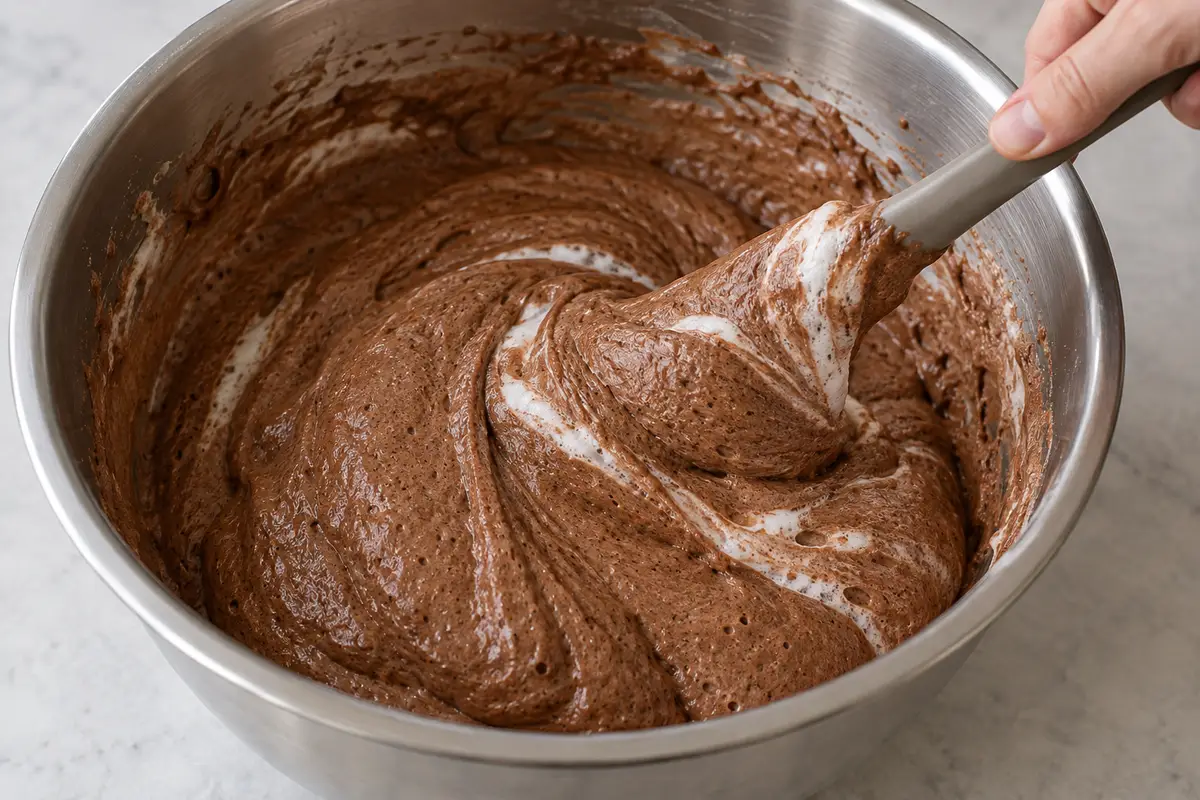
Add about one third of the beaten whites to the chocolate mixture and stir with a spatula to loosen it. Add the remaining whites in two batches, sifting half the flour over each batch, using the full 140 g in total. Fold with broad strokes from the bottom upward, rotating the bowl; do not use the mixer. Stop when the white streaks and pockets of dry flour disappear while the batter is still airy. Transfer all the batter to the prepared pan, level the top with a spatula and immediately place it in the preheated oven.
AI-generated Bake at 170°C for about 55–65 minutes. Do not open the oven during the first 45 minutes. From the 55th minute, check the center with a wooden skewer: it should come out without raw, gooey batter; a few moist crumbs are fine. The top should spring back when lightly touched, and the center should be stable. If the cake is still raw, bake for another 5 minutes at a time and check again. If the top is darkening too much toward the end of baking, cover it loosely with aluminum foil. Take the baked cake out of the oven and leave it in the pan for 20 minutes.
After 20 minutes, carefully loosen the edge of the cake with a thin knife and remove the pan ring. Place a wire rack against the cake, support everything and gently invert it so the flat base is on top. Remove the pan base and paper. Leave on the rack until completely cool, usually about another 100 minutes; allow about 2 hours including cooling in the pan. The center must not still be warm, as the cake would crumble when split and thin the preserves too quickly. Do not put the warm cake under an airtight cake dome.
Use a long serrated knife to split the completely cold cake horizontally into 2 layers as even as possible. Make a shallow guide cut around the circumference halfway up, then follow it with the knife, rotating the cake instead of pressing down from above. Set the upper layer with the flat surface aside on a flat plate. Measure out 150 g of preserves, heat in a small saucepan over low heat only to about 60–70°C and stir until easy to spread. Spread this entire portion in a thin, even layer over the lower cake layer, right to the edge. Place the second layer on top, keeping the flat side uppermost, align the edges and press very lightly with your palm.
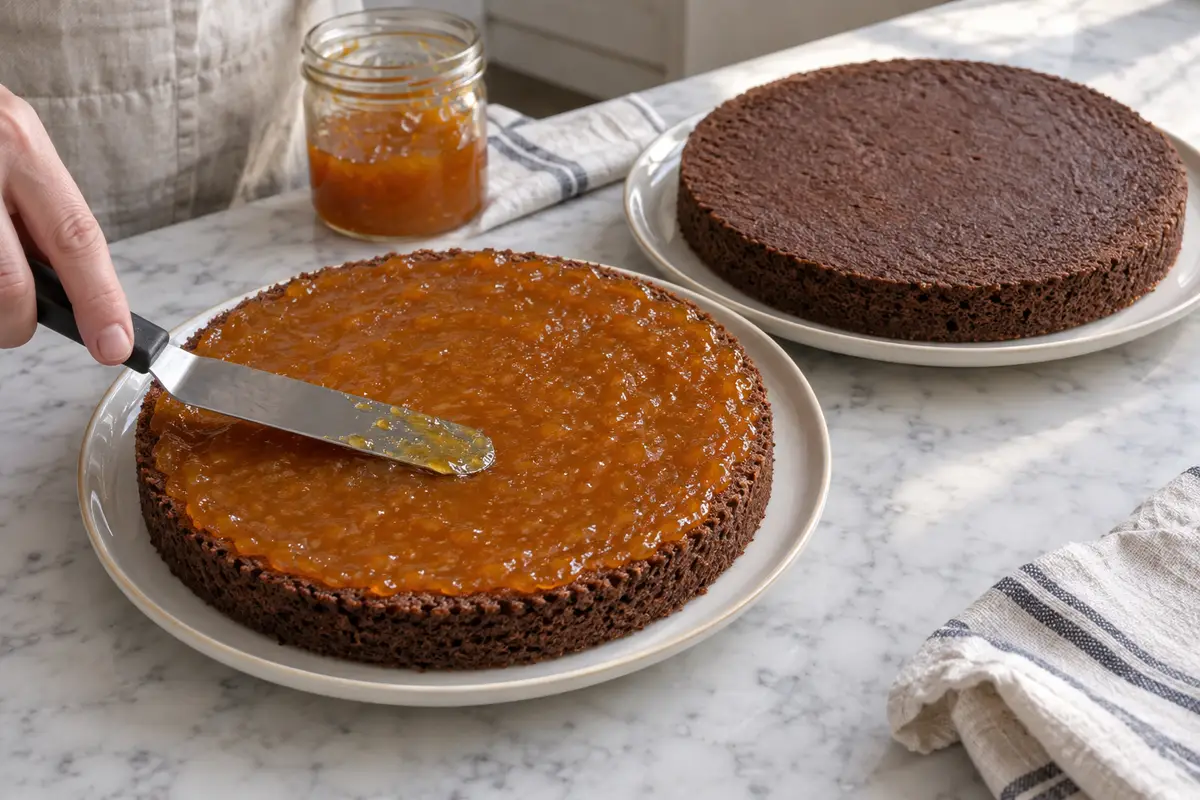
AI-generated Heat the remaining 110 g of preserves to about 60–70°C and stir until smooth. Spread a thin coating over the entire top and sides of the assembled cake, using all of it; this layer should fill small uneven areas and trap crumbs beneath the glaze. Place the cake on a wire rack over a clean baking sheet and leave at room temperature while preparing and cooling the glaze. Before glazing, the apricot surface should be tacky but not wet and runny. Do not soak the cake with additional syrup.
Finely chop the 170 g of chocolate. Combine the 220 g of superfine sugar and 140 g of water in a heavy-bottomed saucepan with a capacity of about 1.5 liters. Heat gently, stirring until the sugar dissolves, then bring to a boil. Reduce the heat, add the chocolate and stir with a spatula until it melts. Cook over medium-low heat, stirring gently along the bottom, until it reaches 108°C; the probe should be immersed in the mixture without touching the bottom. Immediately pour the glaze into a clean heatproof pitcher, without scraping dried sugar from the sides of the saucepan. Cool for about 20–30 minutes to 35–38°C, stirring slowly every few minutes without beating. The ready glaze should flow in a broad, continuous ribbon and level out after a few seconds. If it is too thick within this temperature range, stir in hot water in 5 g additions, up to 15 g, and check the temperature again. If it has cooled too much, briefly warm the pitcher in a warm water bath, without letting water inside.
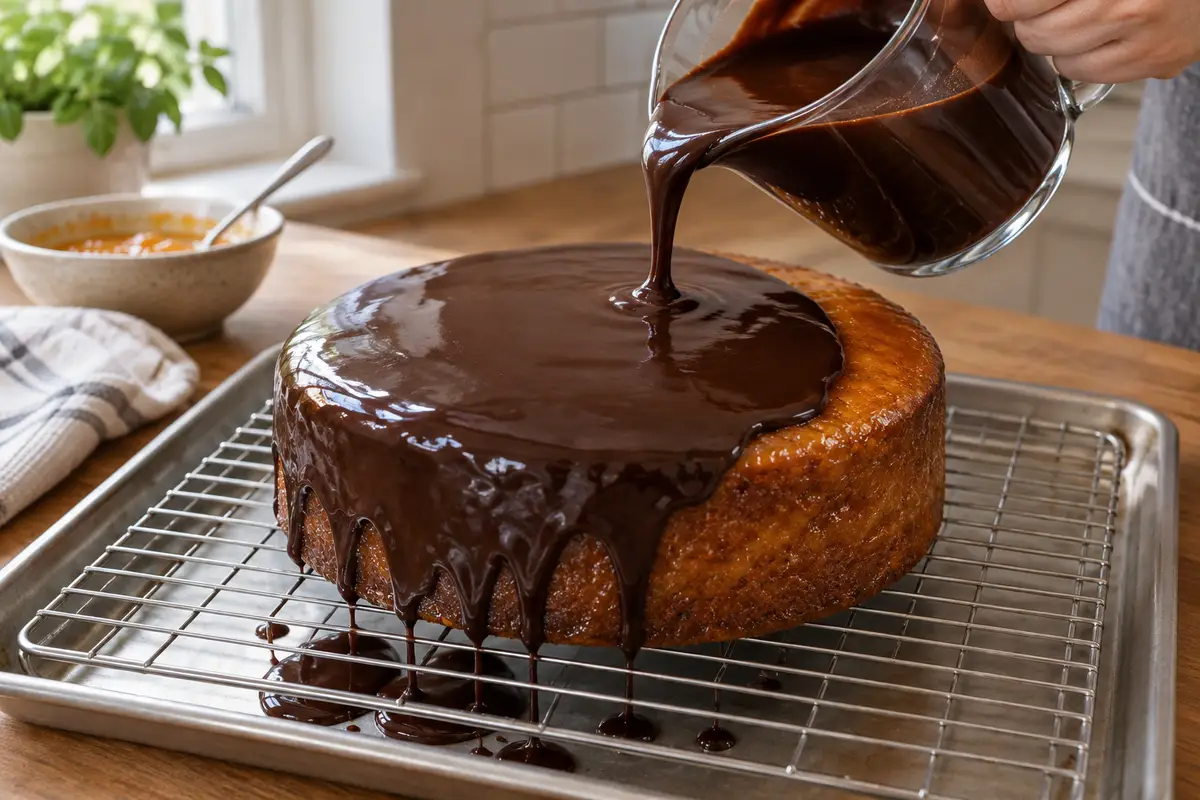
Make sure the cake is at room temperature and the glaze is at 35–38°C and flows smoothly from the spatula. Pour it in one continuous motion onto the center, directing the stream toward the edges. Quickly spread it across the top with a few strokes of a wide palette knife, letting the glaze cover the sides; immediately fill any gaps. Let the excess drip freely onto the baking sheet. Once the surface starts to set, stop adjusting it so you do not create streaks. After about 10 minutes, trim off the drips hanging from the bottom and transfer the cake to a cake stand using two wide spatulas. The glaze collected on the baking sheet is not part of the finished cake.
AI-generated Leave the cake for about 3 hours from glazing in a cool room, about 18–20°C, until the glaze is dry when lightly touched at the edge and can be sliced cleanly. The ten minutes spent on the rack count toward this time. Once set, cover the cake with a cake dome; you can leave it overnight in this cool place and serve it the next day. If your home is warm, refrigerate the cake, covered, after the glaze has initially set and take it out about 60 minutes before serving; refrigeration may reduce the glaze's shine. Cut into 12 servings with a knife warmed in hot water and thoroughly wiped dry, wiping the blade between cuts. Each slice should show 2 chocolate cake layers, one thin apricot layer in the middle and a chocolate coating.
Estimated nutrition

Rate this recipe
0 ratings
Comments