
AI-generated
Idrijski žlikrofi — hat-shaped dumplings with potatoes and bacon
Log in or create a free account to save recipes.
Source: https://recipheon.com/en/recipes/main-dishes/idrijski-zlikrofi-hat-shaped-dumplings-with-potatoes-and-bacon
About this recipe
Idrijski žlikrofi are Slovenian hat-shaped dumplings filled with potatoes, bacon, and herbs. Thin egg dough encloses a firm yet delicate filling scented with chives and marjoram. Their distinctive features are little ears at the sides and a shallow dimple on top, made without piercing the dough. This is a homemade version of the Idrija dish, served simply with melted butter. The quantities make about 120 small dumplings, or four servings. Allow about 3 hours and 30 minutes: hand rolling, sealing, and shaping take the most time, while the dough rests during filling preparation.
Ingredients
Dough and cooking
300 g all-purpose flour, type 450 or 500, for the dough, plus up to 30 g of the same flour for dusting; discard unused dusting flour
2 whole medium eggs, size M
10 g canola oil for the dough
up to 40 ml water for the dough, 1.5 l water for the potatoes, and 3 l water for cooking the dumplings; both cooking waters are discarded
24 g salt, divided into 3 g for the dough, 3 g for the filling, and 18 g for the dumpling cooking water
Filling and serving
500 g raw floury type C potatoes, weighed after peeling
50 g cooked smoked pork belly bacon, ready to eat, without skin; all rendered fat and small pieces go into the filling
50 g raw onion, weighed after peeling
10 g fresh chives, weighed after trimming
1 g dried marjoram
0.5 g ground black pepper
40 g unsalted butter for serving, all used
Steps
Combine 300 g flour with the whole eggs, oil, 3 g salt, and 30 ml water. Knead for about 8–10 minutes until smooth, elastic, and soft enough to roll thinly. If dry crumbs remain, gradually add the rest of the measured water, no more than 10 ml. Shape into a ball, cover tightly with a bowl, and leave for about 45 minutes at room temperature; make the filling during this time.
Cut the potatoes into cubes about 2–3 cm across, add 1.5 l water, and bring to a boil without adding salt. Cook for about 15–20 minutes after the water returns to a boil, until completely tender. Drain, discarding all the water, and put the pot over low heat for about 1–2 minutes, shaking it to steam-dry the potatoes. Mash thoroughly with a potato masher while still warm; do not puree them with a blender.
While the potatoes cook, cut the bacon and onion into very small dice. Put the bacon in a small skillet and heat over medium-low heat for about 5 minutes until it releases some fat. Add the onion and cook gently for approximately another 7–10 minutes, stirring, until soft and lightly golden. Keep all the small pieces, rendered fat, and juices; do not drain anything from the pan.
Add the entire contents of the skillet to the warm potatoes, along with finely chopped chives, marjoram, pepper, and 3 g salt. Mix thoroughly and leave for about 20 minutes to cool; the mixture should be firm and rollable, without loose liquid. Shape all the filling into about 120 even balls the size of a small hazelnut, usually close to 2 cm in diameter. Allow about 15–20 minutes to roll the balls at an unhurried pace.
Divide the dough into four pieces and keep the unused pieces covered. Roll each piece about 1–1.5 mm thick, using only as much of the measured dusting flour as needed. Arrange a row of filling balls along an edge, leaving roughly a finger-width gap between them. Fold the dough edge over the balls, gently push out the air, and firmly seal the long edge and the spaces between the balls; the joins should be without loose flour.
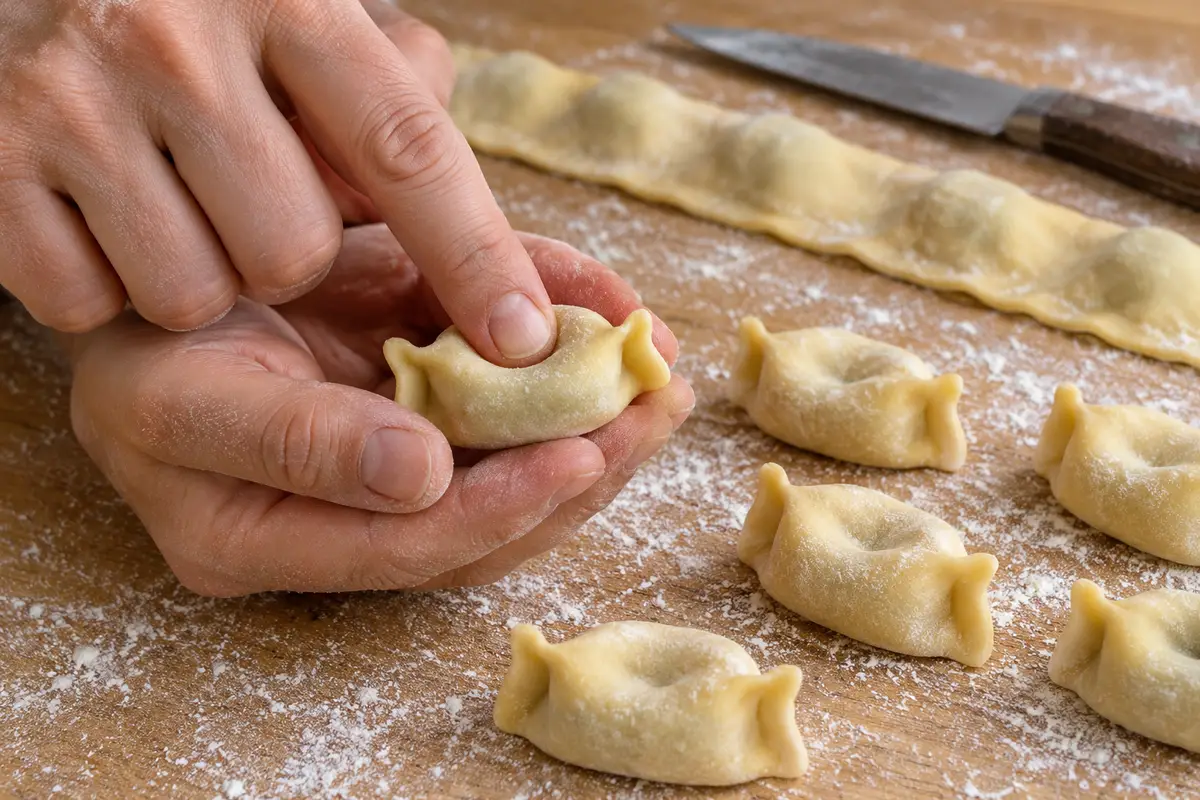
Cut the sealed strip away from the rest of the sheet, then cut between the balls into individual dumplings. Press the side joins together to make little ears, and gently press a shallow dimple into the top of each ball with a fingertip. The dough must stay sealed: do not pierce through to the filling. Each finished hat should be about 3 cm long; set the dumplings apart on a lightly floured tray. Gather the scraps, keep them covered, and roll them thinly again until all the dough and filling are used; discard the remaining loose dusting flour. Allow about 60–75 minutes to roll, seal, and shape the entire batch.
AI-generated Toward the end of shaping, bring 3 l water to a boil in a pot holding about 5 l and add the remaining 18 g salt. Melt all 40 g butter over low heat in a deep skillet about 30 cm in diameter, then take it off the heat. Have ready a slotted spoon and a lid to cover the skillet loosely between batches.
Add the dumplings to the boiling water in four batches of about 30, using the same water. Gently move a spoon along the bottom, wait for the water to return to a boil, and cook gently for about 3–4 minutes until the dumplings float and the dough is tender even at the joins. Lift out with a slotted spoon, let the water drain off, and transfer to the butter; gently mix and cover loosely after each batch. Let the water return to a boil before adding the next batch; discard it after all the dumplings are cooked.
After adding the last batch, warm everything over low heat for about 2–3 minutes, turning carefully, until the dumplings are warm and coated with butter. Keep their pale surface and delicate ears, without frying them until browned. Divide all the dumplings and all the butter from the skillet among four servings and serve immediately.
Estimated nutrition

Rate this recipe
0 ratings
Comments