
AI-generated
Torta pasqualina — layered pie with spinach, ricotta and whole eggs
Log in or create a free account to save recipes.
Source: https://recipheon.com/en/recipes/main-dishes/torta-pasqualina-layered-pie-with-spinach-ricotta-and-whole-eggs
About this recipe
Torta pasqualina is an Italian savory pie with thin pastry layers, spinach, ricotta and whole eggs inside. Slicing reveals green filling and firm egg white around a golden yolk. In this home version, we make four separate olive-oil dough sheets: two beneath the filling and two on top. Thoroughly squeezing the spinach, draining the ricotta and cooling the filling help keep the base crisp. The whole eggs are cracked into wells in the filling and baked inside the pie. A 24 cm pan makes six substantial servings. Allow about 3 hours and 50 minutes for preparation, resting the dough, cooking, baking and cooling; some stages can run at the same time.
Ingredients
Four olive-oil dough layers
300 g wheat flour, Polish type 500
165 ml lukewarm water
20 g olive oil
5 g fine salt
all-purpose flour for light dusting, up to 15 g, not necessarily the full amount
Spinach and cheese filling
400 g leaf spinach after cooking, cooling and squeezing very thoroughly; start with about 900 g frozen leaves without additives
400 g cow’s-milk ricotta, weighed after draining; buy about 500 g
2 medium eggs (size M) to mix into the filling
60 g Parmigiano Reggiano, weighed without the hard rind
100 g onion, weighed after peeling
4 g garlic, weighed after peeling
10 g olive oil
3 g fresh marjoram leaves, weighed without stems
4 g fine salt
1 g ground black pepper
0.5 g ground nutmeg
Whole eggs and brushing
4 medium eggs (size M) for the wells in the filling
30 g olive oil for the pan, separating the layers and brushing the top
Steps
Dissolve 5 g salt in the lukewarm water. Add to the flour with 20 g olive oil, mix and knead by hand for 8–10 minutes until smooth and elastic. Divide into four pieces: two larger ones of about 160 g each and two smaller ones of about 85 g each. Shape into balls, put in a bowl, cover tightly and rest for 60 minutes. This dough contains no yeast: it rests to make it easier to stretch thinly, not to rise. Prepare the filling while it rests.
Put the ricotta in a fine strainer over a bowl, cover and refrigerate for at least 30 minutes. Only after draining, weigh out 400 g. Put the frozen spinach in a wide, heavy-bottomed pot, cover and warm over low heat until it releases some water. Then cook over medium-low heat for 15–20 minutes, stirring and separating the leaves until all the spinach is thawed and cooked; follow any longer cooking time on the package if needed. Transfer to a strainer, cool, then squeeze very thoroughly in handfuls and weigh out 400 g. Chop. The drained ricotta liquid and spinach juice do not go into the filling; the stated weights are for the ingredients after draining.
Finely chop the onion. Heat 10 g olive oil in a skillet and cook the onion over medium-low heat for 5–6 minutes until soft, without browning deeply. Add the finely chopped garlic and stir for a minute, then add all 400 g weighed spinach and cook for another 2 minutes. Transfer everything, including the olive oil, to a wide bowl and spread out to cool. Do not combine hot spinach with the eggs or ricotta.
Add all 400 g weighed ricotta to the cooled spinach, along with the two eggs intended for the filling, finely grated Parmigiano Reggiano, chopped marjoram leaves, 4 g salt, pepper and nutmeg. Mix thoroughly, without whipping, into a uniform, thick filling. Leave the other four eggs in their shells until you fill the wells. Preheat the oven to 180°C with conventional top and bottom heat.
Prepare a metal pan 24 cm in diameter and at least 5 cm deep; line the base with parchment paper. Divide the 30 g brushing oil into 5 g for the pan, 10 g between the bottom sheets, 5 g between the top sheets and 10 g for the top and rolled rim. Brush the sides and parchment-lined base with the 5 g olive oil. Roll each of the two larger dough balls separately into a very thin round about 36 cm across and 1–1.5 mm thick, lightly dusting with flour from the allowance. Gently stretch with your hands as needed; keep the remaining dough covered. Line the base and sides with the first sheet, leaving about 1 cm above the rim. Brush it with the reserved 10 g olive oil and cover with the second large sheet, also extending it above the rim. Do not press the two sheets together over their entire surface.
Transfer all the filling to the pan and level it. Use a spoon to make four fairly deep, evenly spaced wells without piercing the dough underneath. Crack each of the four eggs separately into a small bowl and gently slide into one well, keeping the yolk intact. Use the whole egg, including its white; do not cook the eggs beforehand and do not mix them into the filling. Leave a little space between the wells so filling surrounds each egg.
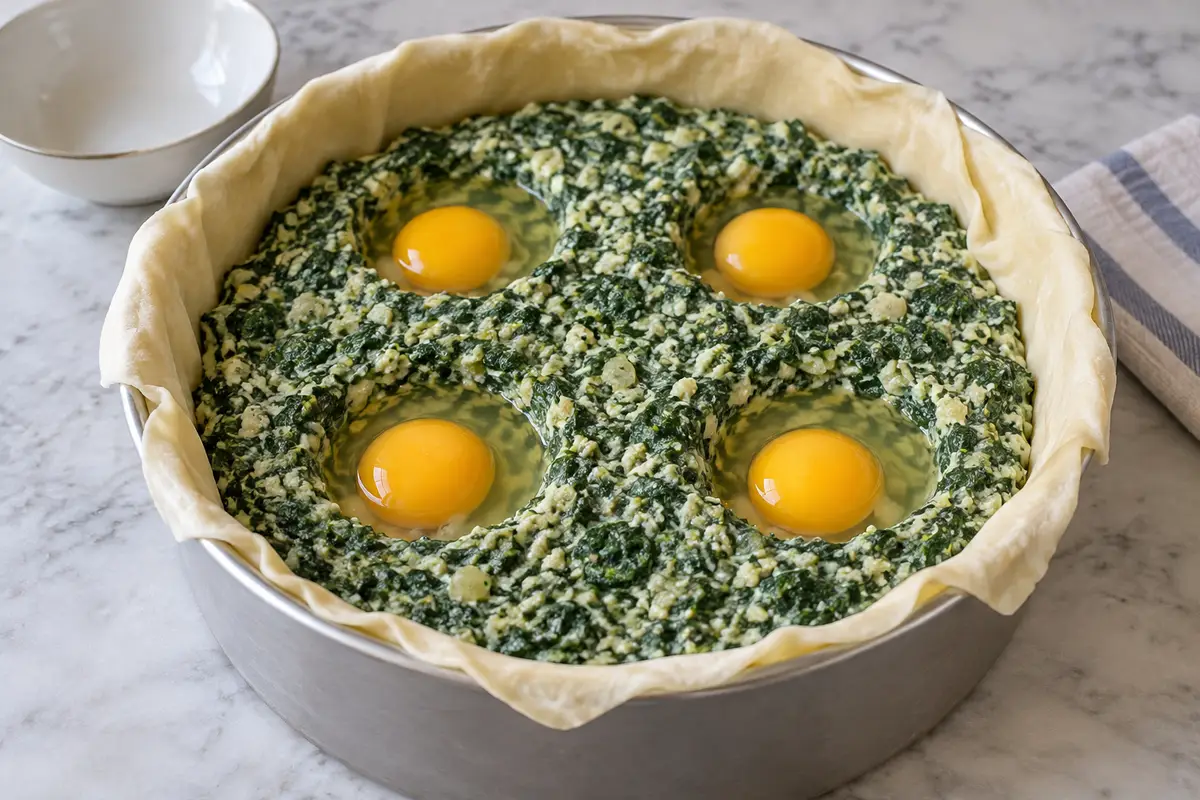
AI-generated Roll each of the two smaller dough balls separately into a thin round about 28 cm across and 1–1.5 mm thick. Lay the first loosely over the filling without pressing on the eggs, and gently brush with the reserved 5 g olive oil. Cover with the second small sheet. Join the overhanging edges of all four sheets only around the circumference and roll inward into a narrow cord, without trimming anything away. Brush the top and rolled rim with the remaining 10 g olive oil. Make a few small steam vents in the top between the egg positions; do not pierce the egg wells.
Place the pan on a rack below the middle of the preheated oven. Bake for 55–65 minutes until the pastry is cooked and the top and rolled rim are evenly golden. If the top browns too quickly, loosely cover it with aluminum foil and continue baking. The base should also be fully baked, dry and crisp; if it remains pale and soft, bake the pie for a few more minutes on a lower rack, with the golden top covered with foil. Remove the pan and leave the pie for at least 30 minutes before unmolding and slicing so the filling settles. Cut into six servings; the eggs should have set whites and yolks. Serve slightly warm or at room temperature.
Estimated nutrition

Rate this recipe
0 ratings
Comments