
AI-generated
Casatiello — yeast bread ring with salami, cheese and eggs
Log in or create a free account to save recipes.
Source: https://recipheon.com/en/recipes/main-dishes/casatiello-yeast-bread-ring-with-salami-cheese-and-eggs
About this recipe
Casatiello is a savory Neapolitan yeast bread distinguished by whole eggs held on top with crosses of dough. In this homemade version, soft dough enriched with pork lard and black pepper wraps around cubes of cured Napoli salami and mild provolone dolce. Spread the filling over a rectangle, roll into a log and join into a ring, giving successive layers of cheese and salami. Four whole eggs bake with the bread, held by strips reserved from the same dough. Two unhurried rises lighten the bread despite its generous filling. After baking, let it rest so it cuts more easily into even servings. Divide the whole ring and all the peeled eggs among twelve portions, without extra sauce, dusting flour or decoration.
Ingredients
All dough, including the crosses
500 g strong Manitoba wheat bread flour, about 14–15% protein, dry, all for the dough, without extra flour for dusting
300 g water, weighed, lukewarm
12 g fresh baker's yeast, not dry yeast
90 g plain rendered pork lard, soft, unsalted and without cracklings, all for the dough
9 g fine salt
2 g ground black pepper
All filling and the eggs on top
180 g ready-to-eat cured Napoli salami, net weight after removing the casing, with its edible fat, not fresh raw sausage
200 g semi-hard provolone dolce cheese, net weight without the inedible rind
4 raw medium eggs in clean, intact shells, about 200 g total edible weight without shells; do not crack before baking
Weighed fat for the pan
5 g of the same pork lard to lightly grease the pan; residue left in the pan after unmolding is not served
Steps
Prepare a metal tube pan: internal diameter about 26 cm, center tube about 7–8 cm, height at least 8 cm and capacity at least 3 L. Separately weigh 90 g lard for the dough and 5 g for the pan. Spread those 5 g thinly over the bottom, sides and center tube. Prepare parchment for rolling, a rolling pin and a bowl. All 500 g flour goes into the dough; do not prepare extra dusting flour or an egg wash.
Mix 12 g fresh yeast into all 300 g lukewarm water. Add 500 g bread flour, 9 g salt and 2 g pepper, bring together and knead for about 5 minutes. Then gradually work in all 90 g soft pork lard in three additions. Knead for about another 8–10 minutes until cohesive, smooth and elastic. Gather every crumb; do not add oil or unweighed water and do not add flour.
Shape a ball and put in a bowl without extra greasing. Cover, leaving room to expand, and set in a warm, undisturbed spot for about 2–3 hours. The dough should become noticeably puffy and roughly double in volume. A cooler kitchen may require more time; follow the dough's growth instead of adding yeast. Prepare the filling during the rise, then keep it refrigerated.
Remove the salami casing and the cheese's inedible rind, then weigh 180 g salami and 200 g provolone dolce. Cut both into small cubes, about 6–8 mm. Keep all edible salami fat and every piece of cheese; do not fry the filling and do not drain it. Keep covered in the refrigerator until shaping. Prepare four medium eggs in clean, intact shells without cracking them into a bowl.
Take the risen dough out of the bowl and weigh off 48 g for the crosses, then cover that portion so it does not dry out. Gently fold the remaining dough into a compact shape and leave covered for about 15 minutes to make rolling easier. Do not add new dough or flour. Use all the reserved 48 g for eight strips; all the remaining dough forms the ring.
Roll the larger dough portion between sheets of parchment into a rectangle about 50 × 30 cm, roughly 5–6 mm thick. Remove the top sheet. Scatter all the salami and cheese cubes evenly, leaving about 2 cm empty along one long edge. Do not add fat to the paper or counter. If the dough springs back strongly, cover it for a few minutes and gently stretch again.
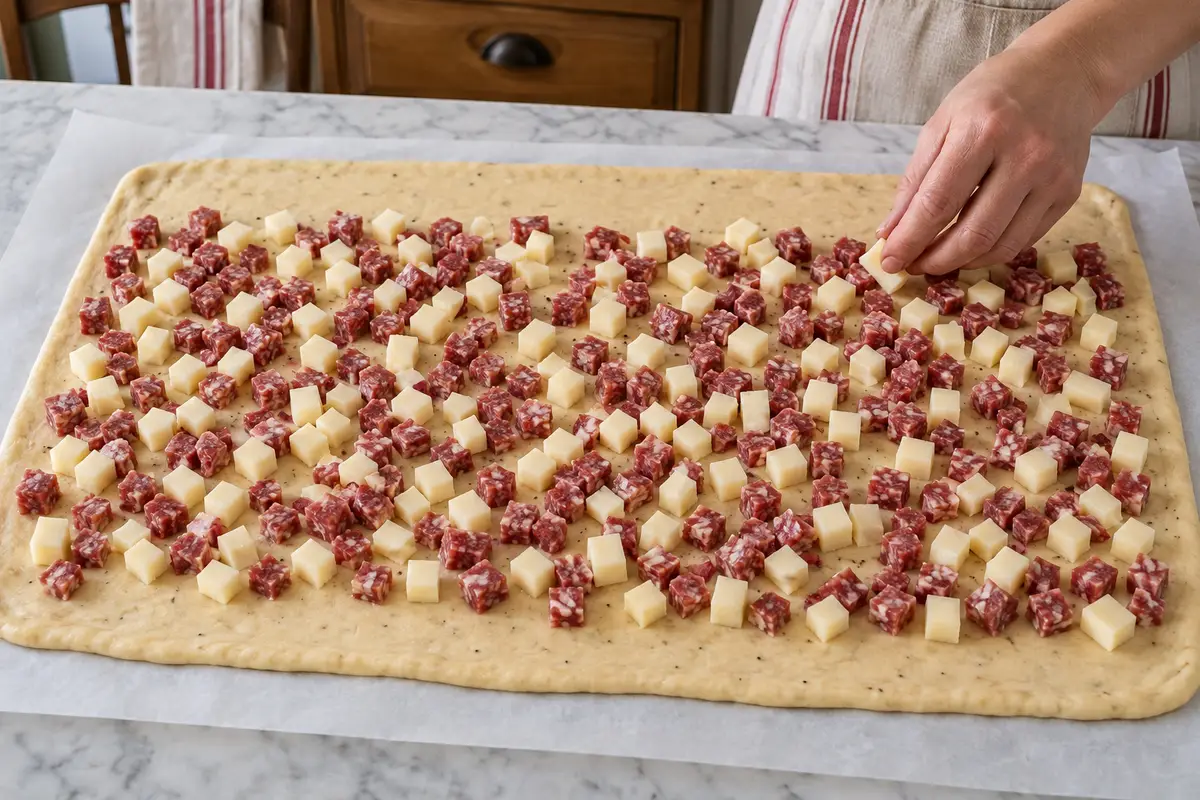
AI-generated Starting at the filled long side, roll into a log about 50 cm long, peeling away the paper as you roll. Do not trap the paper inside. Roll evenly, without squeezing hard or pushing out filling. Pinch the empty edge firmly closed along its entire length. Keep both ends without trimming; return any fallen cubes before sealing the log completely.
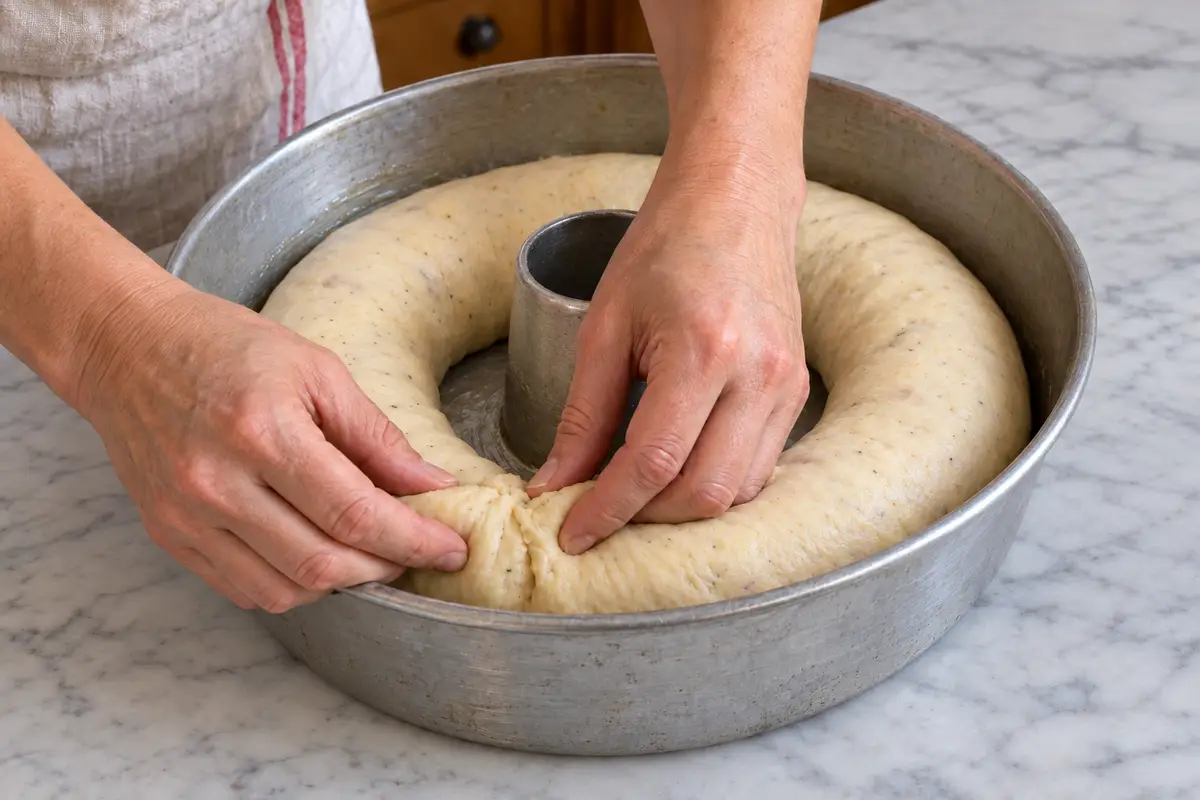
Transfer the log to the prepared pan, seam side down around the center tube. Join the ends into a closed ring and seal firmly, slightly overlapping the dough at the ends. Do not press the log tightly against the sides; leave room to rise. The entire log and all the filling remain in the pan. Remove all paper; it was only for rolling and transferring, and the pan is already greased.
AI-generated Space four whole raw eggs evenly around the ring, gently pressing them into shallow hollows. Do not pierce the shells and do not crack them. Divide the reserved 48 g dough into eight pieces, about 6 g each, and roll into strips about 10–12 cm long. Cross two strips over each egg and attach the ends to the ring. The strips should hold the eggs loosely, allowing for the dough to rise.
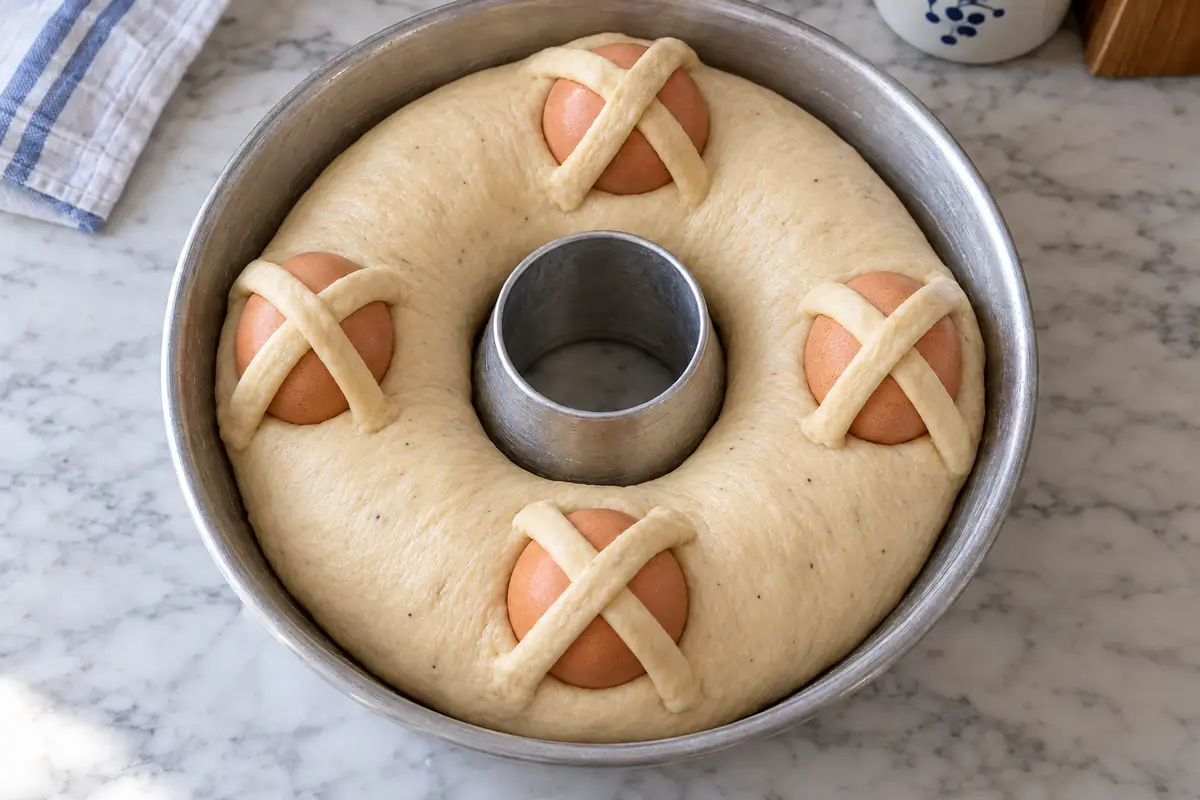
AI-generated Loosely cover the pan so the cover does not touch the strips, and leave in a warm spot for about 60–90 minutes. The ring should become noticeably puffier and the gaps at the sides should shrink; do not wait until dough spills over the rim. Near the end of the rise, preheat the oven to 180°C, conventional heat. If proofing in a switched-off oven, remove the pan before turning it on.
Place the pan below the middle of the oven and bake at 180°C for about 60–70 minutes. The top should be golden brown and the exposed dough sides clearly baked. Test a dough-only area with a long skewer, avoiding cheese and eggs; no raw, sticky dough should cling to it. If the top browns too fast, loosely cover with foil. Bake a few minutes longer if needed rather than increasing the temperature.
Leave in the pan for about 20 minutes, then carefully unmold and cool on a rack for about another hour. Fat residue left in the pan is not served. Cut the whole ring into 12 portions. Peel the four baked eggs, cut each into three pieces and divide among the portions; discard the shells. After cooling, refrigerate leftovers within 2 hours of baking and eat within 2 days. Do not leave the ring with eggs on the counter overnight.
Estimated nutrition

Rate this recipe
0 ratings
Comments