
AI-generated
Stroopwafels — Dutch waffles with buttery syrup filling
Log in or create a free account to save recipes.
Source: https://recipheon.com/en/recipes/desserts/stroopwafels-dutch-waffles-with-buttery-syrup-filling
About this recipe
Stroopwafels are thin Dutch waffles with a fine grid, sandwiched with a chewy filling of sugar syrup, butter, and light basterd sugar. In this homemade version, each waffle is baked individually, immediately split horizontally, and put back together with warm filling. You need a stroopwafel iron or a thin-waffle iron with a shallow pattern that leaves a center soft enough to split. A deep Belgian waffle iron will not work here. The buttery yeast dough rests for an hour, while the filling thickens gently as it cools. Keep the natural, slightly uneven edges without cutting out circles or discarding trimmings. The whole batch makes twelve waffles, with all the filling divided among them. Work calmly, one at a time: a golden waffle stays pliable enough to split only briefly, and the syrup should be warm and spreadable without running out of the layer.
Ingredients
All dough for twelve waffles
250 g dry wheat flour, type 550, all for the dough, with no extra flour for dusting
40 g milk, 3.2% fat, weighed, lukewarm
10 g fresh baker's yeast, not dry yeast
60 g light soft Dutch basterd sugar, lichte basterdsuiker, for the dough, not coarse demerara
50 g raw whole egg without the shell, beaten, about 1 medium egg, all for the dough
100 g unsalted butter, 82% fat, whole and not clarified, softened
2 g fine salt
All the syrup filling
150 g brown Dutch sugar syrup, schenkstroop, weighed, not honey or pure glucose syrup
60 g light soft Dutch basterd sugar, lichte basterdsuiker, for the filling
50 g unsalted butter, 82% fat, whole and not clarified
1 g ground cinnamon
For greasing the plates once
3 g neutral high-oleic sunflower oil for frying; any left on the brush is not served
Steps
Prepare a stroopwafel iron or thin-waffle iron with a shallow grid and nonstick plates, a cutting board, a sharp thin finely serrated knife, a spatula, and a dry oven mitt. The iron must make a waffle thick enough to split horizontally, not a paper-thin sheet. The dough butter should be soft and the milk lukewarm.
Dissolve the fresh yeast in 40 g lukewarm milk. In a bowl, combine all 250 g type 550 flour, 60 g light basterd sugar, 50 g egg, 100 g soft butter, and 2 g salt. Add the yeast and milk. Knead for about 3–5 minutes to make a uniform, soft dough. Gather it with a scraper, without adding flour or extra milk.
Cover the bowl and leave in a normally warm, draft-free kitchen for about 60–75 minutes. The dough should become a little puffier and easier to shape; it does not need to double like bread dough. Toward the end of this time, prepare the filling so it can cool slightly before you bake the waffles.
In a small saucepan, combine all 150 g schenkstroop, 60 g basterd sugar, 50 g butter, and 1 g cinnamon. Heat over low heat, stirring until the butter melts and the sugar dissolves. Bring to a gentle bubble and cook for about 1–2 minutes, still stirring. Remove from the heat; hot syrup sticks firmly to skin.
Leave the saucepan for about 10–15 minutes, stirring occasionally. The filling should stay warm, thick, and spreadable, falling from a spoon in a broad ribbon, not like a thin liquid. If it later becomes too thick, warm briefly over the lowest heat while stirring. Do not add water, milk, or extra butter.
Divide all the dough into twelve balls of about 42–43 g and cover for 10 minutes. Preheat the iron according to its instructions for thin waffles. Before the first waffle, brush both plates with a very thin coating from the weighed 3 g oil; any left on the brush does not go into the waffles. Do not grease again.
Put one ball in the center of the lower plate and close the iron. Bake for about 1–3 minutes, until golden with a fine grid, usually making a circle about 10–11 cm across. Do not press it paper-thin; the center should still be able to split. If the first waffle darkens too quickly, reduce the heat setting.
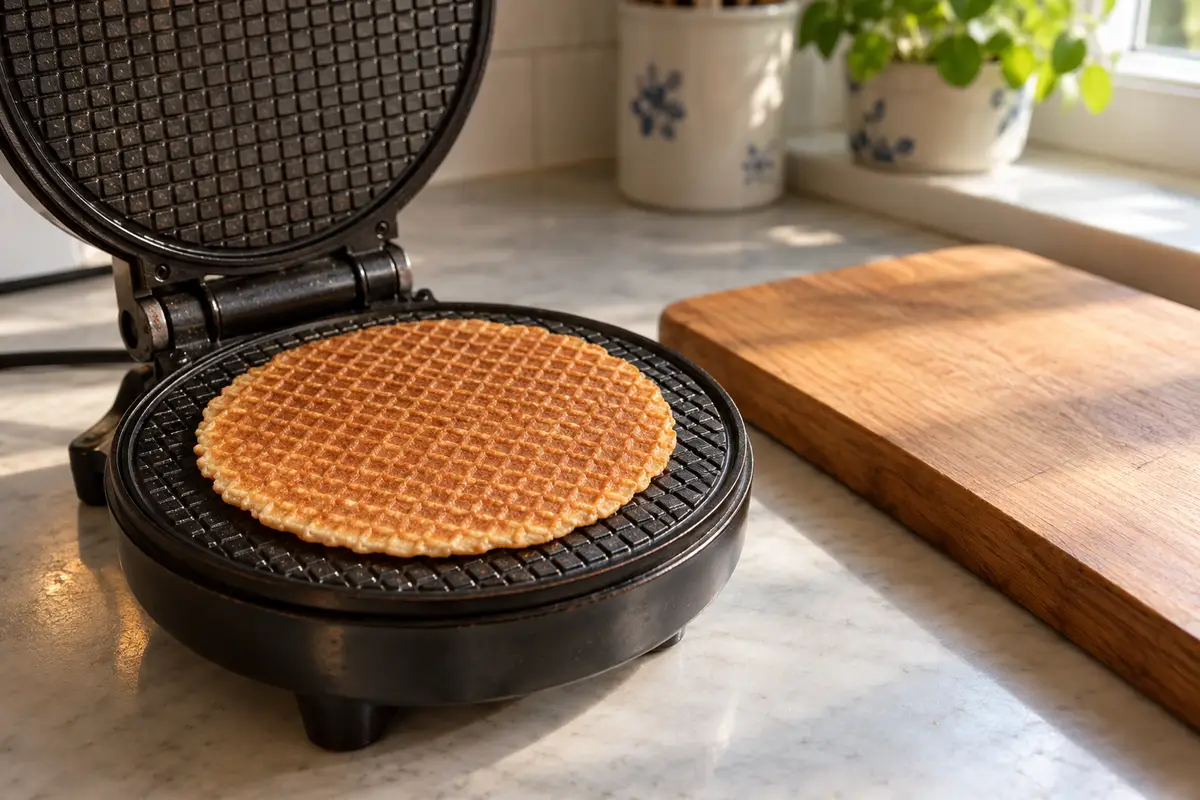
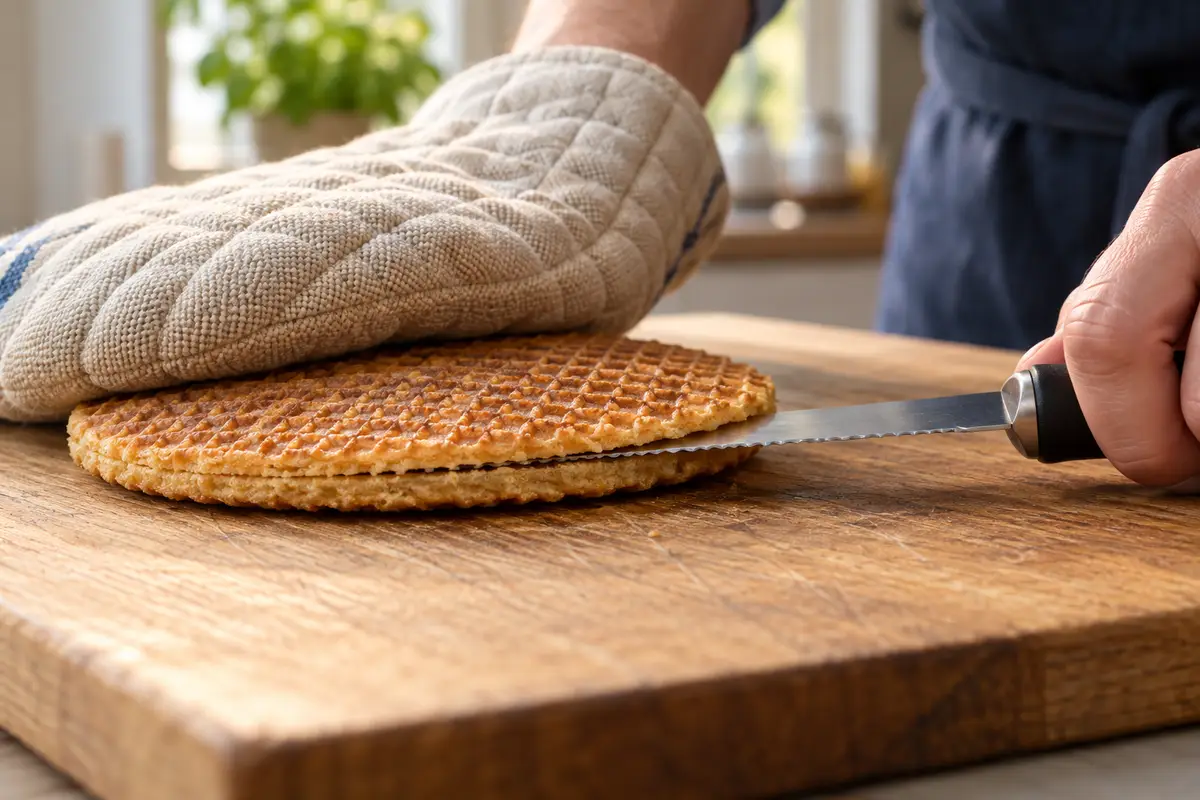
AI-generated Immediately lift the waffle onto the board with a spatula. Hold it from above with a dry oven mitt, keeping your fingers above the blade's path. With the thin finely serrated knife, gently cut horizontally through the center, rotating the waffle on the board. Do not cut it in your hand or in midair. Work before it cools and becomes brittle; do not trim the edges.
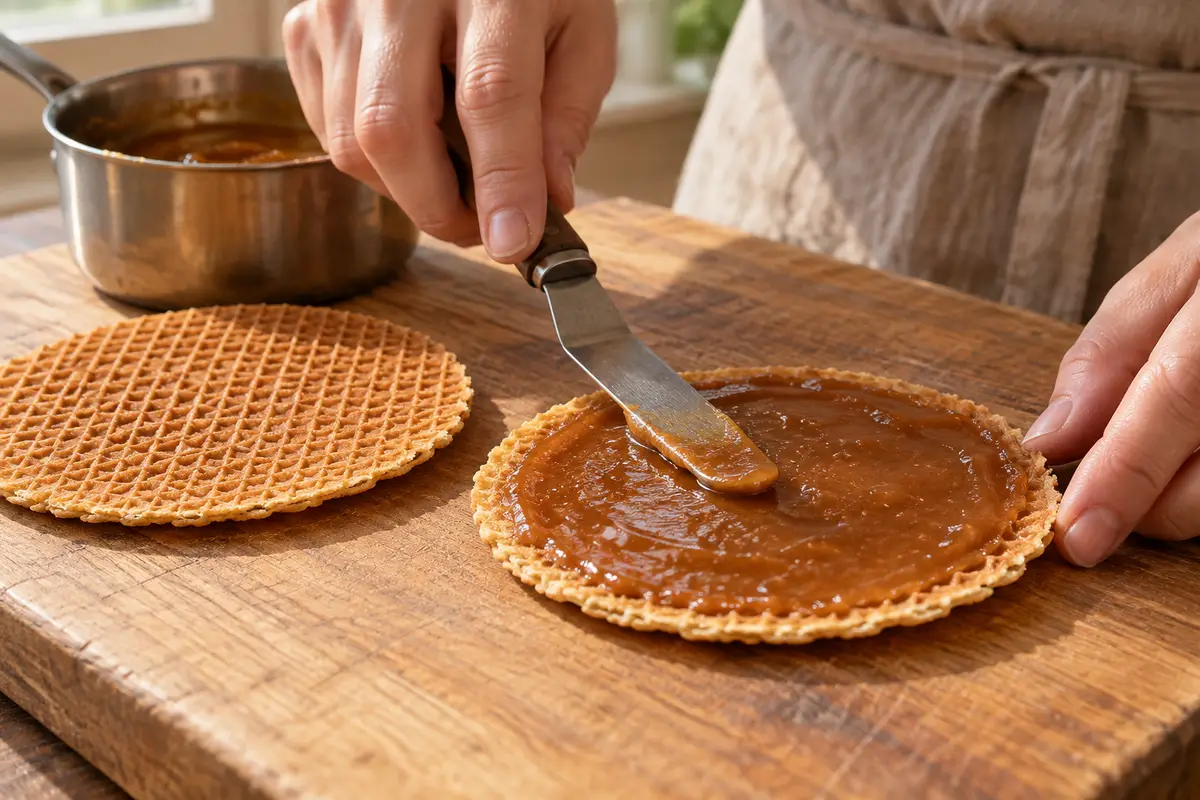
AI-generated Spread about one-twelfth of the warm filling, roughly 20–21 g, over the lower half, leaving a few millimeters free around the edge. Replace the upper half and press lightly to spread the layer evenly. Set flat on a rack. The filling should stay between the layers without running onto your fingers.
AI-generated Bake, split, and fill each remaining ball before starting the next. Allow about 45–60 minutes for the whole batch, including cutting and filling. Divide all the filling among twelve waffles, scraping out the saucepan and spoon. If a half breaks, keep its pieces in the same serving rather than discarding them.
Leave the last assembled waffles on the rack for about 20 more minutes, until cool and the filling has thickened and joined both layers. Do not stack warm waffles and do not seal them in a container immediately, so steam does not soften the surface. Keep all the natural edges without cutting out circles or making extra trimmings.
Serve one whole waffle per portion, approximately 60 g. The surface should be delicately crisp and the filling soft and chewy. Once completely cool, seal the stroopwafels in an airtight container and store in a cool, dry place; they are best eaten within 5 days. The waffles may lose some crispness over time.
Estimated nutrition

Rate this recipe
0 ratings
Comments