
AI-generated
Toscakaka — Swedish butter cake with caramelized sliced almonds
Log in or create a free account to save recipes.
Source: https://recipheon.com/en/recipes/desserts/toscakaka-swedish-butter-cake-with-caramelized-sliced-almonds
About this recipe
Toscakaka combines a soft, buttery center with a thin, crisp topping of sliced almonds in caramel glaze. This Swedish coffee cake tastes best without extra cream or a dusting of sugar. Its distinctive finish takes two stages: first bake the base alone, then spread hot, slightly thickened almond topping over it and finish baking until golden. The timing matters most. The cake surface must already support the almonds, and the center must not remain liquid; adding the topping too soon would make it sink into raw batter. You do not make dry, dark caramel in the saucepan: combine butter, sugar, milk and a little flour, with the browning taking place in the oven. Thin blanched almond slices form an even layer that cracks pleasantly under the knife. After brief cooling, loosen the springform ring before the topping sticks firmly to the sides, but move the cake only once cold. This preserves its delicate crumb and neat almond top.
Ingredients
Pan and delicate butter cake base
5 g unsalted butter with 82% fat for lightly greasing the pan sides; residue on the pan is not part of servings
100 g unsalted butter with 82% fat for the cake, in addition to the pan butter
100 g beaten whole eggs without shells, about 2 medium (M) eggs, at room temperature
140 g fine white sugar for the cake
8 g sugar with real ground Bourbon vanilla
130 g all-purpose flour, type 550, for the cake, without extra dusting flour
6 g regular baking powder
1 g fine salt
65 g milk with 3.2% fat for the cake, weighed and at room temperature
Tosca almond topping
100 g unsweetened blanched sliced almonds without skins, weighed before cooking and baking; not ground or whole almonds
75 g unsalted butter with 82% fat for the topping, in addition to the cake and pan butter
90 g white sugar for the topping
15 g all-purpose flour, type 550, to thicken the topping
30 g milk with 3.2% fat for the topping, weighed, in addition to the 65 g in the cake
Steps
Preheat the oven to 175°C, conventional heat. Prepare a springform pan with an inside diameter of 24 cm and at least 5 cm tall. Line the bottom with parchment, clamping it in the ring, and lightly grease only the sides with the 5 g butter set aside for this. Do not dust with flour or breadcrumbs. Have a rack and spatula ready for spreading the topping later. Check that the properly assembled springform pan is tightly sealed; do not use a loosely fastened base.
Melt the 100 g cake butter over low heat, without browning, and set aside to cool slightly. It should remain liquid but not hot. Do not clarify and do not remove the milk solids. In another bowl, mix the 130 g flour, baking powder and salt. Weigh the cake milk. Keep the topping ingredients separate; its flour, milk, butter and sugar do not go into the base batter now.
Beat the 100 g eggs with 140 g sugar and the vanilla sugar for about 4–5 minutes, until pale and more voluminous, falling in a wide ribbon. Gently fold in the prepared flour in two additions, alternating with the 65 g milk, then add the cooled butter in a thin stream. Fold with a spatula just until combined, reaching the bottom, without prolonged beating after adding flour. Transfer all the batter to the pan and level the surface, scraping the bowl clean.
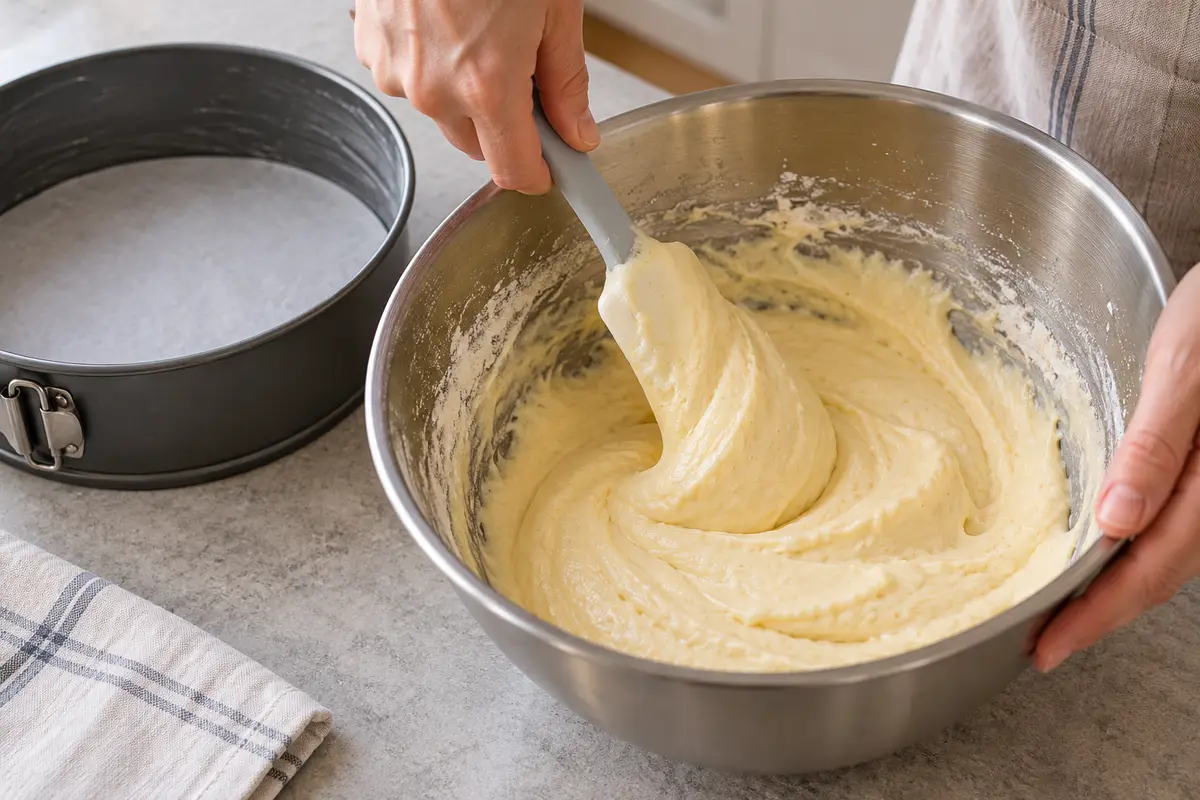
AI-generated Bake on a level below the oven center at 175°C for about 25–30 minutes. The top should be lightly golden, matte and springy, and the center must not ripple like liquid. A skewer inserted in the center should come out without raw batter, at most with a few moist crumbs. If still liquid beneath the surface, bake a few minutes longer before adding the topping. The base should be nearly done and support the almonds, not merely have a thin skin. Do not cool it between stages.
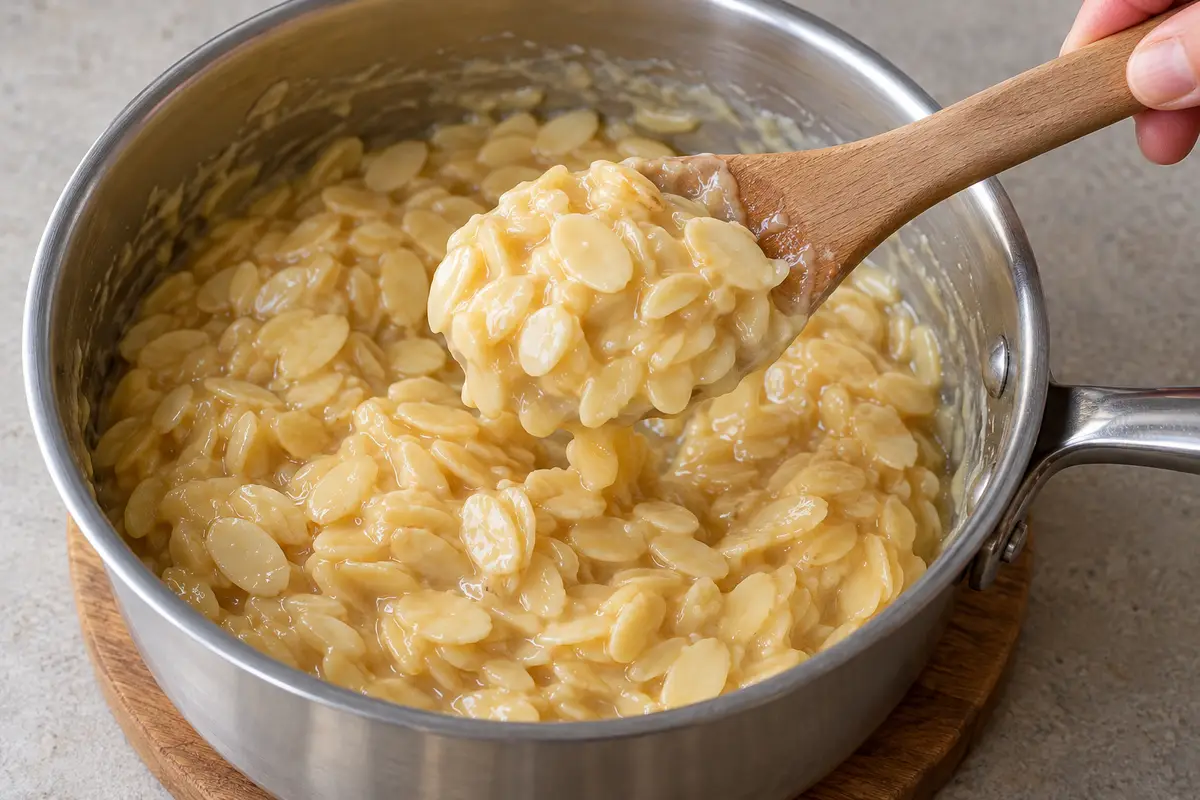
About 10 minutes before the first baking stage ends, combine the 75 g butter, 90 g sugar, 15 g flour and 30 g milk for the topping in a small saucepan. Heat over low heat, stirring constantly, until the butter melts and the mixture is uniform. Once small bubbles appear, simmer gently for 1–2 minutes, stirring along the bottom, until slightly thickened. Do not brown deeply in the pan and do not cook until the fat separates. The caramel color develops only during the final bake.
Remove the saucepan from the heat and gently fold in all 100 g sliced almonds, trying not to break them. All should be coated with the thick glossy mixture. The topping should spread easily but not resemble thin milk. Keep it warm until the base comes out. If you need to wait briefly, keep the pan off the heat and stir once; do not add water or milk and do not heat strongly. Prepare all the topping before removing the cake.
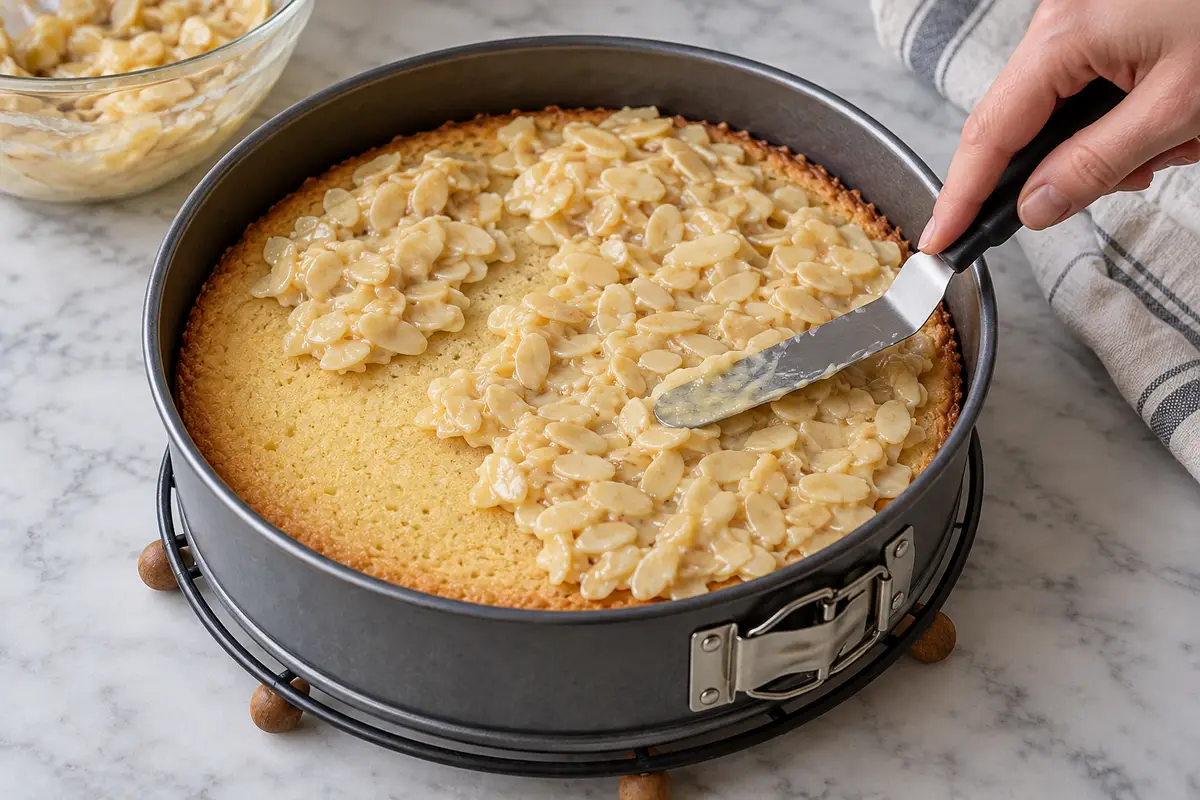
AI-generated Remove the set, partially baked base, leaving the oven on. Add the warm topping in small portions across the surface instead of pouring a heavy mound into the center. Gently spread with a spatula without piercing the cake top. Use all the mixture and every almond slice, scraping the saucepan; do not reserve any for later decoration. Leave about ½ cm free next to the ring, as the topping spreads during baking. Take care with the hot pan and sugar mixture.
AI-generated Put the pan on the middle level and continue baking at 175°C for about 12–18 minutes, until the topping is evenly golden and the almond slices at the edges are lightly amber. The mixture should bubble clearly, not remain a pale wet puddle. Do not wait for dark brown, bitter almonds. If one edge browns quickly, carefully rotate the pan toward the end. Do not turn on the broiler. Remove to a rack; the hot topping is still soft and will set as it cools.
After 10–15 minutes, gently loosen any stuck topping from the ring with a thin spatula and carefully release the pan side. Do not touch warm caramel with your fingers and do not invert the cake. Leave on the springform base to cool completely, about 1½ hours, until the center is no longer warm and the almond top is firmer. Only then transfer to a plate using wide spatulas and remove the parchment underneath. Do not add fat residue left on the pan to servings.
Cut the completely cold cake into 12 pieces with a sharp knife, gently cutting through the almond top first, then the soft base. Serve the glazed edges too; do not trim anything. Do not dust with powdered sugar or extra almonds and do not add cream. Keep covered at cool room temperature for up to 2 days or refrigerate for up to 4 days; leave out for about 20 minutes before serving from the refrigerator. Pack only when completely cold, so steam does not soften the top.
Estimated nutrition

Rate this recipe
0 ratings
Comments