
AI-generated
Beef Wellington — Beef Tenderloin with Mushrooms in Puff Pastry
Log in or create a free account to save recipes.
Source: https://recipheon.com/en/recipes/main-dishes/beef-wellington-beef-tenderloin-with-mushrooms-in-puff-pastry
About this recipe
Beef Wellington is beef tenderloin wrapped in a mushroom layer and prosciutto, baked in golden puff pastry. Dijon mustard adds a gentle sharpness, while thyme brings out the mushrooms' flavor. The crisp pastry contrasts with the juicy beef, revealing all the layers of filling when sliced. It makes an impressive dish for a festive lunch or a dinner where you want to serve something special.
Ingredients
Beef tenderloin
900 g center-cut beef tenderloin in one even piece, about 22 cm long and 7 cm in diameter, weighed after removing the silverskin
15 g refined rapeseed oil for searing; some will remain in the pan
20 g smooth Dijon mustard
5 g fine salt for the beef
0.5 g ground black pepper for the beef
Mushroom filling, cooked dry
500 g cremini mushrooms, weighed after cleaning
60 g shallot, weighed after peeling
6 g garlic, about 2 small cloves, weighed after peeling
20 g unsalted butter with 82% fat
2 g fresh thyme leaves, without the tough stems
1 g fine salt for the mushrooms
0.5 g ground black pepper for the mushrooms
Wrapping and egg wash
100 g thinly sliced prosciutto crudo, about 8–10 large slices
500 g uncooked all-butter puff pastry in a block, chilled; if frozen, thaw completely in the refrigerator beforehand; excess pastry will be trimmed off
1 medium egg, size M, for brushing, about 50 g without the shell; only part will be used
5 g water to beat with the egg, about 1 teaspoon
Steps
Start with chilled tenderloin and completely thawed, cold puff pastry. Choose an evenly thick center section of beef; remove the silverskin before weighing out 900 g. Pat the surface dry with a paper towel. Tie the beef at several points with cotton kitchen twine, about 3–4 cm apart, just to hold its shape. Refrigerate while you prepare the mushrooms. Have ready a wide frying pan about 28 cm across, shallow dishes for cooling, plastic wrap, parchment paper, a rolling pin, a heavy baking sheet, and a probe thermometer. Use a clean cutting board and utensils to assemble the chilled layers.
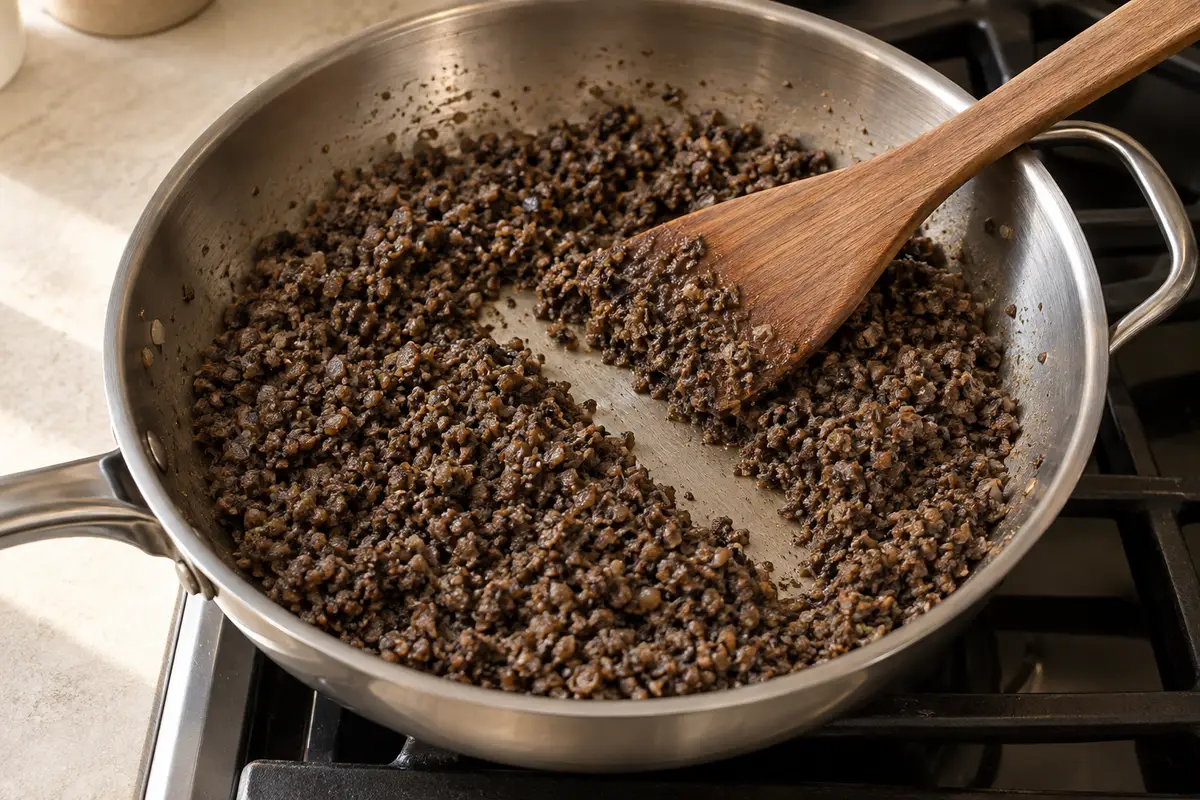
Chop the mushrooms, shallot, and garlic very finely; you can pulse the mushrooms briefly in a food processor, keeping them in small pieces. Melt 20 g butter in the wide frying pan. Cook the shallot over medium heat for 3–4 minutes until translucent, add the garlic for about 30 seconds, then add all the mushrooms and 1 g salt. Cook over medium-high heat for about 20–25 minutes, stirring often and breaking up any clumps. The mushrooms will release water at first; by the end, the mixture should be dark, crumbly but paste-like, and distinctly dry. A spatula drawn through it should leave a clear track with no liquid flowing back in, even when you press the mushrooms down. Stir in 2 g thyme and 0.5 g pepper during the final minute. Spread the mixture in a thin layer in a shallow dish, let steam escape for 5 minutes, then refrigerate. It will cool while you prepare the beef.
AI-generated Wash and thoroughly dry the mushroom pan, or use another pan. Season the beef with 5 g salt and 0.5 g pepper just before searing. Heat the pan until very hot, add 15 g oil, and sear the tenderloin for about 90 seconds on each of 4 successive sides, then for about 30 seconds on each end, about 7 minutes in total. Turn with tongs: the entire outer surface should be browned, while the center remains undercooked. Transfer the beef to a clean metal tray, remove all the twine, and brush the warm surface with all 20 g mustard. Do not add the fat and juices left in the pan to the mushrooms or pastry.
About 5 minutes after searing, put the tray of beef in the refrigerator for about 60 minutes. Keep the mushrooms beside it in the refrigerator in a separate shallow dish. Before assembly, both components must be thoroughly cold, including at the center; aim for no more than 8°C. Chill for longer if needed. Do not wrap warm beef or mushrooms in ham or pastry. Before moving the tenderloin, gently blot its underside to remove juices collected on the tray, leaving the mustard layer in place. Stir the mushrooms again; they should not release any watery liquid.
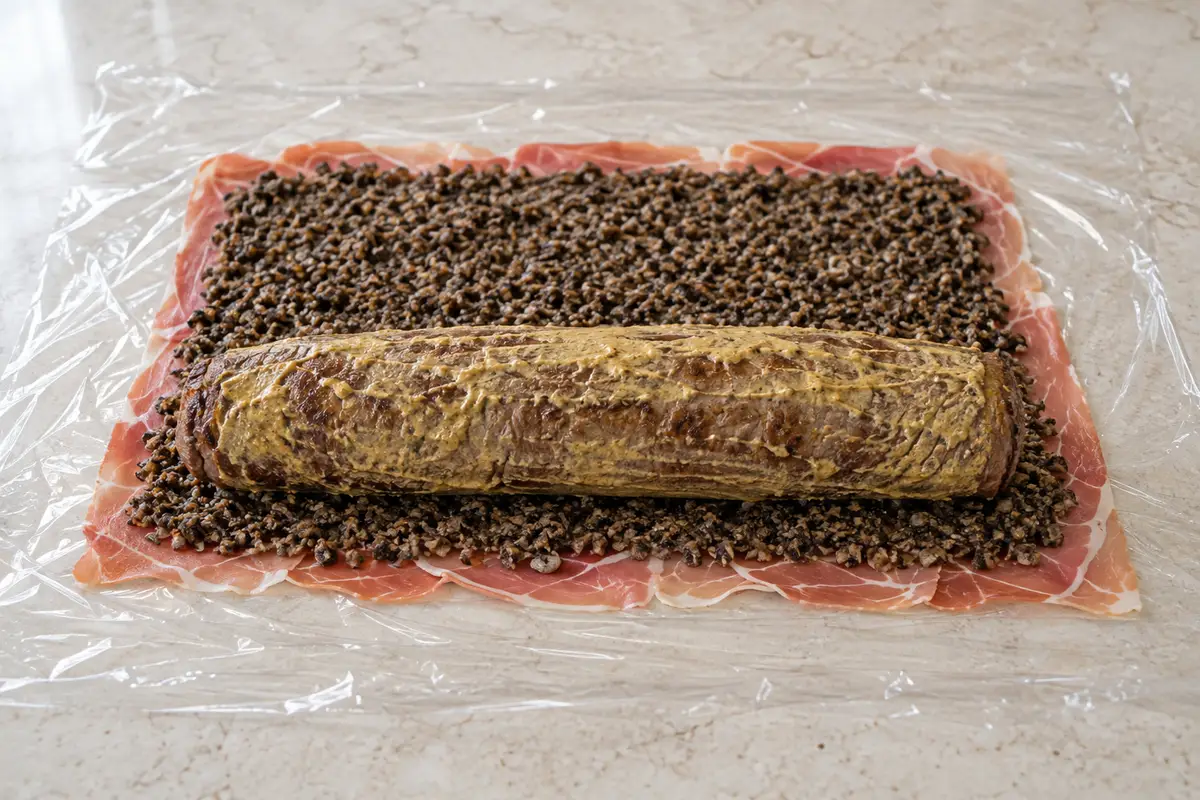
Lay two overlapping sheets of plastic wrap on the countertop. Arrange all the prosciutto slices on them, overlapping slightly to form a rectangle about 30 × 28 cm with no gaps. Spread all the cold mushroom filling over the ham in a thin, even layer, leaving a border of about 1 cm. Place the chilled tenderloin along the 30 cm side, close to the bottom edge. Lift the plastic wrap to roll the ham and mushrooms tightly around the beef; tuck in the ham at the sides to cover the ends of the tenderloin too. Keep the plastic wrap on the outside, not between the ingredients. Twist its ends like a candy wrapper to form an even cylinder.
AI-generated Refrigerate the wrapped beef roll for 30 minutes. After that, keep it chilled while you roll the cold puff pastry between two sheets of parchment paper into a rectangle about 36 × 32 cm and 3–4 mm thick. Remove the top sheet of paper. The pastry should be pliable but cold and firm; if it becomes soft or greasy, refrigerate it for about 10 minutes before continuing. Beat the whole egg with 5 g water without making it foamy, and have a pastry brush ready. The mixture will seal the pastry and provide two thin coats over the top; the remainder is not part of the finished dish.
Remove all the plastic wrap from the beef roll. Place it on the pastry parallel to the 32 cm side, leaving about 4–5 cm of pastry at each end. Wrap the pastry around the roll, using the paper underneath to help, and adjust the length so the edge overlaps by only about 2 cm. Trim off the excess; do not add it as a second layer. Brush the overlap lightly with egg and seal. At the ends, trim away excess pastry that would form thick bulges, fold the remaining flaps like an envelope, seal with egg, and tuck underneath. Turn the parcel seam-side down. Brush the top and sides with a very thin layer of egg. Refrigerate the remaining egg mixture for the second coating. The pastry trimmings are not part of the Wellington.
Place the Wellington on parchment paper on a flat board or small tray and refrigerate for 30 minutes. Meanwhile, preheat the oven to 200°C with top and bottom heat, without convection. Put a heavy baking sheet on a rack just below the middle of the oven so it heats with the oven for at least 20 minutes. The hot sheet will help the bottom pastry bake through. Keep the parcel cold until it goes into the oven.
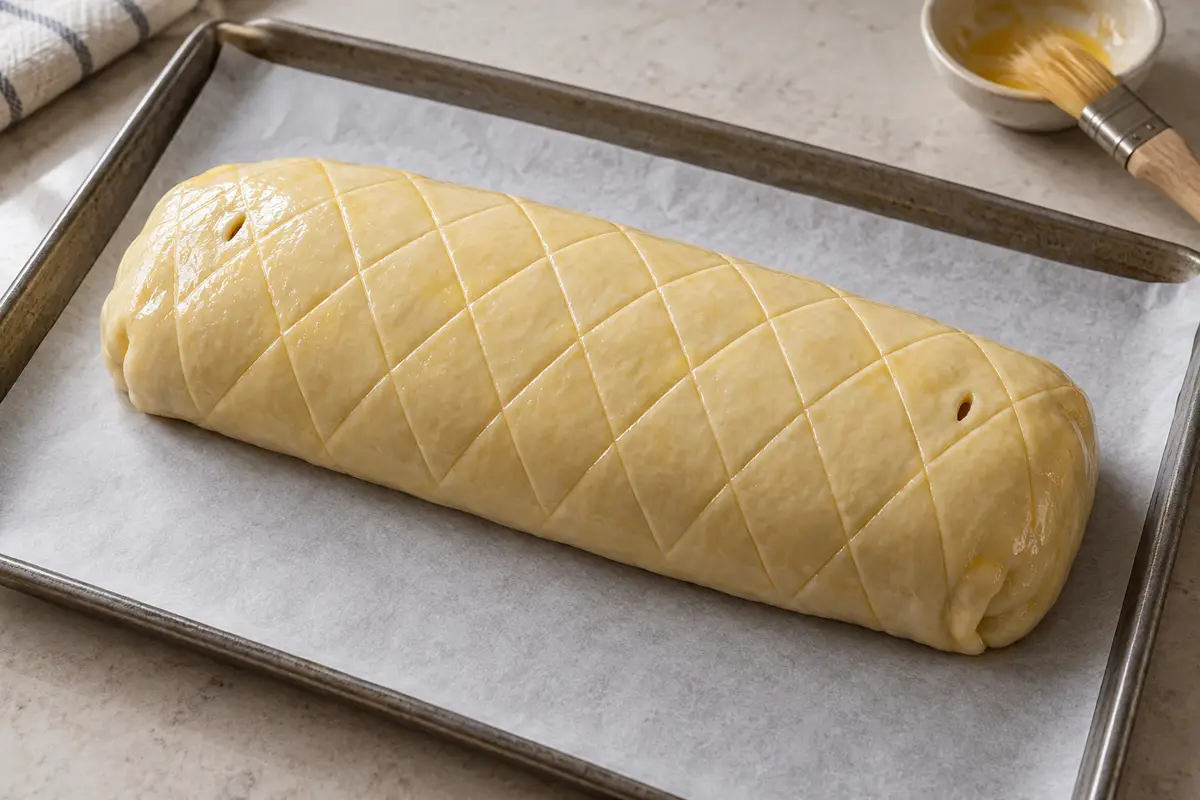
Take out the chilled parcel and brush with a second thin layer of egg, leaving no pools around the base. Keep the remaining raw egg mixture separate from the finished dish. With a sharp knife, make 5–6 shallow diagonal lines across the top and the same number in the opposite direction, forming diamonds and cutting only into the surface layer of pastry. Also make 2 small steam vents about 5 mm long through the pastry on top, one near each end; do not push the knife into the beef. No plastic wrap should remain on the outside of the parcel. Bake immediately.
AI-generated Slide the Wellington, still on its paper, onto the hot baking sheet, using a flat board to help. Bake at 200°C for about 45–60 minutes; start checking after 35 minutes. Insert a clean probe horizontally through the side of the parcel, halfway along its length and halfway up, so the tip reaches the geometric center of the beef, not the mushrooms or pastry. Move the probe gently to find the lowest reading in the central part of the tenderloin. Remove the Wellington only once this reading reaches at least 63°C and the pastry is puffed, deeply golden, and baked through underneath as well. If needed, continue baking in 3–5 minute intervals; loosely cover the top with aluminum foil if it browns too quickly. The meat temperature and fully baked pastry determine when it is ready, not the stated time alone.
Use two wide spatulas to transfer the cooked Wellington to a wire rack and let it rest for 15 minutes without covering. The center temperature may rise further as the juices settle; the sliced meat in this version may have a delicate, muted pink color. Transfer to a cutting board only after resting. With a long, sharp knife, cut into 6 servings about 3–4 cm thick, using steady strokes without crushing the pastry. Each slice should show the beef, a thin layer of mushrooms and ham, and crisp puff pastry. Serve immediately, adding the edible pastry crumbs from the board to the portions.
Estimated nutrition

Rate this recipe
0 ratings
Comments