
AI-generated
Cabbage and Mushroom Loaf
Log in or create a free account to save recipes.
Source: https://recipheon.com/en/recipes/main-dishes/cabbage-and-mushroom-loaf
About this recipe
This sauerkraut and mushroom loaf has golden yeast dough and a bold filling of sauerkraut and dried porcini. The soft dough encloses a single compact layer of filling, revealing an appetizing cross-section when sliced. The sauerkraut cooks with the mushrooms, then the filling is thoroughly reduced and cooled so its moisture does not soften the base. The dough rises twice; the first rise partly overlaps with preparing the filling. Before baking, the top is brushed with milk and slashed to let steam escape. One large loaf yields eight thick slices, which can be served warm after a short rest.
Ingredients
Yeast dough
520 g dry type 550 wheat flour: 500 g for the dough and 20 g for dusting
280 ml milk with 3.2% fat: 250 ml for the dough and 30 ml for brushing the top
60 g butter with 82% fat, for the dough
1 size M egg, about 50 g without the shell, for the dough
7 g instant dry yeast, for the dough
10 g white sugar, for the dough
6 g fine salt, for the dough
Sauerkraut and porcini filling
600 g sauerkraut, weighed after firmly squeezing out the juice
40 g store-bought dried porcini mushrooms (Boletus edulis), dry weight before soaking
200 g onion, weighed after peeling
20 ml refined canola oil, for the onion; all the oil stays in the filling
1 g ground black pepper, for the filling
800 ml water: 500 ml for soaking the mushrooms and 300 ml for cooking the sauerkraut; also use 300 ml of the filtered soaking water, and discard the remaining liquid and sediment
Steps
Put 40 g store-bought dried porcini in a bowl and pour over 500 ml hot water. Cover and leave for about 30 minutes, until the mushrooms soften; prepare the dough meanwhile. Have ready a pot with a lid and a capacity of about 3 l, a wide skillet about 28 cm in diameter, a paper coffee filter with a sieve, and a flat baking sheet with a usable area of at least 40 × 35 cm.
Melt 60 g butter over low heat and set aside until just lukewarm; warm 250 ml milk only until lukewarm as well. In a large bowl, mix 500 g flour, the instant yeast, sugar, and 6 g salt, then add the egg without its shell, lukewarm milk, and butter. Knead for about 10 minutes by hand or 6–8 minutes with a mixer fitted with a dough hook on low speed, until the dough is soft and elastic and begins to pull away from the bowl. Do not add the flour reserved for dusting at this stage; this entire stage, including warming the ingredients, takes about 20 minutes.
Cover the bowl and leave in a warm, undisturbed place for about 60–75 minutes, until the dough roughly doubles in volume. Meanwhile, cook and reduce the filling as described in the following steps. If the dough rises before the filling has cooled, gently deflate it with your hand and keep it covered until shaping; do not wrap warm filling in the dough.
Lift out the softened porcini and chop them finely. Pour the soaking water through a sieve lined with the paper filter, measure out 300 ml clear liquid, and discard the remaining liquid and sediment. Firmly squeeze out the sauerkraut, weigh out 600 g, and chop any long strands; put it in the pot with the mushrooms, 300 ml filtered liquid, and the remaining 300 ml fresh water. Bring to a gentle simmer and cook, covered, over low heat for about 45–55 minutes, stirring occasionally, until the sauerkraut and mushrooms are tender; do not drain the cooking liquid.
While the sauerkraut cooks, finely dice 200 g peeled onion. Heat all 20 ml oil in the wide skillet over medium-low heat and sauté the onion for about 8–10 minutes, stirring often. It should be soft, translucent, and lightly golden; set the skillet aside until the sauerkraut is cooked.
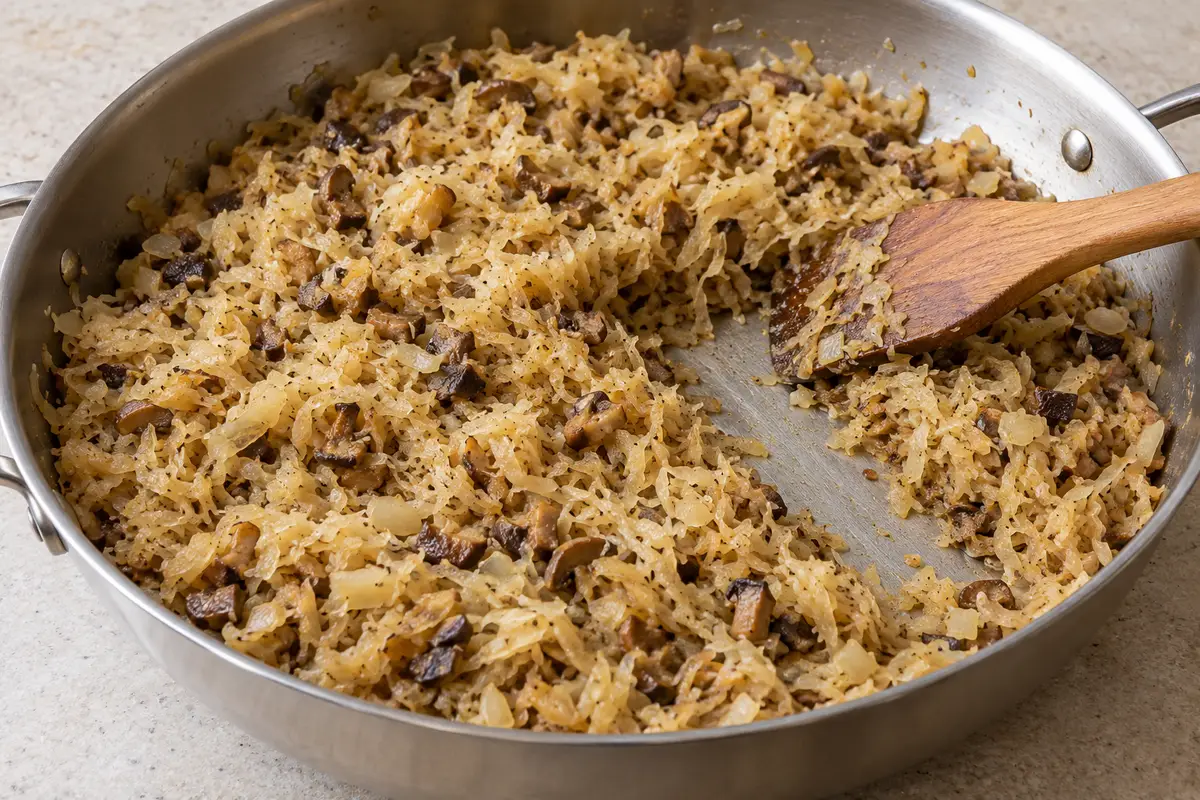
Transfer the sauerkraut, mushrooms, and all the remaining cooking liquid to the skillet with the onion and oil, and add 1 g pepper. Cook, uncovered, over medium heat for about 20–25 minutes, stirring often, until no free liquid remains and the path left by the spatula no longer fills with water; reduce the heat toward the end so the filling does not burn. Spread the filling on a large, flat plate in a layer no thicker than about 2 cm and cool for about 35–45 minutes, until it no longer gives off warmth. If it is still warm, wait before rolling out and wrapping the dough.
AI-generated Line the baking sheet with parchment paper. Use a small portion of the reserved 20 g flour to lightly dust the work surface and rolling pin; add the rest sparingly, only where the dough sticks. Deflate the risen dough and roll it into a rectangle about 40 × 35 cm, about 5 mm thick. Do not knead extra flour into it, and do not use more than the measured 20 g; discard any excess flour from the work surface.
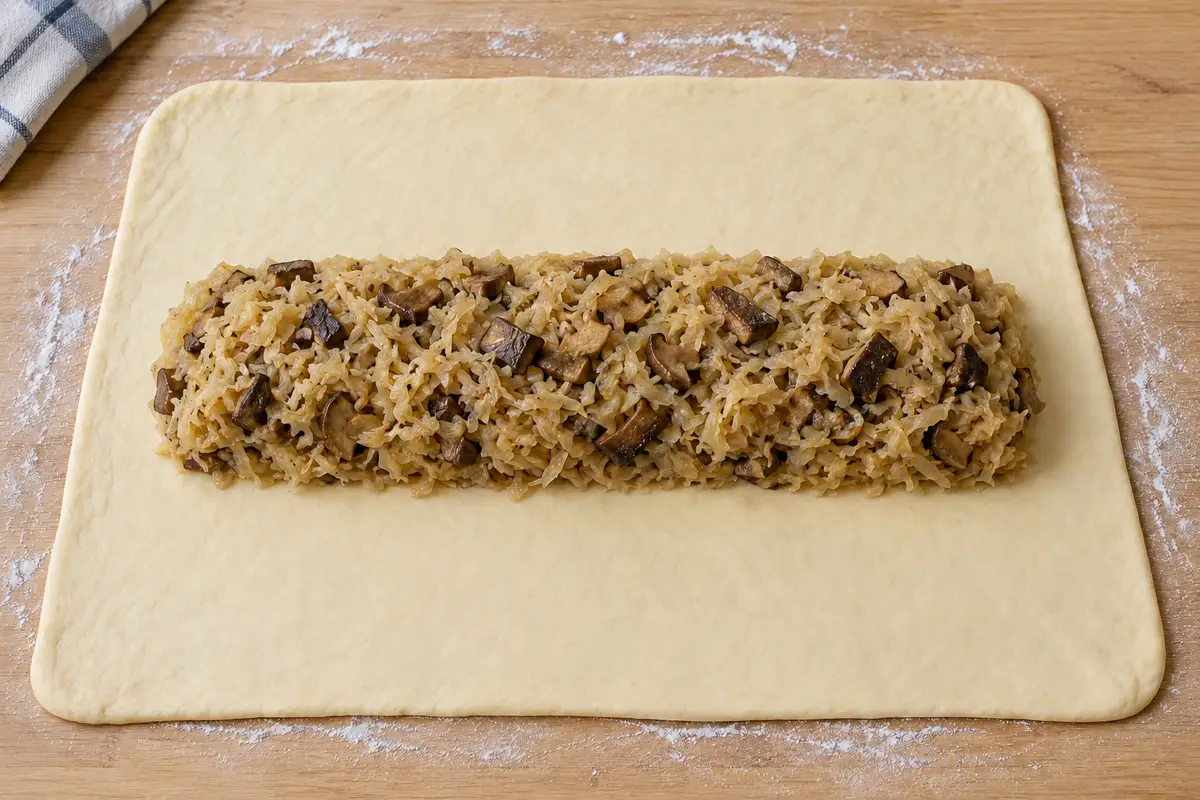
Place the cooled filling along the center of the rectangle, parallel to the 40 cm side. Shape it into an even log about 32 cm long and about 10 cm wide, leaving about 4 cm of bare dough at each short end. Smooth the filling with a spoon without packing it down firmly; the strips of dough along the sides must stay clean so they can be sealed tightly.
AI-generated Fold both short ends of the dough over the filling, then lift the long sides and bring them together above the filling, pinching the seam firmly with your fingers. Carefully turn the loaf over and transfer it to the baking sheet with the main seam facing down; support it with two wide spatulas if needed. It should be about 35–36 cm long and 12–13 cm wide, with sealed ends and no holes; do not stretch the dough tightly.
Loosely cover the loaf with a clean kitchen towel and leave for about 25–30 minutes, until noticeably puffy. Meanwhile, preheat the oven to 180°C on the conventional (no-fan) setting. Brush the entire surface with the remaining 30 ml milk, applying it in a thin layer, and make three short diagonal slashes in the top, about 5 mm deep. The slashes should open the top layer of dough to let steam escape without cutting the loaf into pieces.
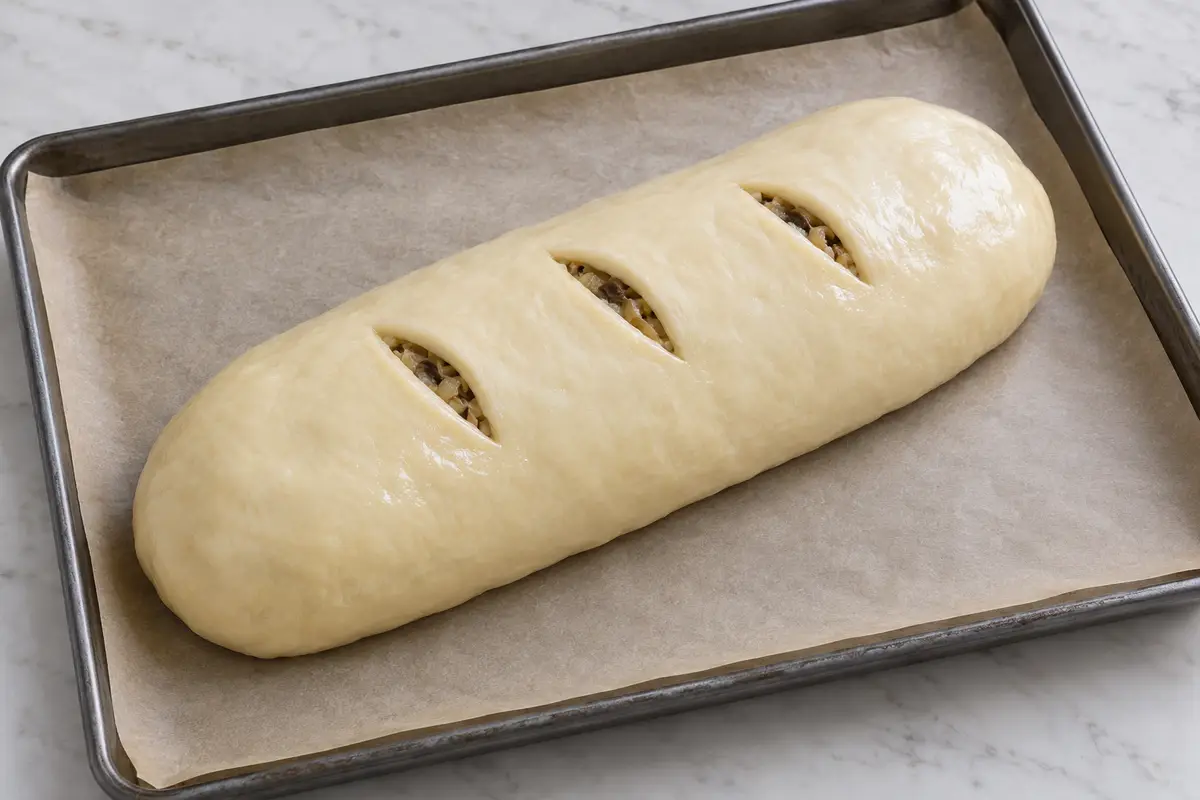
AI-generated Place the baking sheet on the middle rack of the preheated oven and bake for about 40–45 minutes. The top should be evenly golden, and the dough around the slashes and at the base should be clearly baked through, with no moist, raw layer. If the top browns too quickly, loosely cover it with aluminum foil and finish baking; if the base or the dough around a slash remains underbaked, bake for about 5–10 minutes longer.
Transfer the baked loaf, still on its parchment paper, to a wire rack and leave for about 15 minutes so the filling does not fall apart when sliced. Use a sharp serrated knife to cut the loaf into 8 thick slices, one per serving. Serve warm; once the remaining slices have cooled, cover them and refrigerate them. Do not leave them on the counter until the next day.
Estimated nutrition

Rate this recipe
0 ratings
Comments