
AI-generated
Piróg biłgorajski — buckwheat, potato and Polish curd cheese bake
Log in or create a free account to save recipes.
Source: https://recipheon.com/en/recipes/main-dishes/pirog-bilgorajski-buckwheat-potato-and-polish-curd-cheese-bake
About this recipe
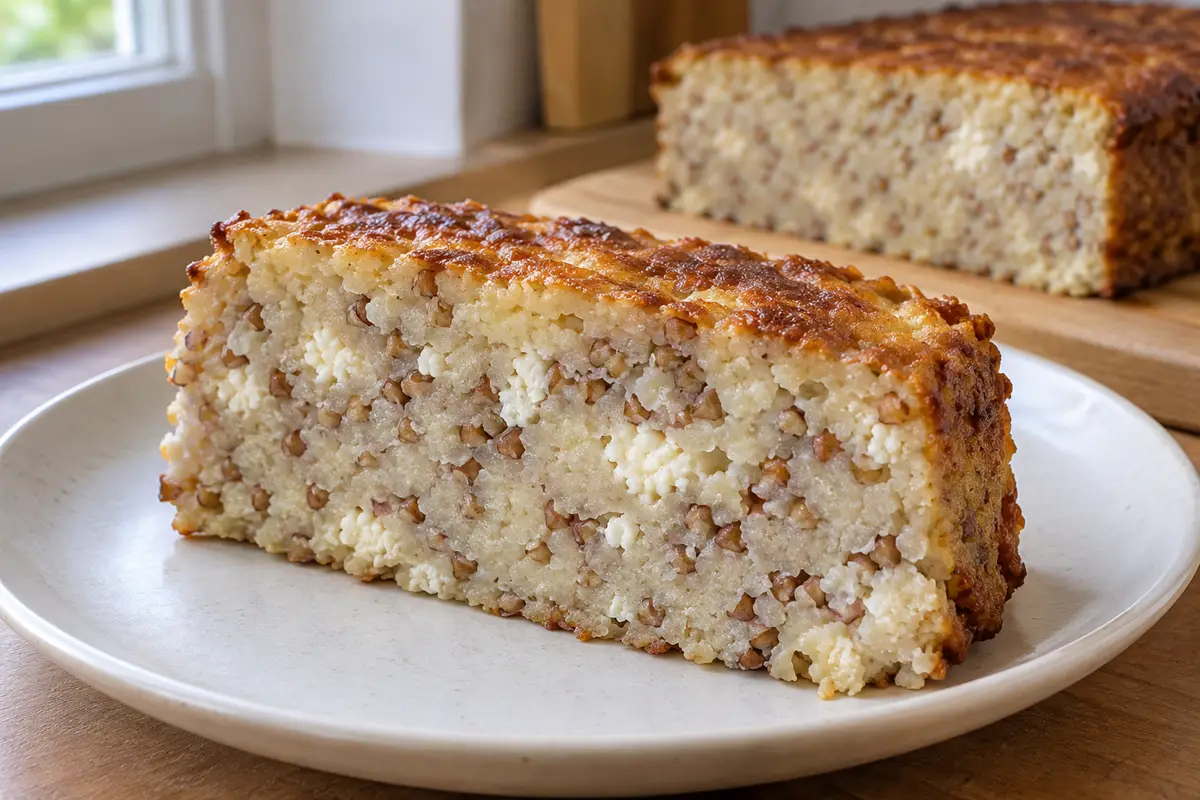
Piróg biłgorajski is a hearty baked dish from Poland's Lublin region, combining potatoes, buckwheat and Polish curd cheese into a firm, slightly crumbly whole. This home version has no yeast-dough casing and is called łysy piróg. Roasted buckwheat gives a distinct buckwheat aroma, full-fat curd cheese adds mild tang, and butter and sour cream mellow the flavor. Cook the groats separately, letting them absorb the water so they are already tender before combining with potatoes. Use the entire cooked batch of groats and precisely weighed potatoes after cooking and draining. No dough, flour or extra coating is needed: parchment makes the rectangular bake easier to lift from the pan. Baking creates a browned crust with visible grains and curd pieces beneath. After resting, divide into eight thick slices. The warm bake is more delicate and slices more evenly after chilling; either way, it remains a savory homemade dish.
Ingredients
The whole bake for eight servings
700 g potatoes cooked without salt, peeled and thoroughly drained, weighed after cooking; prepare from about 900 g raw potatoes before peeling
200 g dry roasted buckwheat groats, loose, not cooked groats
400 g water for cooking the groats by absorption
400 g firm full-fat Polish curd cheese (twaróg) in a block, without free whey, not creamy spreadable cheese
100 g sour cream with 18% fat
2 medium eggs, size M, about 100 g without shells
50 g butter with 82% fat, all for the mixture
8 g fine salt, all for the mixture
0.6 g ground black pepper
Water for boiling the potatoes
1.5 liters water without salt for boiling the potatoes, discarded after cooking and not added to the mixture
Steps
Prepare about 900 g raw potatoes, peel and cut into similar pieces. Cover with 1.5 liters water without salt and boil gently for about 20–25 minutes until tender. Discard all the water, leave the potatoes to steam dry for 2 minutes and weigh exactly 700 g. Any extra stays outside the recipe; the bake uses cooked weight without skins or cooking water.
Meanwhile, bring the weighed 400 g water to a boil in a small saucepan. Add all 200 g sorted dry roasted groats, stir and cover. Cook over the lowest heat for about 15–18 minutes until the grains soften and absorb the liquid. Turn off the heat and leave covered for another 10 minutes. Do not cook in a large volume of water and do not drain; all the resulting cooked groats will go into the bake.
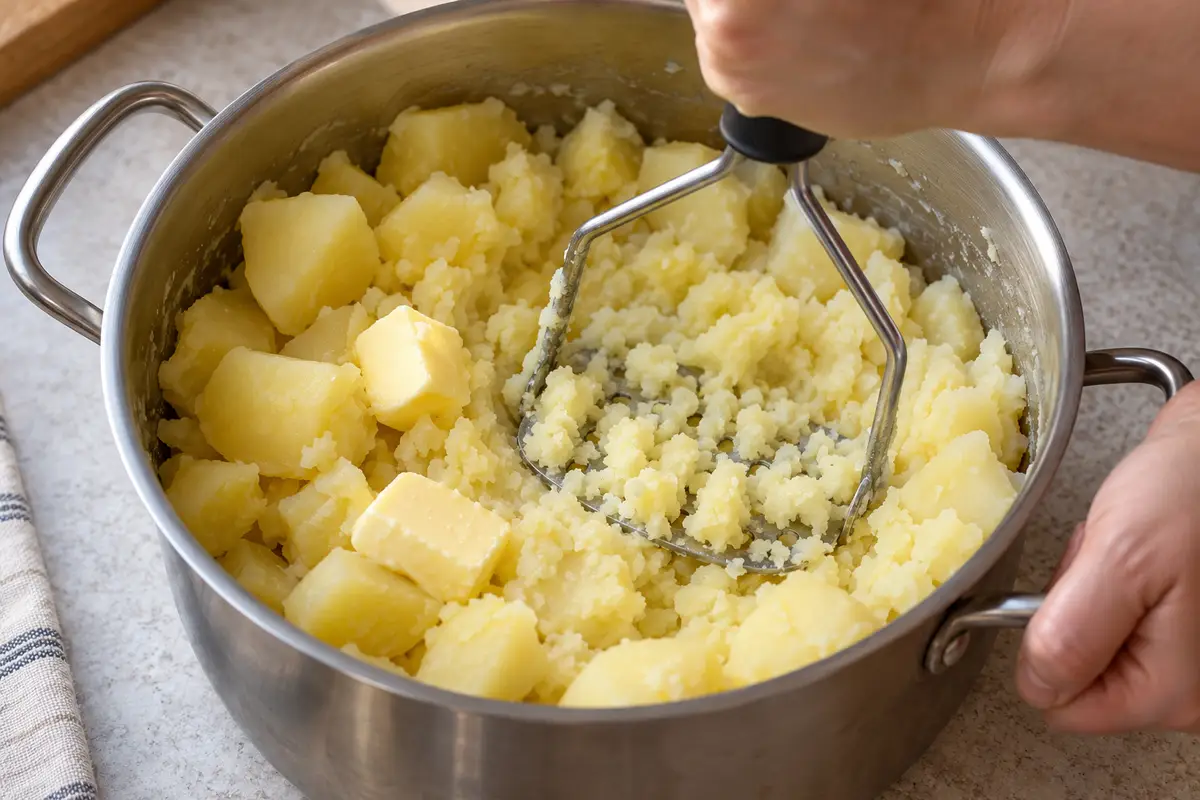
While the weighed 700 g potatoes are still warm, add all 50 g butter. Mash until smooth without adding milk or cooking water. Fluff the cooked groats with a fork. Set potatoes and groats aside for about 15 minutes until clearly cooler and no longer steaming before adding eggs. Do not blend the potatoes, so the mixture does not turn gluey.
AI-generated Preheat the oven to 180°C, conventional heat. Line a metal loaf pan with internal dimensions about 25 × 12 cm and a height of 8 cm with parchment, including the sides. Do not add grease and do not dust with flour. Weigh 400 g firm full-fat Polish curd cheese without free whey and crumble with a fork into small lumps; do not use watery soft cheese.
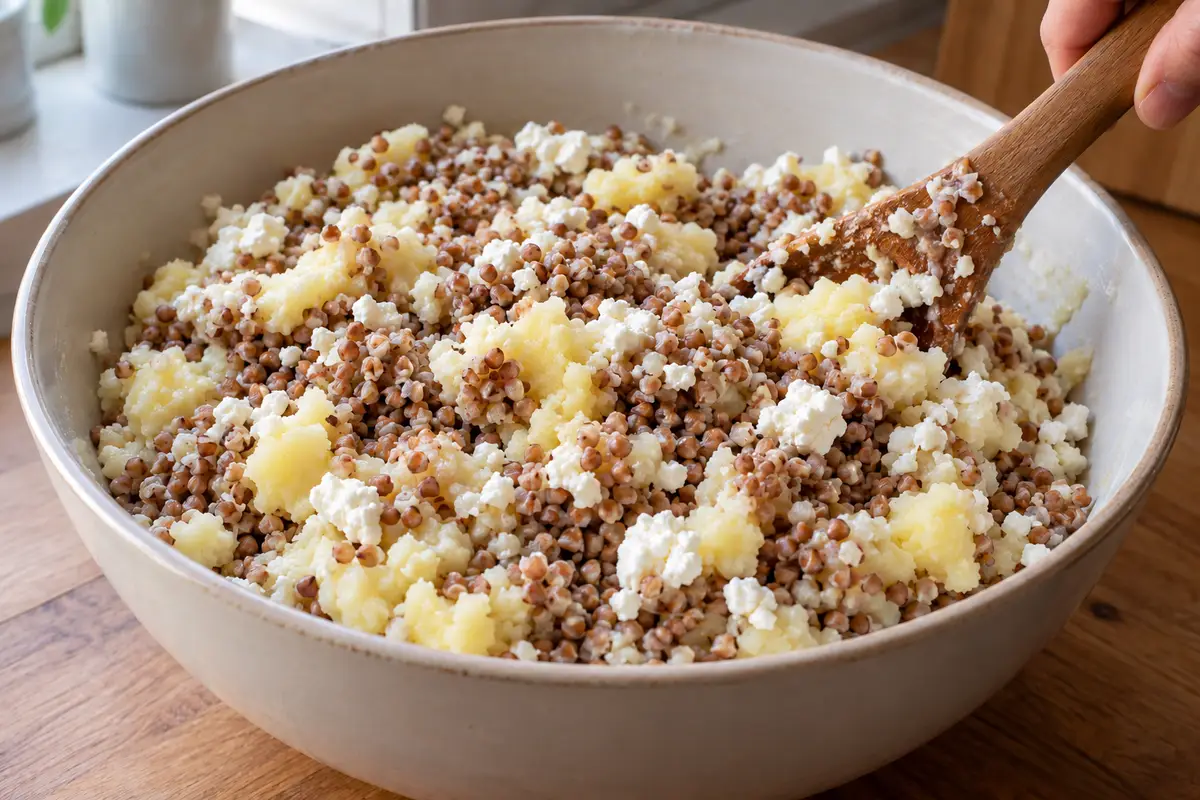
Put all the potatoes with butter, all the cooled groats from the saucepan and all the crumbled Polish curd cheese into a large bowl. Mix with a sturdy spoon, breaking up larger potato lumps. Do not measure out a new portion of cooked groats: use the entire result of cooking 200 g dry product. Visible grains and small white pieces of curd cheese should remain in the mixture.
AI-generated Once the mixture is lukewarm, beat 2 size M eggs, about 100 g without shells, in a small bowl and add all of them. Add 100 g sour cream, all 8 g salt and 0.6 g pepper. Mix thoroughly, gathering ingredients from the bottom of the bowl. The mixture should be thick, moist and easy to spoon into the pan. Do not add water, do not add flour and do not taste the mixture with raw eggs.
Transfer all the mixture to the prepared pan and scrape the bowl thoroughly. Add in portions, pressing with a spoon along the base and sides to reduce large air gaps. Smooth the surface with the back of that same spoon, without brushing with egg, sour cream or extra fat. Leave a little room at the pan rim; this is a firm bake that does not need to rise.
Place the pan slightly below the middle of the preheated oven. Bake at 180°C for about 85–100 minutes until the top is golden brown, the edges pull slightly from the parchment and the center stays firm when the pan is gently moved. If the top browns too fast, loosely cover with foil. Do not remove the bake just because the outside has colored if the center still clearly wobbles.
Take the pan out of the oven and place on a rack. Leave the piróg in the pan for about 60 minutes to set; do not invert the hot bake and do not try to cut thin slices immediately. Then gently lift out with the parchment, supporting the base with a wide spatula or board. The warm center is more delicate; fully chilled, it cuts into neater pieces.
Remove the parchment and cut the entire piróg into 8 thick slices, including both ends. Serve without extra fat or sauce. Arrange remaining slices in a single layer in a shallow container and refrigerate within 2 hours of taking the bake out of the oven; use within 2 days. Reheat in a covered dish at 170°C for about 15–20 minutes until hot inside, without adding butter.
AI-generated
Estimated nutrition

Rate this recipe
0 ratings
Comments