
AI-generated
Spanish Galician Pie with Tuna, Peppers and Onions
Log in or create a free account to save recipes.
Source: https://recipheon.com/en/recipes/main-dishes/spanish-galician-pie-with-tuna-peppers-and-onions
About this recipe
Galician pie encloses a juicy filling of tuna, peppers and onions between two thin layers of yeast dough. The vegetables first soften in olive oil, then simmer with passata until no liquid pools in the skillet. The tuna is drained before it goes into the filling, so its pieces remain distinct and the bottom crust does not become waterlogged. A larger bottom sheet makes it possible to seal the edges firmly, while a small hole in the lid lets steam escape. After baking, the pie rests on a wire rack: the filling firms up slightly and the golden crust is easier to cut into even portions.
Ingredients
Dough and shared ingredients
470 g type 550 wheat flour: 450 g for the dough and 20 g for dusting; discard any unused dusting flour
250 ml lukewarm water for the dough
5 g instant dry yeast for the dough
100 g olive oil: 50 g for the dough, 40 g for the filling and 10 g for brushing the baked pie
10 g fine salt: 8 g for the dough and 2 g for the filling
Tuna filling
300 g canned chunk tuna packed in water, weighed after draining thoroughly; discard the liquid from the cans
400 g onions, weighed after peeling
300 g red bell peppers, weighed without stems and seed cores
200 g smooth tomato passata
3 g ground sweet paprika, not smoked
Steps
In a large bowl, mix 450 g flour, the yeast and 8 g salt, then add all 250 ml lukewarm water and 50 g olive oil. Knead by hand for about 8–10 minutes, until the dough is smooth, elastic and soft but retains its ball shape and starts to pull away from the bowl. Do not add extra flour: the measured dusting flour is for rolling out the dough later.
Cover the bowl and leave the dough in a warm place without drafts for about 60–90 minutes, until it has roughly doubled in volume. Prepare and cool the filling in the following steps while the dough rises; if the dough is ready first, keep it covered until assembly. Slice the onions into thin half-moons and cut the peppers into cubes about 1 cm across.
Heat 40 g olive oil over medium heat in a large, deep skillet about 28 cm in diameter, then add all the onions and peppers and 2 g salt. Cook over medium-low heat for about 20 minutes, stirring frequently, until the vegetables have softened noticeably and the onions are translucent; do not let them burn. Add the sweet paprika, stir for about 20 seconds and immediately add all the passata. Simmer without a lid for about 10–15 minutes, stirring along the bottom, until the filling is thick with no pools of liquid and a spatula drawn across the bottom leaves a trail that does not immediately fill with water; keep all the olive oil in the filling.
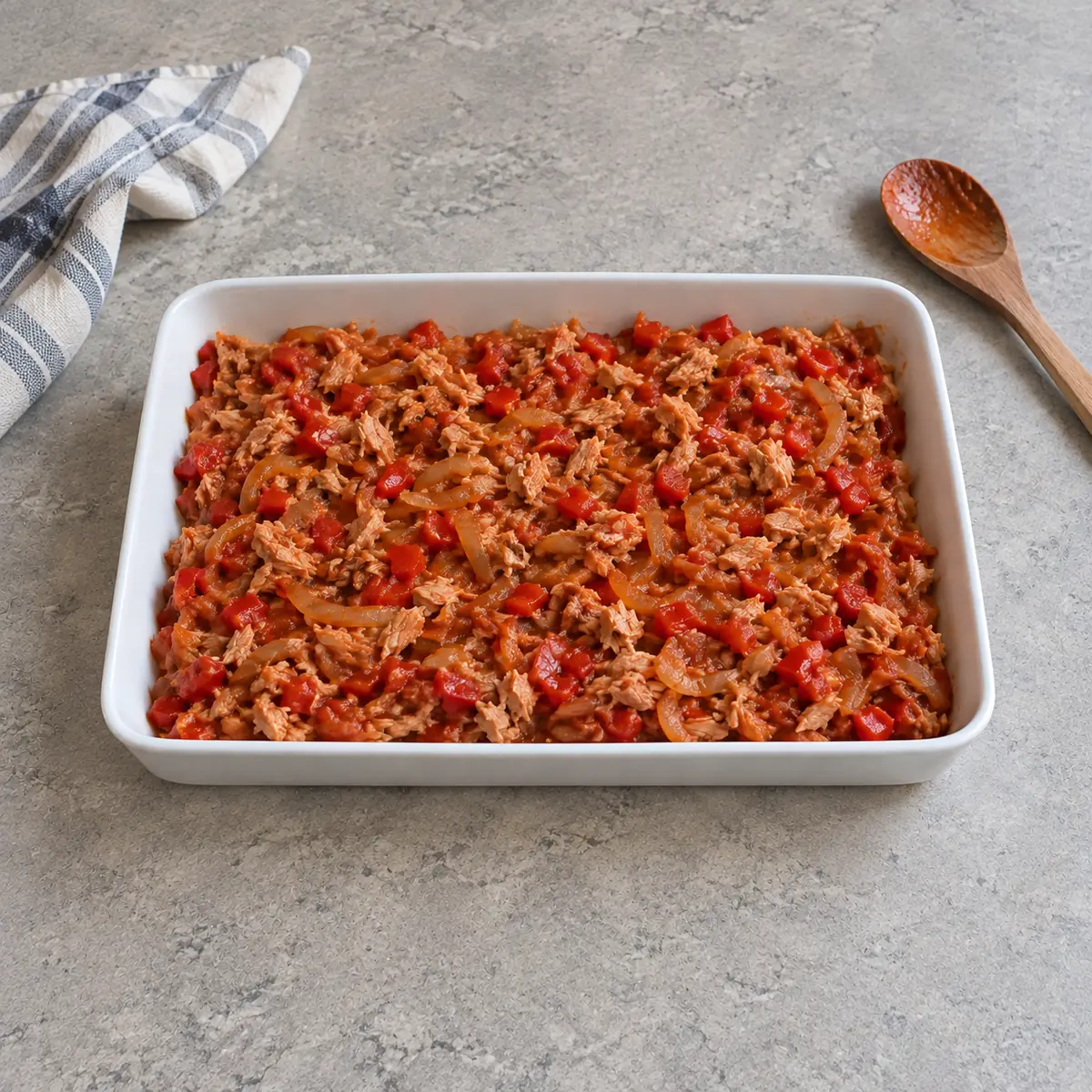
Transfer the entire contents of the skillet to a wide dish, spread in a layer no thicker than about 2 cm and cool for about 45 minutes, stirring occasionally, until the filling is at room temperature with no warmth remaining. Meanwhile, drain the tuna in a sieve for about 10 minutes, discard the liquid from the cans and weigh out 300 g drained fish. Break it into small pieces with a fork and gently fold it all into the cold vegetables without mashing it into a paste. Toward the end of cooling, preheat a conventional oven (no fan) to 200°C, with a rack slightly below the middle.
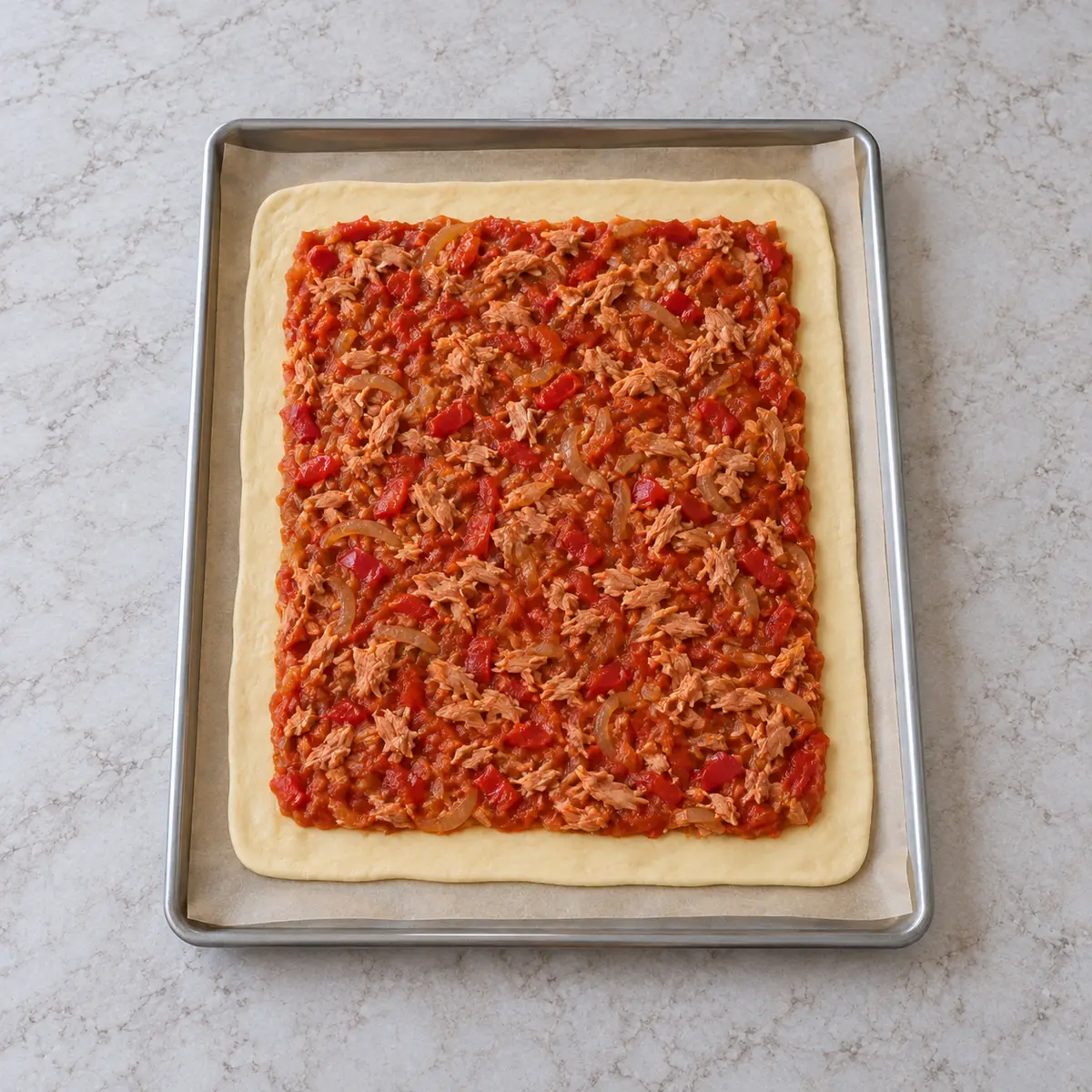
AI-generated Have ready a flat metal baking sheet with a usable surface of at least 30 × 40 cm and parchment paper. Gently deflate the risen dough and divide it into a slightly larger portion for the bottom, about 55% of the total, and a smaller portion for the lid; keep the second portion covered. Using only as much of the measured 20 g dusting flour as needed, roll the bottom into a rectangle about 30 × 36 cm and the lid to about 28 × 34 cm, both about 3 mm thick. Transfer the larger sheet to the parchment on the baking sheet; use all the dough without trimming the edges and discard any unused flour.
Spread all the cooled filling over the bottom sheet in a rectangle about 26 × 32 cm, leaving a clean border of about 2 cm on each side. Level the filling to an even thickness without high mounds, scraping every piece of fish and vegetable out of the dish and onto the dough. Keep the dough border free of filling and olive oil so it can be sealed firmly.
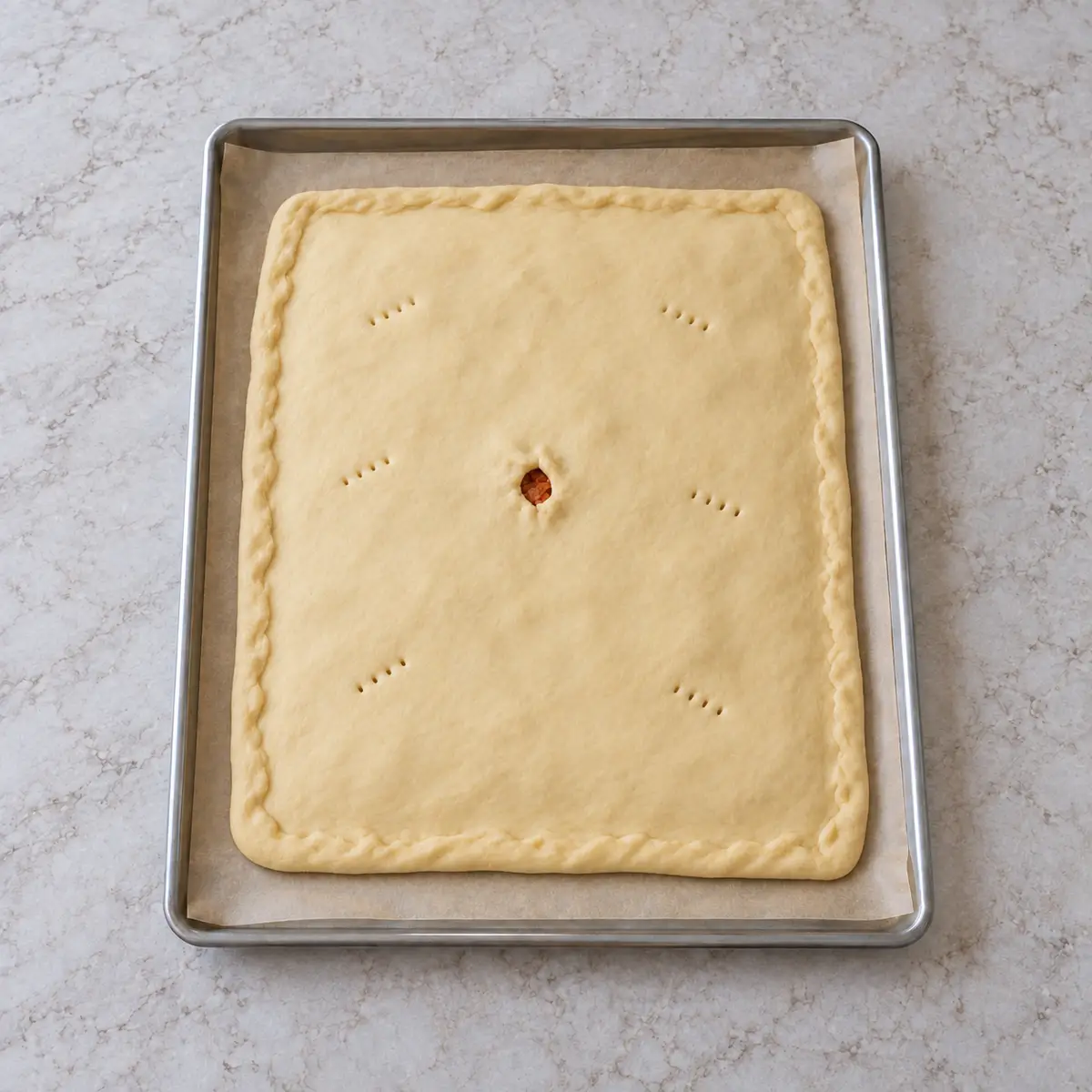
AI-generated Cover the filling with the smaller sheet of dough, gently push any larger air pockets toward the edges and press the two layers together around the filling. Fold the overhanging bottom edge over the top one and pinch it firmly with your fingers to make a low, tightly sealed rim; the finished pie will measure about 28 × 34 cm. Make a small slit in the center of the lid, then open it with your fingers into a hole about 1 cm in diameter; do not cut out any dough and do not discard any. Prick the lid with a fork in a few more places, avoiding the rim, so steam can escape during baking.
AI-generated Place the baking sheet in the preheated oven and bake for about 45–50 minutes, until the top and rim are evenly golden brown. Near the end, carefully lift one corner with a wide spatula: the bottom should be browned, dry and firm enough to support the filling, without a pale, gummy layer of dough. If the bottom is still pale, bake for a few minutes longer; loosely cover the top with aluminum foil if it is browning too much. Do not judge whether the whole pie is done by the color of the lid alone.
Brush the hot pie with all the remaining 10 g olive oil, spreading it thinly over the top and rim. Leave on the baking sheet for about 5 minutes, then use the paper and a wide spatula to transfer it to a wire rack, carefully slide out the paper and cool for about 15 minutes more without a cover. Transfer to a board and use a serrated knife to cut into 8 rectangular pieces without pressing down hard. Serve the pie warm, with bottom crust, filling and lid in every portion.
Estimated nutrition

Rate this recipe
0 ratings
Comments