
AI-generated
Sausage rolls — flaky puff pastry with juicy pork and sage
Log in or create a free account to save recipes.
Source: https://recipheon.com/en/recipes/snacks/sausage-rolls-flaky-puff-pastry-with-juicy-pork-and-sage
About this recipe
Sausage rolls are British savory pastries with a flaky puff pastry shell and a juicy pork and sage filling. The all-butter pastry separates into crisp layers in the oven, while finely chopped sautéed onion mellows the filling. Use raw ground pork with a moderate fat content, not ready-made sausage. A little fine breadcrumb mixture soaked in milk helps keep the filling tender. Cold pastry, chilling the shaped rolls and placing the sealed seam underneath help them hold their shape and develop crisp layers. These quantities make sixteen small rolls, or eight snack servings of two each. Allow about 2 hours and 10 minutes for preparation, cooling the onion, chilling and baking the entire tray.
Ingredients
Juicy pork filling
500 g raw ground pork with 15–20% fat, without added seasonings
75 g onion, weighed after peeling
5 g olive oil
25 g plain fine dry breadcrumbs, without added seasonings
30 g milk with 3.2% fat
4 g fresh sage leaves, without stems
6 g fine salt
1 g ground black pepper
Pastry and finishing
375 g raw ready-made all-butter puff pastry, refrigerated, in a block for rolling
1 whole egg (size M), for sealing and lightly brushing the pastry; some will be left over
All-purpose flour for light dusting, up to 10 g; you may not need it all
Steps
Chop the onion very finely. Heat 5 g olive oil in a small skillet and cook the onion over medium-low heat for 6–8 minutes, stirring, until soft without deep browning. Transfer all the onion and oil to a wide plate, spread in a thin layer and leave for about 15 minutes until completely cool. Do not add warm onion to raw meat. Keep the pork and pastry refrigerated until needed.
Mix the breadcrumbs with the milk in a bowl and leave for 5 minutes until absorbed. Finely chop the sage leaves. Add the raw pork, all the cooled onion and oil, sage, salt and black pepper. Work together by hand for 1–2 minutes until evenly mixed and slightly sticky. Do not add the egg to the filling. Divide all the filling into two equal portions and keep covered in the refrigerator until wrapping.
Very lightly dust the counter with some of the allocated flour. Roll the cold pastry into a rectangle about 26 × 40 cm and 3–4 mm thick, keeping the sides as straight as possible. Cut lengthwise into two strips about 13 × 40 cm each. Do not cut anything off and do not trim the edges straight; use all the pastry. If it becomes soft and sticky, place it on parchment paper and refrigerate for about 10 minutes rather than adding lots of dusting flour.
Beat the egg separately in a small bowl; it is only for sealing and lightly brushing the pastry, and you do not need to use it all. Put one portion of filling along the center of each strip in an even log about 40 cm long and about 3 cm in diameter, reaching both short ends. Brush a narrow strip along one long pastry edge with a little egg. Wrap the pastry around the filling, gently pushing out air, and firmly seal with an overlap about 2 cm wide. Do not stretch the wrapper tightly over the meat. Turn both long logs seam-side down.
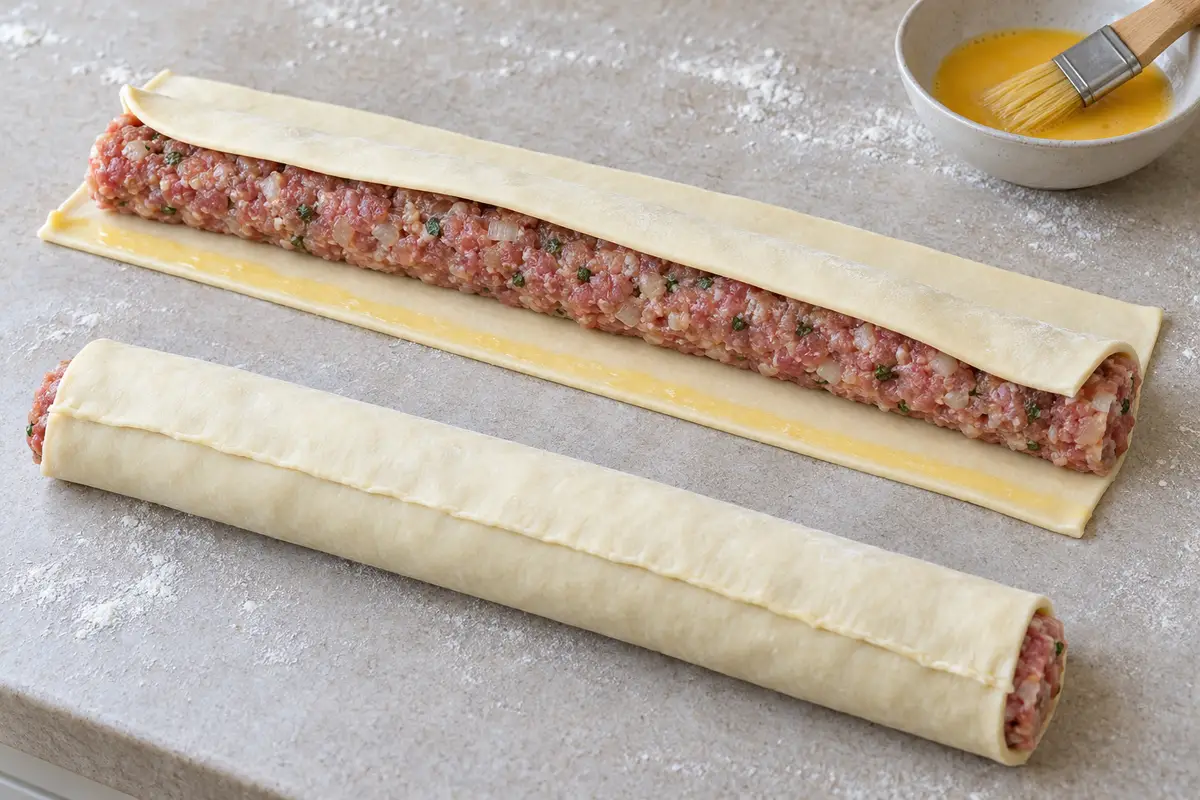
AI-generated Line a metal baking sheet with a usable surface about 30 × 40 cm with parchment paper. Use a sharp knife to cut each log into eight pieces about 5 cm long, without trimming off the ends. Put all sixteen pieces seam-side down in four rows of four, leaving about 3 cm between them. Do not pinch the open cut ends closed. Refrigerate the entire tray for 20 minutes. Meanwhile, preheat the oven to 200°C with conventional top and bottom heat.
Take the tray out of the refrigerator. Brush the tops with a thin layer of beaten egg, avoiding the exposed pastry layers at the cut ends so they do not stick together. Make two short slits through the pastry on top of each roll to let steam escape. Bake the entire tray just below the middle of the oven for 35–40 minutes, until the pastry is well risen, deep golden and crisp, including underneath. If the tops brown too quickly, cover loosely with aluminum foil and continue baking; top color alone is no reason to shorten the baking time.
After the full baking time, cut one roll open: the meat filling must be cooked all the way through, and the pastry next to it must not be raw or gummy. If the center needs longer, bake the whole batch for a few more minutes, protecting overly darkening tops with foil. Use a spatula to transfer the rolls to a wire rack, leaving rendered fat on the tray, and wait about 10 minutes before serving. Serve warm, two rolls per snack serving.
Estimated nutrition

Rate this recipe
0 ratings
Comments