
AI-generated
Rugbrød — Danish Whole-Grain Rye Sourdough Bread with Seeds
Log in or create a free account to save recipes.
Source: https://recipheon.com/en/recipes/breakfast/rugbrod-danish-whole-grain-rye-sourdough-bread-with-seeds
About this recipe
Rugbrød is Danish rye sourdough bread with a dense, moist crumb containing cracked grain, sunflower seeds, and flaxseeds. This loaf uses only rye and seeds, with no added baker's yeast. You need a mature, active starter made from equal weights of whole-grain rye flour and water; a weak starter straight from the refrigerator will not produce a similar rise. The grains soak overnight, then the thick dough is mixed with a spoon and transferred to a pan. Do not wait for the dough to double: a noticeable, moderate rise and the first small surface pores are enough. After baking, the bread needs a full day before slicing so the moist interior can be cut into thin slices. One loaf makes about 32 slices, or 16 portions of two slices each.
Ingredients
One seeded loaf
400 g mature active rye sourdough starter at 100% hydration, made only with whole-grain rye flour and water; equivalent to 200 g flour and 200 g water already included in this weight
300 g dry whole-grain rye flour, Polish type 2000
200 g dry cracked rye grain, meaning broken whole kernels, not flakes
80 g hulled raw unsalted sunflower seeds
50 g whole dry flaxseeds
500 ml drinking water; 450 ml for soaking, 40 ml for mixing the dough, and 10 ml for smoothing the top, without draining off the soaking water
14 g fine salt
Steps
In the evening, put the cracked rye, sunflower seeds, flaxseeds, and salt in a heatproof bowl. Bring 450 ml of water to a boil, pour over the mixture, and stir thoroughly to moisten all the grains and seeds. Cover and leave for about 10–12 hours at room temperature; the grains will swell and the flaxseeds will bind the water into a slightly gel-like mixture. Keep everything in the bowl, including the moisture between the grains.
The next day, use the measured 400 g of already active starter at room temperature: it should be visibly airy, have risen after feeding, and just be reaching the end of its rise, with a pleasantly sour aroma. Add the starter, 40 ml of lukewarm water, and 300 g of rye flour to the cooled grain mixture. Stir with a sturdy spoon for about 4–5 minutes, scraping the bottom and sides, until you have a uniform, heavy, sticky paste with no dry patches. Do not knead it like wheat dough: it should be spoonable and hold the spoon marks, but should not form a dry ball or flow freely.
Line a metal loaf pan of about 2½ liters, usually about 30 cm long, with parchment paper. Add the mixture in batches, pressing with a spoon into the corners too, so no large air pockets remain; it should fill roughly half to two-thirds of the pan's height. Spread the remaining 10 ml of water over the top and smooth with the back of a spoon. Mark the starting level on the paper at the edge and put a cover over the pan without letting it touch the dough.
Leave the pan in a warm spot, about 24–26°C, usually for 3–5 hours. The dough should increase in volume by roughly one-third to one-half, and the first small holes and fine cracks should appear on its gently domed surface. Once the rise is noticeable, start preheating a conventional oven (no fan) to 210°C so it is ready after about 25–30 minutes; bake without further waiting once these signs appear. If the dough is still flat and has barely risen, give it more time in the warmth, but do not wait for it to double or for the top to collapse.
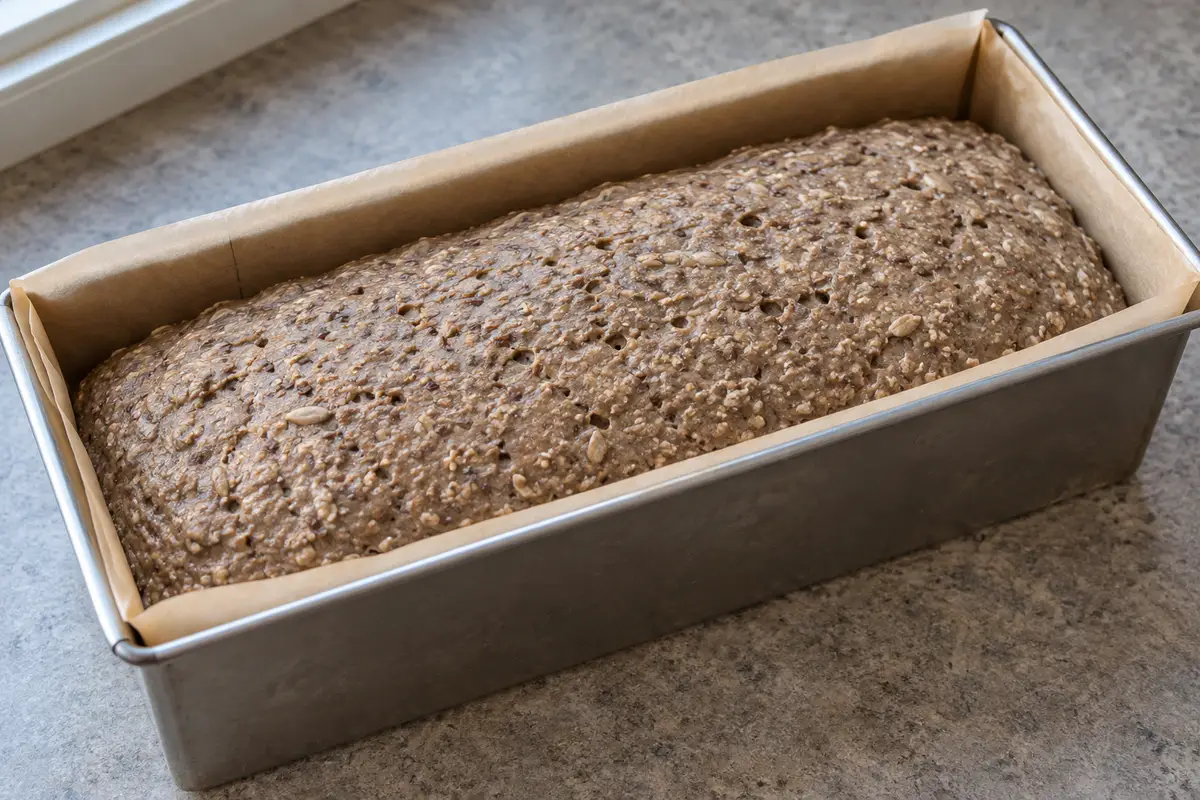
AI-generated Remove the cover and place the pan just below the middle of the preheated oven. Bake for 15 minutes at 210°C, then lower the temperature to 180°C and bake for about 80–90 minutes more; if the top browns deeply sooner, cover it loosely with aluminum foil. The baked bread has a deep brown, dry crust and pulls slightly away from the paper at the sides. A long wooden skewer inserted deep into the center may have moist crumbs on it but should not be coated with raw paste. If sticky raw dough remains on it, bake for about 10–15 minutes more under the cover instead of removing the bread just because the stated time has elapsed.
After about 15 minutes, take the bread out of the pan, remove the paper, and leave uncovered on a rack for about 4–5 hours until completely cool. Only then wrap the cold loaf in a clean cloth and leave at room temperature so that at least 24 hours pass from taking it out of the oven to slicing; the initial cooling is part of this day. Then use a sharp serrated knife to cut slices about 8–10 mm thick, guiding the blade without squashing the bread. You will get about 32 slices, two per portion; the interior will remain dense and moist, with visible softened grains.
Estimated nutrition

Rate this recipe
0 ratings
Comments