
AI-generated
Baklava — crisp phyllo layers with nuts and syrup
Log in or create a free account to save recipes.
Source: https://recipheon.com/en/recipes/desserts/baklava-crisp-phyllo-layers-with-nuts-and-syrup
About this recipe
Baklava combines thin, buttery phyllo layers with finely chopped nuts and sweet syrup. This home version uses walnuts with a little cinnamon, while the lightly lemony syrup contains no extra flavorings or glaze. The dessert is known in Greece, the Balkans and many other regional cuisines, with numerous local variations. Patient layering needs the most attention: keep unused sheets covered and give each layer a thin coating of melted butter. This recipe uses regular butter, without clarifying it or removing the milk solids. The sheet count, three nut layers and use of narrow trimmings are all specified, so no unexplained portion of the package is left over. Cut the pastry into small squares before baking, then bake gently until the top and visible layers are distinctly golden. Cooled syrup goes onto the hot baklava and slowly seeps through the cuts. Resting for several hours is part of the recipe: it evens out moisture and lets you lift out pieces while keeping the top delicately crisp.
Ingredients
Phyllo, nuts and butter
500 g fresh refrigerated phyllo pastry: 20 very thin sheets about 30 × 31 cm, such as two packs of 250 g and 10 sheets each; not puff pastry or thick yufka flatbreads
400 g shelled walnuts, unsalted and unroasted; weight without shells
2 g ground cinnamon
250 g unsalted butter with 82% fat for the pan, all layers and top; do not clarify and do not remove the milk solids
Lightly lemony syrup
400 g white sugar
250 g water for the syrup
15 g freshly squeezed, strained lemon juice, without seeds or peel
Steps
Combine the sugar, all 250 g water and the lemon juice in a saucepan. Heat, stirring gently only until the sugar dissolves. Bring to a boil, reduce the heat and boil gently for 4–5 minutes without stirring. The syrup should stay fluid, not turn caramel-colored. Remove from the heat and leave to cool completely for at least 45 minutes while preparing and baking the pastry. Do not reduce to a thick thread; you will pour cooled syrup onto hot baklava.
Prepare a metal pan with internal dimensions of 30 × 30 cm and sides at least 4 cm high. Take the unopened refrigerated phyllo out for about 15–20 minutes, following the package instructions. Open only just before layering. Put plastic wrap over the stack of sheets and a slightly damp kitchen towel on top; the damp cloth should not touch the pastry. Uncover only briefly to take the sheets you need. Do not use frozen-solid phyllo and do not wet the sheets themselves with water.
Chop the nuts with a knife or short food-processor pulses into small pieces about 2–4 mm across, not a paste. Mix with cinnamon and divide everything into three equal portions. Melt all 250 g butter over low heat without browning. Do not skim off foam and do not pour off sediment: this is regular melted butter. Stir before taking any. Use about 5 g for the pan, keep 20 g for the finished top, and spread the remaining 225 g thinly between the sheets.
Count out 20 sheets about 30 × 31 cm. Trim to 30 × 30 cm, cutting a narrow strip from each; keep all strips and divide into three roughly equal portions. With the stated dimensions, this gives one strip about 1 × 30 cm per sheet. Divide the full squares into stacks of 6, 4, 4 and 6 sheets. Trimmings go inside the three nut layers, not on the very top. Fit torn sheets together like puzzle pieces inside; save the neatest ones for the top.
Brush the bottom and sides of the pan with the allocated approximately 5 g butter. Lay in the first phyllo square and lightly drizzle or gently brush with butter from the 225 g portion. Add the remaining five base sheets one at a time, spreading a thin layer of butter between them. Smooth gently; do not crush the sheets and do not tear them with the brush. There should now be exactly six full squares on the bottom, with the remaining sheets still covered.
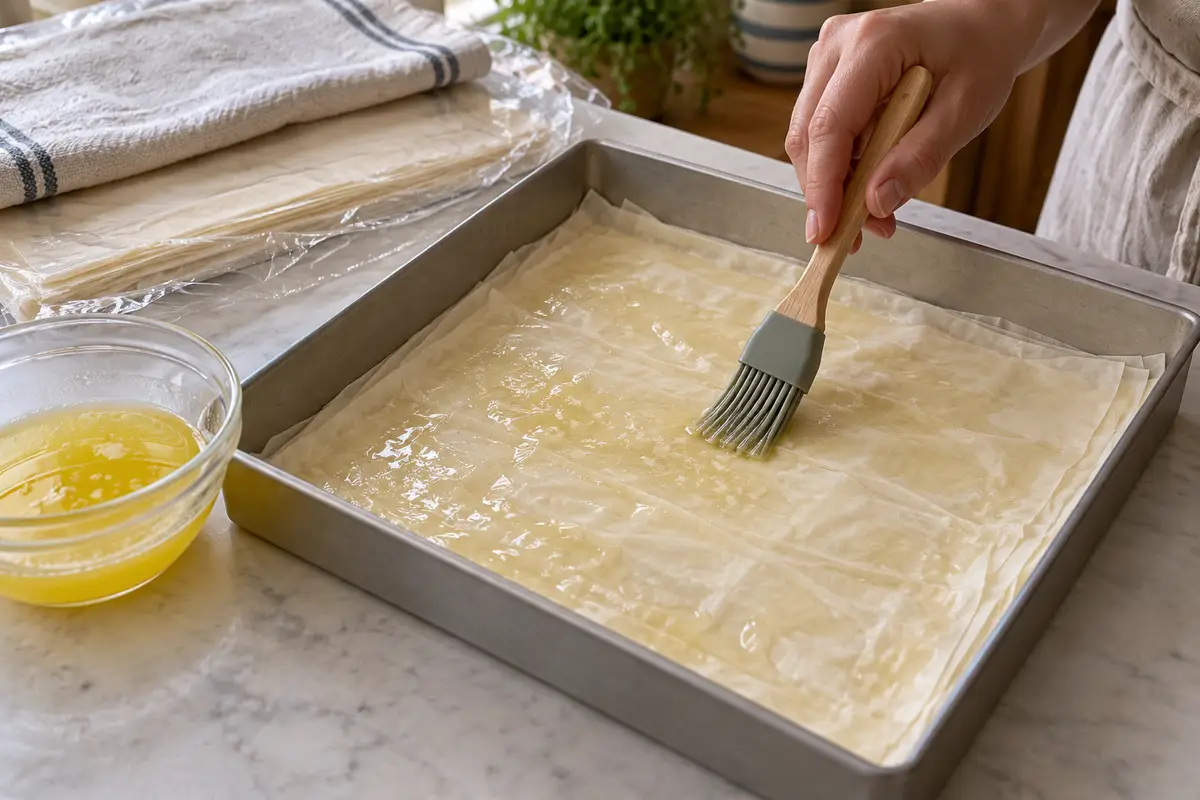
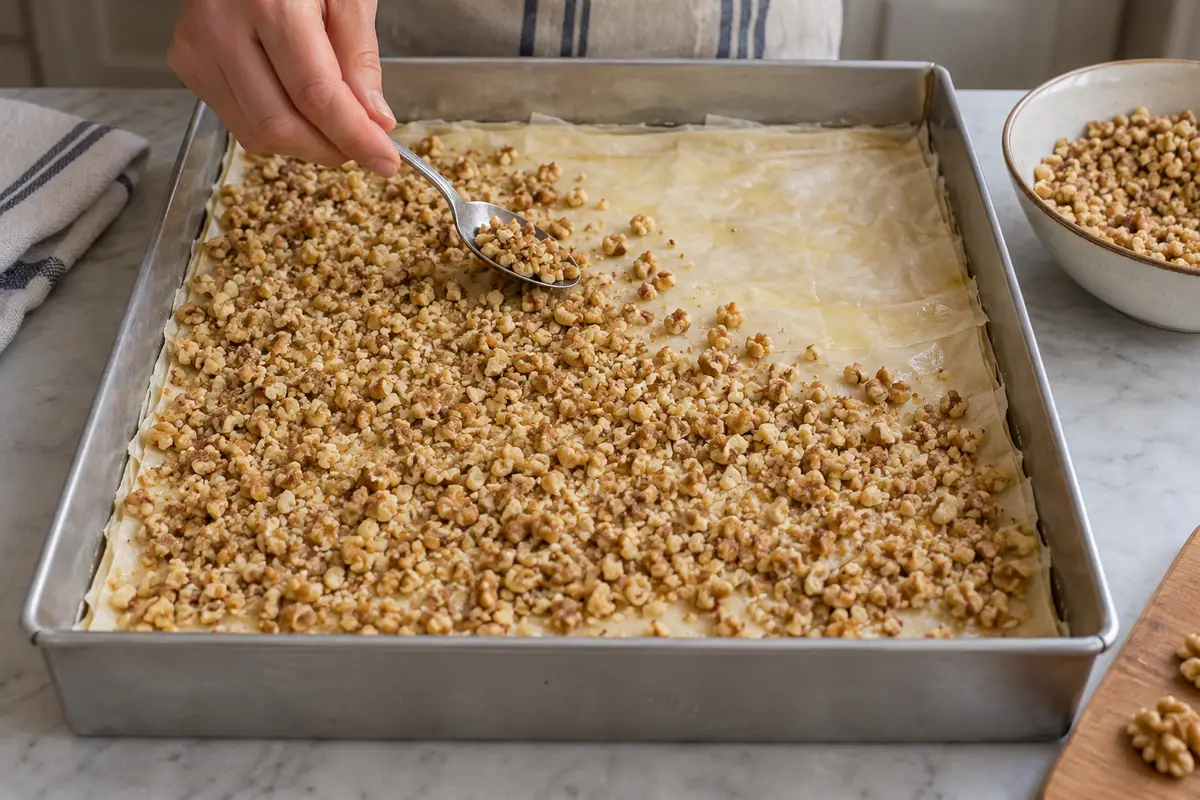
AI-generated Scatter the first third of the nuts evenly over the base. Spread the first portion of saved trimmings over them, distributing strips across the surface without a thick clump in one spot, and lightly drizzle with butter from the same 225 g portion. Cover with the next four full phyllo squares, thinly buttering each. Do not add extra sugar to the filling. After this layer, 10 full squares out of 20 have been used.
Scatter the second third of the nuts. Spread the second portion of trimmings over them, drizzle lightly with butter and cover with the next four full squares, thinly buttering each separately. Keep the surface level, without piling nuts in the middle. Continue using only the weighed butter allocation. You have now used 14 full squares and two-thirds of the filling; the six neatest sheets remain for the top.
AI-generated Add the last portion of nuts and all remaining phyllo strips, spreading thinly. Drizzle with butter, then add the last six full squares, buttering each. Use up the 225 g portion and brush the top with the reserved 20 g. Scrape remaining butter from the saucepan onto the surface; do not add oil. The final sequence is 6 sheets, nuts, 4 sheets, nuts, 4 sheets, nuts and 6 sheets; all trimmings are inside. Do not scatter nuts on top.
Refrigerate the pan for about 20 minutes so the butter firms up and cutting is easier. Preheat the oven to 160°C with conventional top and bottom heat. With a sharp knife, cut all the way to the bottom of the pan into six equal strips, then crosswise into six rows. This gives 36 squares about 5 × 5 cm, without trimming the edges. Gently hold the top so the sheets do not move with the knife. Do not remove any pieces from the pan yet.
Put the pan below the middle of the oven. Bake at 160°C for about 75–90 minutes, until the entire surface is distinctly golden and the sheets along the cuts are dry, separated and crisp. If the top darkens too quickly, cover loosely with aluminum foil toward the end and continue baking gently. Do not stop baking while the top is still pale and the layers look raw and damp. Check that the prepared syrup has cooled completely; do not reheat it.
Take the hot pan out onto a heatproof mat. Immediately pour on cooled syrup with a small ladle, spreading it along the cuts, edges and surface. Work gradually in two passes, giving the liquid a moment to soak in. Add all the prepared syrup, scraping any residue from the saucepan. You will hear sizzling; do not lean your face over the pan. Do not stir the pieces, do not press them down and do not pour off syrup straight after adding it.
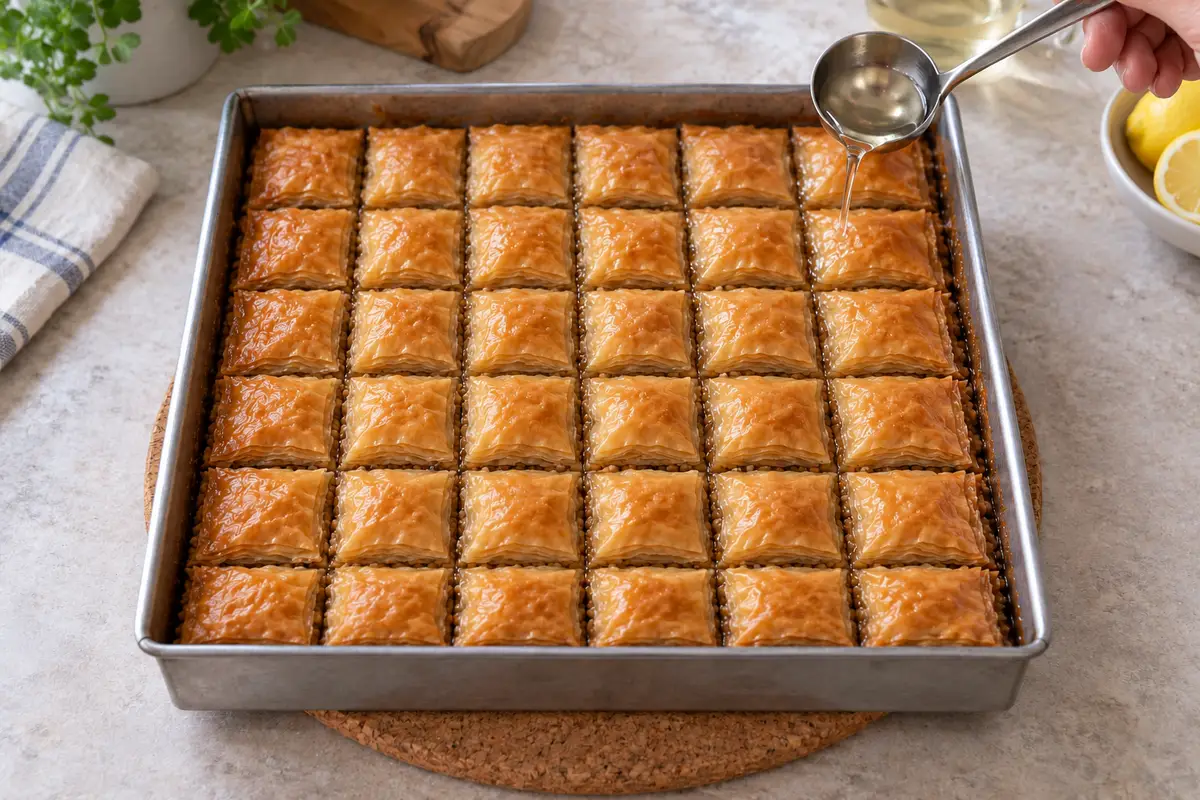
AI-generated Leave in the pan without covering for at least 6 hours in a cool place, until completely cooled and soaked; ideally, make it the day before. Do not seal the hot pan, as steam will soften the top. Recut all the way to the bottom before lifting pieces out. Serve 36 squares, one per serving, leaving any loose syrup in the bottom of the pan. Serve without extra glaze or toppings. Once completely cooled, cover and store for up to 2 days in a cool place or up to 5 days in the refrigerator.
Estimated nutrition

Rate this recipe
0 ratings
Comments