
AI-generated
Brunsviger — Danish Yeast Cake with a Butter and Sugar Topping
Log in or create a free account to save recipes.
Source: https://recipheon.com/en/recipes/desserts/brunsviger-danish-yeast-cake-with-a-butter-and-sugar-topping
About this recipe
Brunsviger is a Danish yeast cake with a soft, buttery brown sugar topping. Its characteristic dimples hold the topping and create sweet pockets in the fluffy cake. In this version from Funen, the soft, sticky dough is spread in the pan before baking rather than rolled out on a floured board. Choose soft, moist brun farin sugar with cane syrup; dry Demerara will give a different topping. The topping should be warm, not hot, and the baked cake should rest in its pan until the sweet layer stops flowing. An 18 × 30 cm pan makes 12 pieces. Allow about 2.5 hours, including rising and cooling; the dough will take longer to rise in a cooler kitchen.
Ingredients
Dough and butter-sugar topping
200 g all-purpose flour
100 ml pasteurized milk (3.2% fat)
25 g fresh baker’s yeast
1 raw size M egg, about 50 g without the shell, at room temperature
245 g unsalted butter (82% fat): 40 g softened for the dough, 200 g for the topping and 5 g for greasing the spatula and your fingers
10 g granulated white sugar
2 g salt
200 g soft, moist brown sugar with cane syrup, brun farin type; not dry Demerara
Steps
Gently heat the milk until it is lukewarm and pleasantly warm to the touch, not hot. Pour it into a bowl, crumble in the yeast and add the white sugar. Stir to disperse the yeast, then add the whole egg and stir again.
Add the flour, salt and 40 g softened butter. Work vigorously with a wooden spoon or use a mixer attachment on low speed for about 5–7 minutes, until the dough is smooth, elastic and slightly glossy. It should remain very soft and sticky; do not add more flour to make a ball suitable for rolling out.
Line a pan about 18 × 30 cm and at least 4 cm high with parchment paper. Use some of the reserved 5 g butter to grease a spatula, saving the rest for your fingers. Transfer the dough to the pan and gently spread it into an even layer. Cover loosely and leave in a warm place for about 45–60 minutes, until visibly puffy and nearly doubled in volume. If it is still dense, give it more time rather than relying on the clock alone.
Toward the end of the rise, preheat a conventional oven (no fan) to 175°C. Put 200 g butter and the brown sugar in a small saucepan. Heat over low heat for about 3–5 minutes, stirring, until the butter melts and the mixture is smooth and thick. Do not bring it to a boil. Remove from the heat and let cool for about 10–15 minutes, until the topping is still fluid and warm, but not hot. Prepare and cool the topping during the final part of the dough’s rise; if it becomes too thick, briefly warm it again over low heat.
Grease your fingers with the remaining butter from the greasing portion. Make closely spaced deep wells in the risen dough without piercing the base down to the paper. Leave a higher rim of dough about 1 cm wide around the edges to hold the topping. Spoon the warm topping over the surface and into the wells, keeping this rim clear.
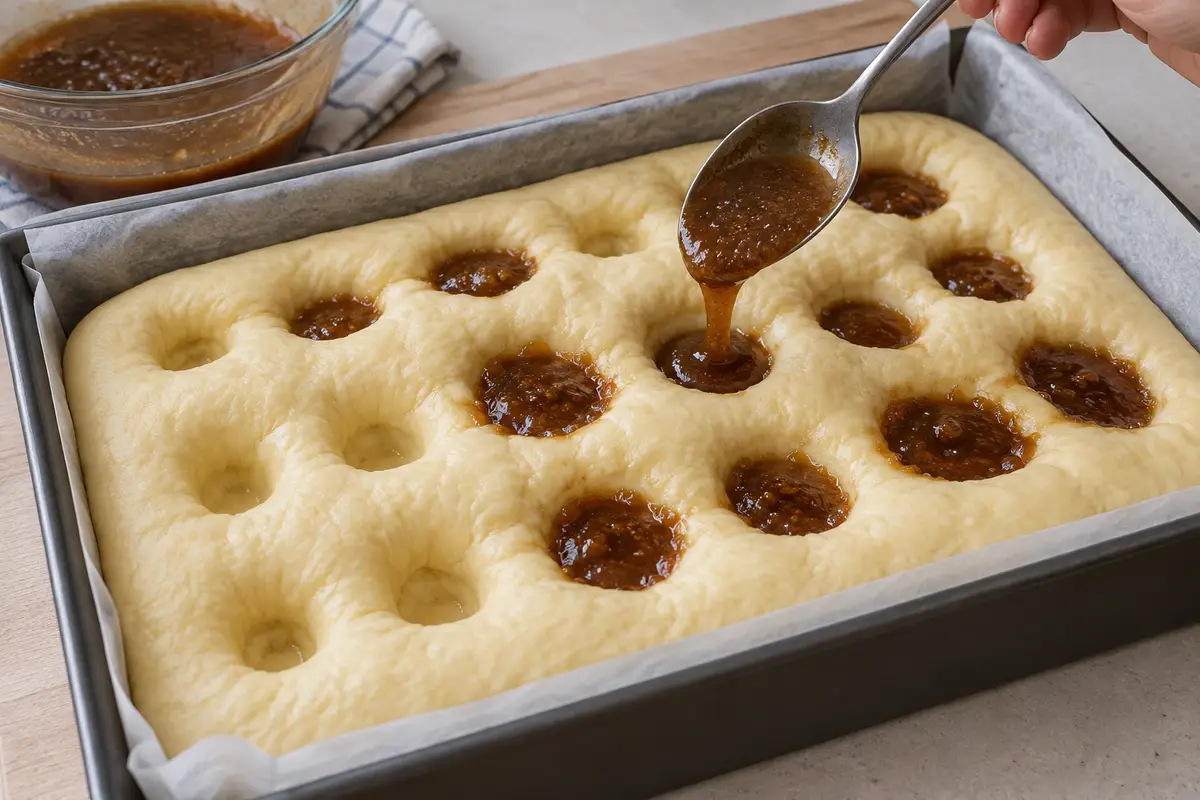
AI-generated Place the pan on the middle rack of the preheated oven and bake for about 20–25 minutes. The edges should be golden and the dough between the wells springy. A skewer inserted into the dough between the wells should come out without sticky raw dough; traces of the sugary topping are normal. Leave in the pan for about 30 minutes, until the topping stops flowing freely, then cut into 12 pieces. Serve slightly warm or after further cooling.
Estimated nutrition

Rate this recipe
0 ratings
Comments