
AI-generated
Gâteau Basque with Vanilla Pastry Cream and a Golden Fork Crosshatch
Log in or create a free account to save recipes.
Source: https://recipheon.com/en/recipes/desserts/gateau-basque-with-vanilla-pastry-cream-and-a-golden-fork-crosshatch
About this recipe
Gâteau basque is a buttery Basque cake enclosing a thick vanilla pastry cream filling. Two layers of tender pastry surround a cream cooked with milk, whole eggs, sugar and flour. Brush the top with egg and decorate it with a shallow crosshatch made with a fork. This is a pattern on a solid pastry lid, not a lattice of separate strips. Chilling the dough makes rolling easier, while completely cold cream helps seal the filling inside. After baking, wait patiently for the cake to cool completely so the cream can set and the slices hold their shape. This version contains only vanilla pastry cream, without jam and without rum. A 22 cm pan makes 10 servings. Allow about 7 hours and 30 minutes, including softening the butter, chilling the components and cooling the baked cake.
Ingredients
Butter pastry
300 g all-purpose flour for the dough
120 g unsalted butter with 82% fat for the dough; softened but not melted
200 g fine white granulated sugar for the dough
2 raw whole size M eggs for the dough, about 100 g without shells
5 g baking powder
2 g salt
5 g natural vanilla extract for the dough
Vanilla pastry cream
500 ml pasteurized milk with 3.2% fat
3 raw whole size M eggs for the cream, about 150 g without shells
125 g fine white granulated sugar for the cream
40 g all-purpose flour for the cream
10 g natural vanilla extract for the cream
For the pan, rolling and egg wash
up to 20 g all-purpose flour for dusting; use only as much as needed
5 g unsalted butter with 82% fat for greasing the pan
1 raw whole size M egg for brushing, about 50 g without the shell; discard the remainder after brushing
Steps
Take the butter for the dough and the eggs out of the refrigerator about 30 minutes before starting. The butter should yield easily when pressed but should not be runny. Beat 120 g butter with 200 g sugar and the salt just until combined. Add the 2 eggs one at a time, followed by 5 g vanilla extract. Add 300 g flour mixed with the baking powder and mix briefly into a soft, uniform dough; do not knead for long. Divide into two portions, roughly 2/3 for the base and sides and 1/3 for the lid. Flatten each separately, wrap and refrigerate for at least 90 minutes. Make the cream meanwhile.
In a bowl, thoroughly mix 3 eggs with 125 g sugar and 40 g flour without leaving lumps. Bring 500 ml milk to a boil in a saucepan. Gradually pour about half the hot milk into the eggs, whisking constantly. Pour everything back into the saucepan with the remaining milk. Cook over medium-low heat, stirring constantly across the bottom and into the corners. Once the cream is visibly bubbling, cook for about 3–4 minutes more, still stirring vigorously. It should be smooth and very thick. Remove from the heat and stir in 10 g vanilla extract.
Immediately spread the cream in a wide, shallow dish in a layer no thicker than about 2 cm. After about 10 minutes, once the heavy steaming has stopped, press plastic wrap directly onto the surface and refrigerate for about 60–90 minutes. Before filling, the cream must be completely cold and thick, not lukewarm; chill longer if needed. The cream chills while the dough rests.
Prepare a 22 cm springform pan at least 4 cm tall. Line the base with parchment paper and grease the sides with 5 g butter. Use the measured allowance of up to 20 g dusting flour sparingly. Roll the larger portion of cold dough between two sheets of parchment into a circle about 32 cm across and about 4–5 mm thick. Remove one sheet, invert the pastry over the pan and remove the second. Gently line the base and sides, making a pastry rim about 3.5 cm tall. Press any small cracks together with your fingers. Trim the dough extending above that rim and add the trimmings to the dough for the lid. If the pastry gets too soft, chill it for a few minutes before continuing.
Briefly stir the cold cream with a spoon until smooth and transfer all of it to the pastry base. Level it; the filling should end at least 1 cm below the top edge of the pastry, leaving a clean strip for sealing. Roll the smaller portion of dough together with the trimmings into a circle about 24 cm across and about 4–5 mm thick. Lay it over the cream and carefully join it to the pastry at the sides, pressing all around with your fingers without leaving gaps. Trim the excess at the outside edge of the pan. Set unused trimmings and leftover dusting flour aside, outside this recipe; do not push them into the filling.
Refrigerate the sealed cake in its pan for about 20 minutes so the pastry firms up again. Meanwhile, preheat the oven to 160°C on the conventional (no-fan) setting. Position a rack in the middle of the oven.
Beat the remaining 1 egg intended for brushing. Brush only enough over the cold lid to make a thin, even coating; discard the remainder. Lightly draw parallel lines with the tines of a fork, then draw a second set diagonally across them to make a crosshatch. Do not pierce the lid through to the cream. This is a shallow pattern on a solid pastry sheet, without adding separate strips.
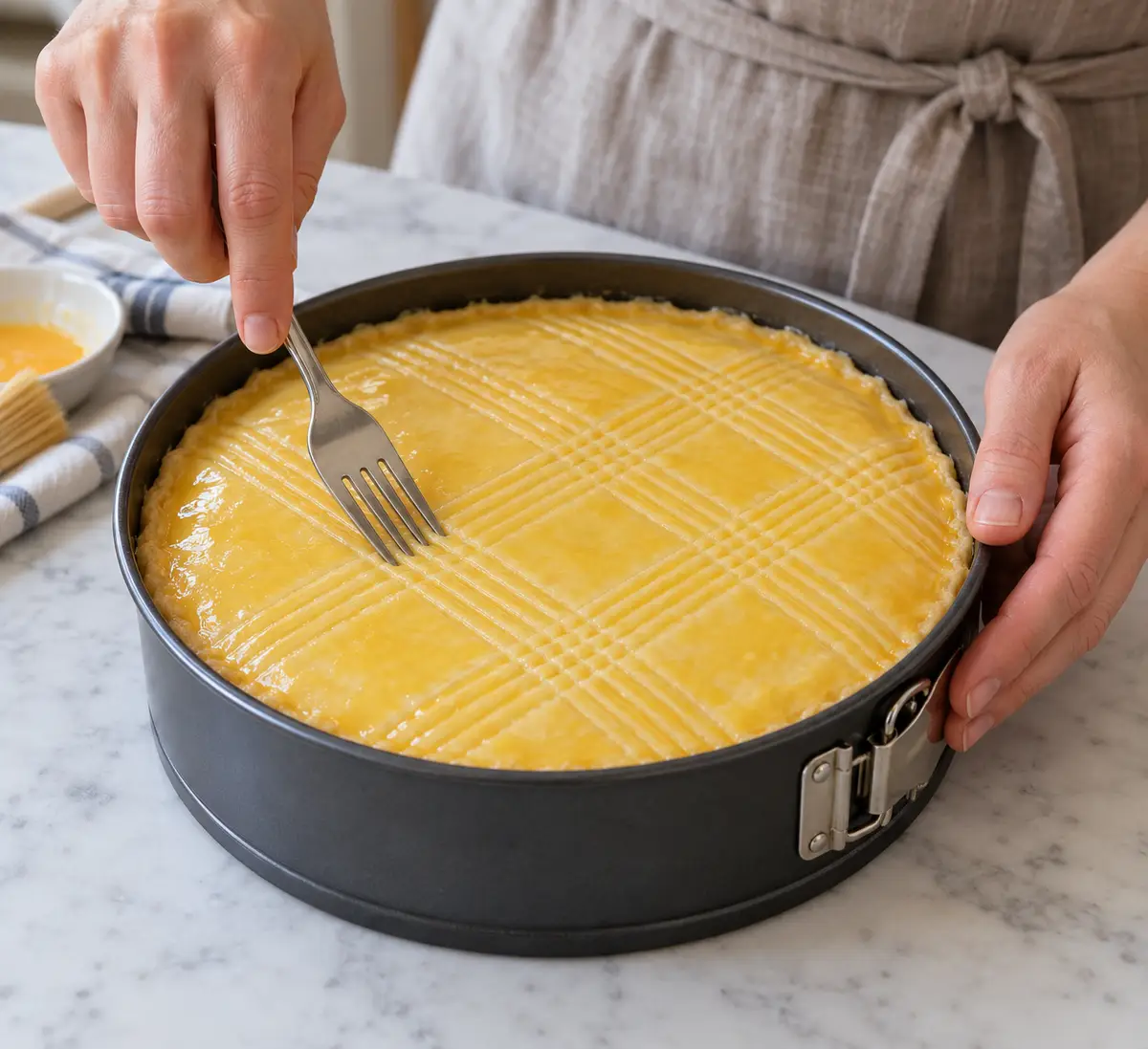
AI-generated Place the pan on the middle rack of the preheated oven. Bake at 160°C for about 45–55 minutes, until the top is evenly golden brown, the pastry at the edge is baked and the center stays stable when you gently move the pan. If the top browns too quickly, loosely cover it with aluminum foil toward the end. If the pastry at the edge is still noticeably soft and raw, bake for a few more minutes. Do not judge doneness by the color of the egg glaze alone.
After removing the cake from the oven, set the pan on a wire rack and cool for about 90 minutes. Then refrigerate the cake, still in its pan, for at least 90 minutes, until completely chilled and the cream has set. Do not leave the cream-filled cake at room temperature for longer than 2 hours. Do not open the hot pan and do not cut the cake while warm. If the center is still warm after this time, chill longer in the refrigerator. Only once completely chilled, remove the springform ring and cut into 10 servings. Store the cream-filled cake covered in the refrigerator.
Estimated nutrition

Rate this recipe
0 ratings
Comments