
AI-generated
Kvæfjordkake — Norwegian cake with meringue, almonds and vanilla cream
Log in or create a free account to save recipes.
Source: https://recipheon.com/en/recipes/desserts/kvaefjordkake-norwegian-cake-with-meringue-almonds-and-vanilla-cream
About this recipe
Kvæfjordkake, also known as verdens beste (‘the world’s finest’), combines thin butter cake, delicate meringue, sliced almonds and cool vanilla cream. Its striking structure is made without baking several separate layers: spread the butter batter in one rectangular pan, cover with freshly whipped meringue, scatter over the weighed almonds and bake together. Once completely cold, cut the sheet into two equal halves. In this home version, both sit meringue-side up, leaving a delicate almond meringue layer inside that gradually softens against the cream. Make the filling from scratch with cooked yolk custard and whipped cream. Both must be well chilled before combining; warm custard would melt the fluffy cream. The assembled cake rests in the refrigerator, making it easier to cut into sixteen servings. Its top stays slightly uneven, golden and almond-covered. It needs no icing, fruit or extra sprinkles.
Ingredients
Thin butter cake base
100 g softened unsalted butter with 82% fat
100 g fine white sugar
72 g raw egg yolks, weighed without whites, about 4 yolks
150 g all-purpose flour, type 550
6 g baking powder
1 g fine salt
60 g milk with 3.2% fat, weighed for the cake
Meringue and all the almonds
120 g raw egg whites, weighed without yolks
180 g fine white sugar
60 g unsweetened blanched sliced almonds
All the homemade vanilla cream
350 g milk with 3.2% fat, weighed for the custard
54 g raw egg yolks, weighed without whites, about 3 yolks
70 g fine white sugar
8 g sugar with real ground vanilla
30 g cornstarch, not corn flour
250 g well-chilled heavy whipping cream with 36% fat, weighed
Steps
Make the custard first. From the 350 g milk for the custard, pour off and weigh 50 g separately, then heat the remaining 300 g in a saucepan almost to a boil. In a bowl, mix the 54 g yolks with 70 g sugar, vanilla sugar, starch and the reserved 50 g milk until smooth, without dry lumps. The yolk and white weights are net; unused egg parts are not included in this recipe.
Pour the hot milk into the yolks in a thin stream, whisking constantly. Return everything to the saucepan. Heat over low or medium heat, stirring along the bottom and sides continuously, until clearly thickened. Once gently bubbling, cook for about another 1 minute, stirring vigorously. Remove from the heat. It should be a smooth thick custard, without raw starch, egg lumps or a scorched bottom.
Scrape all the custard into a wide shallow dish and cover with plastic food wrap directly on the surface. After about 15–20 minutes, once it stops steaming heavily, refrigerate for at least 2 hours, until completely cold in the center too. Do not leave it cooling on the counter for hours. Keep the cream refrigerated; do not add it to the custard yet.
Preheat the oven to 175°C, conventional heat. Line the bottom and sides of a metal pan with inside dimensions of 30 × 40 cm and a rim at least 3 cm high with parchment. Do not grease with butter and do not dust with flour. Position the rack slightly below the center. The cake butter, yolks and milk should be at room temperature. Keep the meringue whites in a clean bowl without traces of yolk or fat.
Beat the 100 g softened butter with 100 g sugar for about 4–5 minutes until pale and fluffy. Add the 72 g yolks in several additions, mixing briefly after each. Mix the flour with baking powder and salt. Add it alternately with the 60 g milk, mixing on low speed or with a spatula just until combined. This makes fairly thick spreadable batter, not a liquid sponge batter.
Transfer all the batter to the parchment and spread with a wide spatula over the entire 30 × 40 cm bottom, including the corners. Scrape the bowl and smooth a thin layer with no gaps; this deliberately shallow base will make two tiers when assembled. Do not add flour, milk or fat. Do not put the pan in the oven yet: the cake will bake together with the meringue.
In a clean dry bowl, beat the 120 g whites until finely foamy with soft peaks. Gradually add the 180 g sugar a spoonful at a time, continuing to beat. Once all is added, beat for a few more minutes until thick and glossy, holding a distinct peak on the beater. A little rubbed between your fingers should not have noticeable sugar crystals. Stop when stable; do not beat into dry, lumpy foam.
Immediately place all the meringue in small portions over the raw batter. Gently join them with a spatula into an even layer with shallow waves, without very tall peaks. Scatter all 60 g sliced almonds evenly, including on the half that will go underneath during assembly. Do not reserve almonds for later decoration and do not press them hard into the meringue.
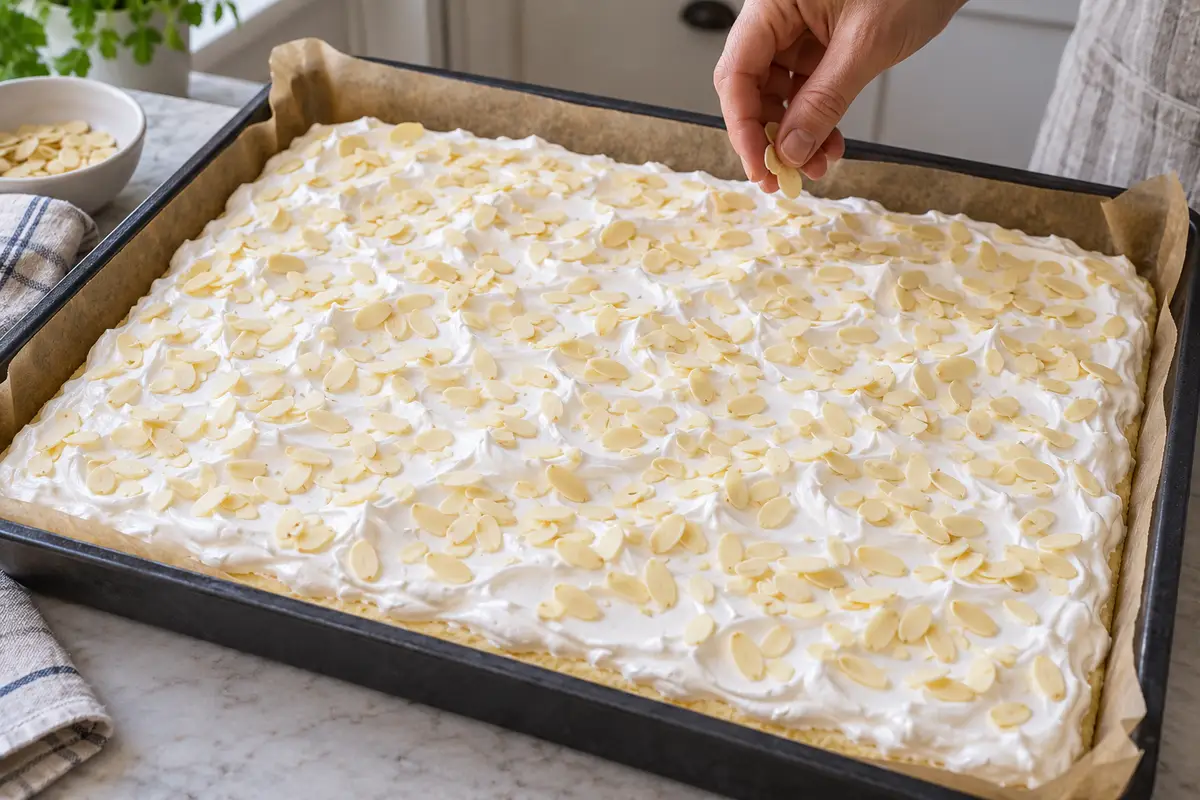
AI-generated Bake at 175°C for about 30–35 minutes, until the meringue is pale golden and dry on top, almonds lightly browned and cake baked at the edge. A skewer inserted near the edge through the meringue into the base should not bring out raw batter. Do not dry the meringue like a separate pavlova: it stays delicate beneath its crust. Remove the pan to a rack and leave until completely cold, about 1 hour. Do not spread cream on a warm sheet.
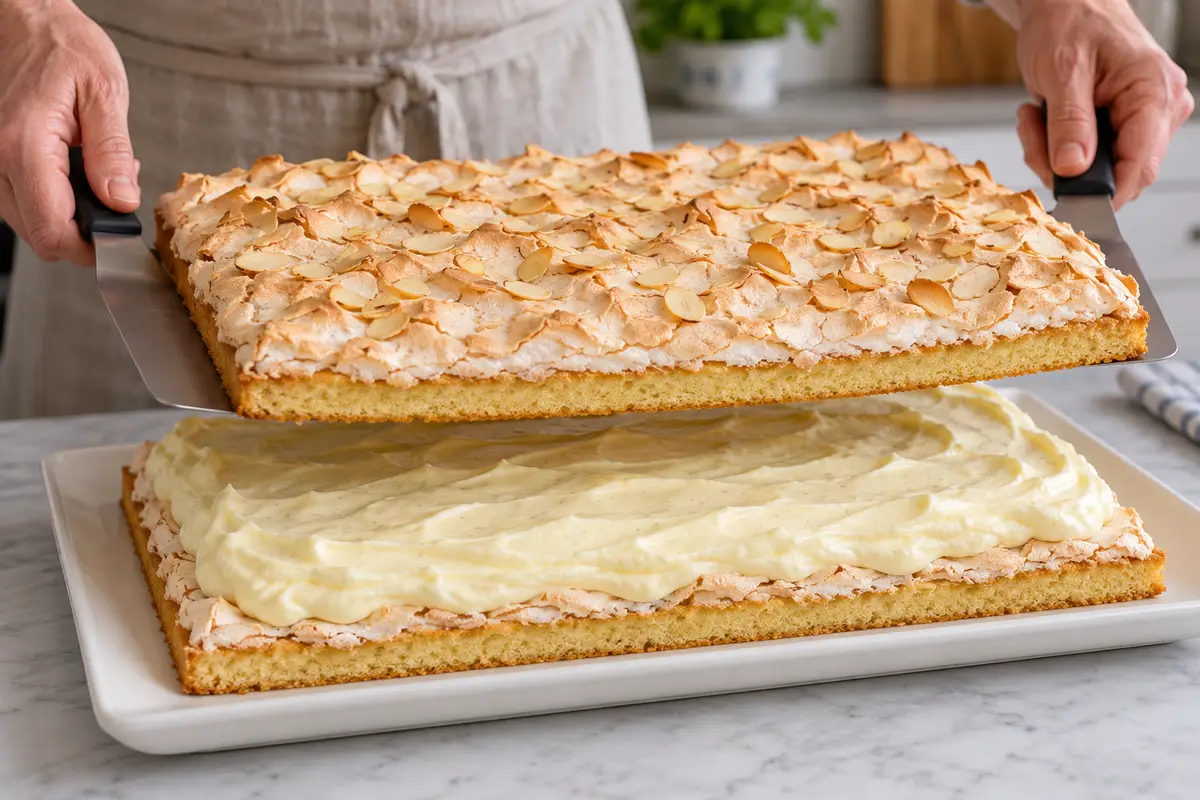
Cut the cold sheet through both layers into two 20 × 30 cm rectangles, halving the 40 cm side. Cut the parchment at the same place. Loosen the base from the paper with a thin spatula. Supporting with wide spatulas, transfer the first half to a flat platter and slide the parchment out from underneath. The almond meringue stays ON TOP. Keep the other half facing the same way; do not turn either over onto its meringue.
Briefly whisk the cold vanilla custard just until smooth. In another cold bowl, whip all 250 g chilled cream to distinct peaks that hold their shape; stop before it turns grainy. Fold about a third of the whipped cream into the custard with a spatula, then gently fold in the rest. Do not mix the finished filling for long. Both components must be cold; do not thin with milk and do not add sugar or gelatin.
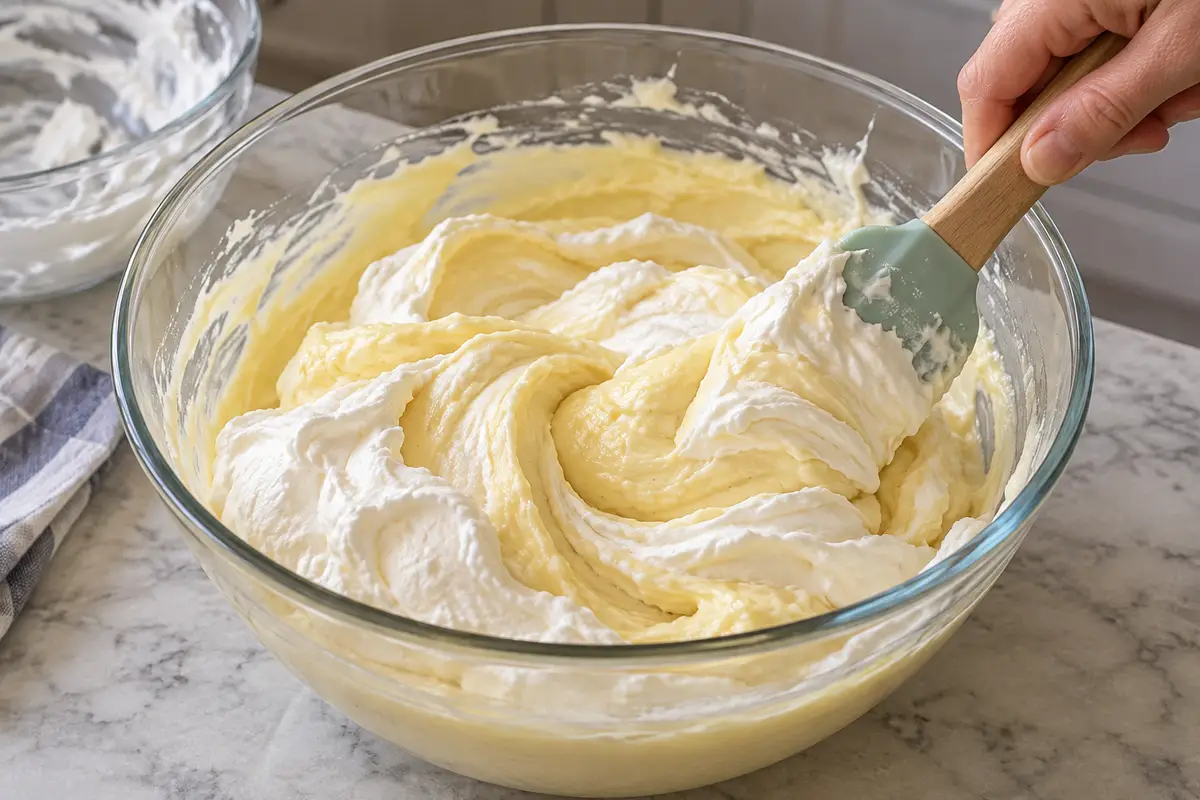
AI-generated Spread all the vanilla cream filling over the first half, which rests cake-side down on the platter and meringue-side up. Scrape both bowls and make an even layer, leaving about 1 cm around the edges. Do not put the filling underneath the cake and do not reserve any for decorating the sides or plate. The filling sits on the lower meringue and almonds, which will soften slightly over time.
Support the second half with two wide spatulas, loosening and sliding out its parchment. Carefully lower it onto the filling with the butter cake base down and almond meringue up. Both meringues therefore face the same way. Align the edges without pressing hard. Refrigerate for at least 2 hours; leave the top meringue uncovered or under a tall cover that does not touch it. Do not cover the surface with plastic wrap.
AI-generated Cut the chilled cake into 16 servings in a 4 × 4 grid. With a sharp serrated knife, gently cut through the meringue first, then the cake and filling, without crushing the whole. Serve every edge; do not trim anything. No extra almonds, powdered sugar, fruit or cream. Best on the day assembled; refrigerate for up to 2 days, covered without touching the meringue. Meringue next to the cream naturally softens over time.
Estimated nutrition

Rate this recipe
0 ratings
Comments