
AI-generated
Matured Traditional Polish Gingerbread with Plum Butter and Chocolate Glaze
Log in or create a free account to save recipes.
Source: https://recipheon.com/en/recipes/desserts/matured-traditional-polish-gingerbread-with-plum-butter-and-chocolate-glaze
About this recipe
Traditional Polish gingerbread matures as raw dough before baking into three spiced layers filled with plum butter. Buckwheat honey and a blend made only from spices give it a distinct aroma, while thick plum butter forms two filling layers. The dough matures for 21 days in a refrigerator maintained at 2–4°C. The sheets are baked one at a time in a single oven and filled only after cooling completely. Once assembled, the gingerbread rests for another 48 hours in the refrigerator before receiving a dark chocolate glaze. A thin coating covers the top and sides; once it sets, the cake can be cut into rectangular portions with visible layers.
Ingredients
For the Dough and Finish
900 g dry wheat flour (type 500), for the dough
450 g liquid natural buckwheat honey for the dough
250 g white sugar for the dough
250 g butter (82% fat), divided: 200 g for the dough and 50 g for the glaze
3 fresh eggs (size M), used whole without shells, for the dough
120 ml fresh milk (3.2% fat), for the dough
10 g baking soda for the dough
30 g dry ground gingerbread spice blend made only from spices, without sugar, flour or cocoa
2 g fine salt for the dough
600 g ready-to-use thick plum butter with no added sugar, divided: 300 g for each of the two filling layers
200 g dark chocolate (70% cocoa), for the glaze
Steps
Combine the honey, sugar and 200 g butter for the dough in a pot holding about 2 l. Heat over low heat for about 6–8 minutes, stirring, until the butter melts and the mixture is uniform with no lumps of sugar; do not let it boil. Pour into a wide heatproof bowl and let cool for about 45 minutes, stirring occasionally. Before adding the eggs, the mixture must be no warmer than lukewarm, not hot.
In a separate bowl, mix all the flour with the salt and the gingerbread spice blend made only from spices, without sugar, flour or cocoa. Use fresh eggs and milk: beat the 3 eggs, then stir the baking soda very thoroughly into 120 ml milk, pressing out every lump. Stir the eggs into the lukewarm honey mixture, stir the milk and baking soda again and add it, then gradually mix in all the flour and spice mixture. Work with a sturdy spoon, then knead by hand for about 5–10 minutes until the dough is uniform, soft and sticky; distribute the baking soda evenly, do not add more flour and do not taste the raw dough.
Put all the dough in a clean food container holding about 4 l and close it with a tightly sealing lid. Immediately refrigerate at a maintained 2–4°C and note the preparation date. Leave for a full 21 days, counted from when the dough enters the refrigerator; keep it covered under these conditions throughout, with no breaks in refrigeration. Do not use a cellar or room temperature in place of the refrigerator, and do not taste the raw dough.
After 21 days, divide the cold dough into 3 equal parts. Cover two and return them to the refrigerator immediately; leave the first covered for about 20–30 minutes so it can be rolled. Prepare one flat metal baking sheet with a usable inner area of at least 30 × 40 cm, parchment paper, a rolling pin and a flat, rigid board for supporting each sheet of cake fully. Preheat a conventional oven (no fan) to 170°C and use the middle rack; the three sheets will bake one at a time.
Roll the first portion between two sheets of parchment paper into a rectangle about 25 × 35 cm and about 7–8 mm thick, evening the edges with your hand. Do not dust with flour, and do not grease the paper. Remove the top sheet of paper, leaving the dough on the bottom sheet, and transfer both to the prepared baking sheet. Shape each remaining portion the same way later, just before baking it.
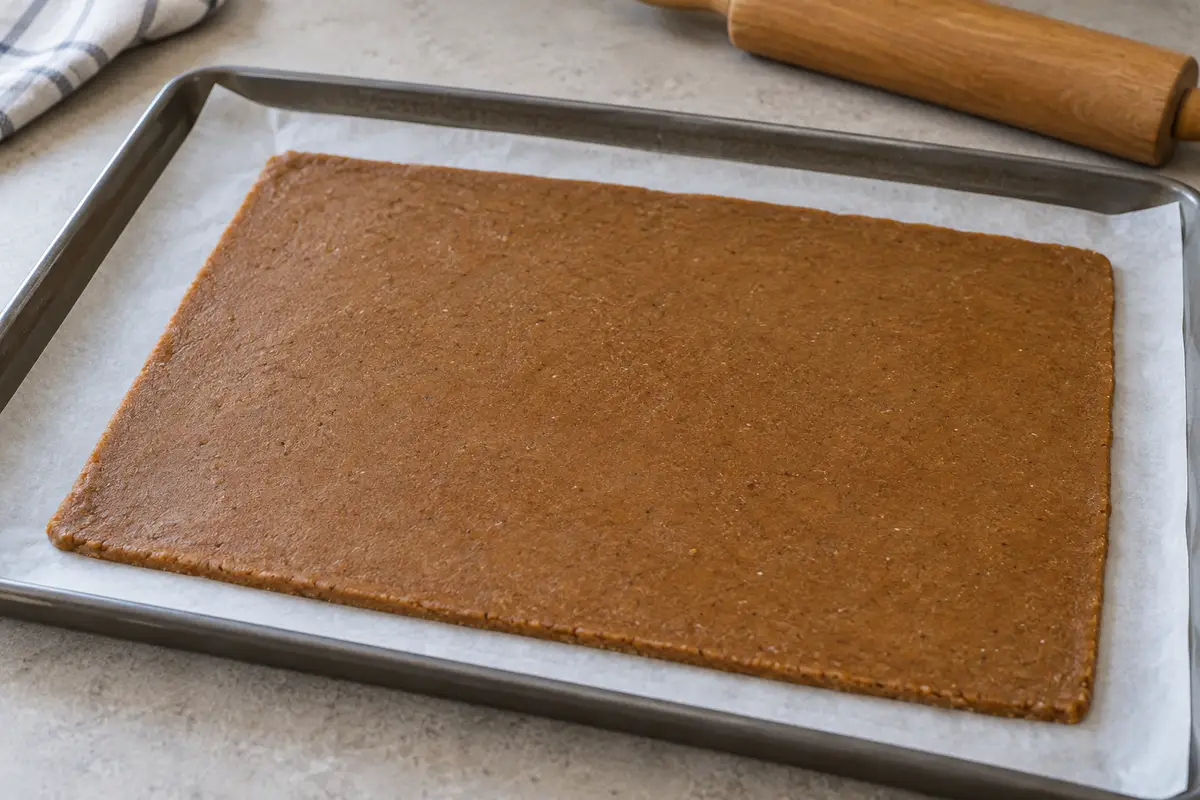
AI-generated Bake the first sheet in the preheated oven on the middle rack for 20–25 minutes; once it is in the oven, take only the second portion of dough out of the refrigerator for about 20–30 minutes. Near the end of baking, the surface should be brown, the center slightly springy when gently pressed, and a skewer inserted into the center must not come out coated with raw, sticky dough; a few moist crumbs are fine. If the center is still underbaked, bake for about 5 minutes at a time and check again, loosely covering the top with foil if it is browning strongly. After removing it from the oven, leave the sheet on the baking sheet for 10 minutes, then lift the edges of the parchment, slide the rigid board under the entire base and transfer the cake with its paper to a wire rack. Leave the empty baking sheet for about 10–15 minutes until it is no longer hot; roll the second portion while it cools.
Shape the second rectangle as in step 5, transfer it with its parchment to the cooled baking sheet and bake at 170°C on the conventional setting for 20–25 minutes, using the same doneness cues and extending the baking if needed. During the second bake, take the third portion out of the refrigerator for about 20–30 minutes; after removing the second sheet from the oven, wait 10 minutes before transferring it with full support, then cool the empty baking sheet again for about 10–15 minutes. Roll and bake the third sheet the same way, separately for 20–25 minutes; do not put several sheets in the oven at once. Leave all three on wire racks to cool completely, allowing the last about 60 minutes from removal from the oven before filling; warm sheets are not yet ready to assemble.
Stir the plum butter with no added sugar with a spoon; assemble the entire gingerbread on a flat, rigid base that fits in the refrigerator. Carefully remove the paper from the first cold sheet, supporting its entire base with the board, and spread 300 g plum butter over it in a thin, even layer. Remove the paper from the second sheet the same way, place it on the filling and spread with the remaining 300 g plum butter. Remove the paper from the third sheet with full support and place it on the second filling layer; there will be three sheets and exactly two layers of plum butter, with no plum butter on top.
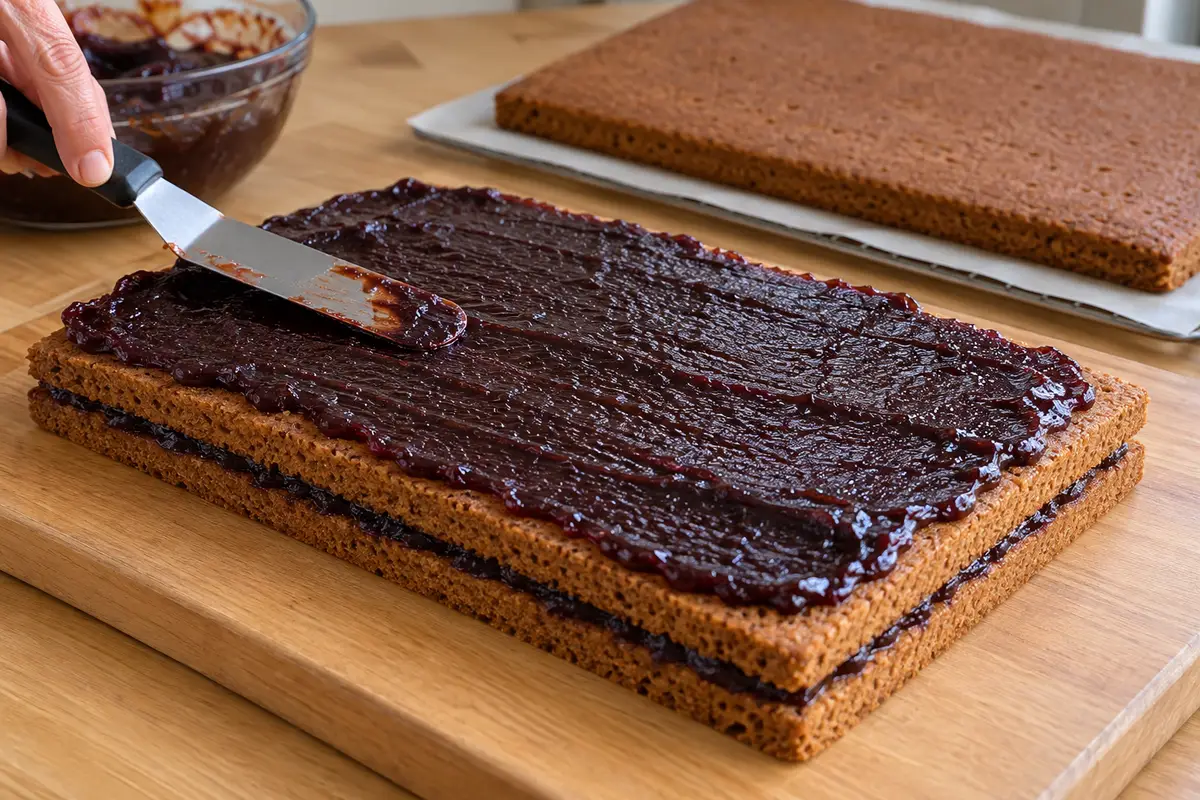
AI-generated Wrap the assembled gingerbread in parchment paper and put it on its rigid base in a tightly closing container with inner dimensions of at least 30 × 40 × 10 cm. Place a light, flat board on the wrapped cake so the layers sit gently against one another; do not press hard. Close the container and immediately refrigerate at a maintained 2–4°C for a full 48 hours. This rest comes after baking and filling, separately from the earlier 21 days of raw dough maturation.
After 48 hours, remove the board and parchment from the gingerbread, leaving the cake on its rigid base. Break the chocolate into small pieces and cut the remaining 50 g butter into cubes. In a small saucepan, melt the butter over very low heat, add the chocolate and stir for about 3–5 minutes, removing the pan from the heat when most of the pieces have melted. Keep stirring off the heat until the glaze is smooth and fluid; do not boil it, and do not add water.
Immediately spread the warm, but not hot, glaze over the top and all sides of the cold gingerbread with a spatula. Coat the cake with a thin, even layer of glaze. Transfer the cake on its base to a clean container with a tall lid that does not touch the glaze and refrigerate for at least 2 hours, until the glaze is set and does not smear when cut. Do not count this time as part of the earlier 48-hour rest.
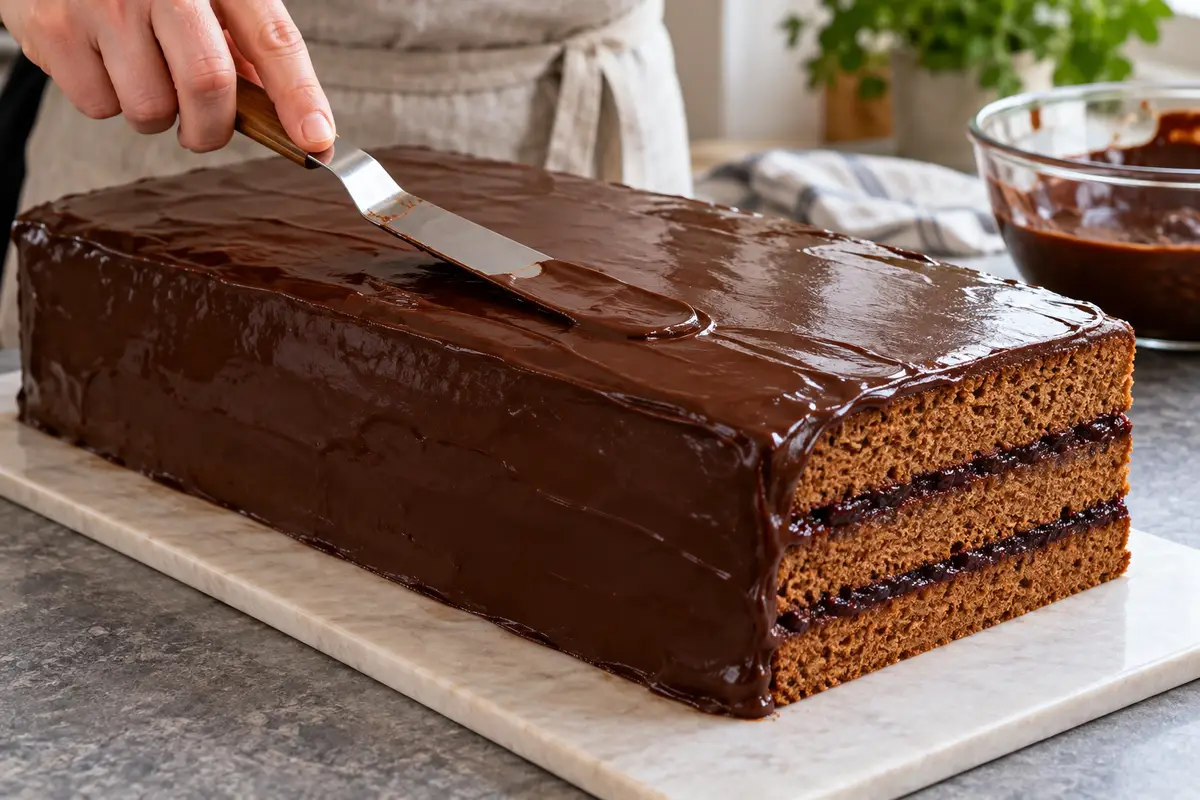
AI-generated Once the glaze has set, cut the gingerbread with a sharp knife into 24 rectangular portions in a 4 × 6 grid, wiping the blade between cuts. Each piece should show three spiced sheets and two thin layers of plum butter, with chocolate glaze on top. Serve; cover the remaining gingerbread and return it to the refrigerator immediately.
Estimated nutrition

Rate this recipe
0 ratings
Comments