
AI-generated
Poppy Seed Rolls with Homemade Filling and Icing
Log in or create a free account to save recipes.
Source: https://recipheon.com/en/recipes/desserts/poppy-seed-rolls-with-homemade-filling-and-icing
About this recipe
Poppy seed rolls have tender yeast dough, a spiral of homemade poppy seed filling and a thin layer of lemon icing. Whole dry poppy seeds must first be cooked, thoroughly drained and ground several times so the filling is soft and fine. The filling with raisins and walnuts must thicken and cool completely before the whipped egg whites are folded in. Preparing and cooling it fits into the dough's first rise. Compact rolling, closed ends and a second rise in loose parchment paper help keep the spiral even without tearing the dough. This recipe makes two loaves about 30 cm long, with ten servings each; ice them only after they have cooled completely.
Ingredients
Dough and Shared Ingredients
500 g all-purpose flour, dry weight: 480 g for the dough and 20 g for dusting the work surface; unused flour left on the work surface is not served
240 ml milk with 3.2% fat, for the dough
3 size M (medium) eggs, about 150 g without shells: all 3 yolks, about 54 g, for the dough and all 3 whites, about 96 g, for the poppy seed filling
100 g butter with 82% fat: 80 g for the dough and 20 g for the poppy seed filling
210 g white sugar: 60 g for the dough and 150 g for the poppy seed filling
16 g sugar with real vanilla, made from sugar and ground vanilla bean: 8 g for the dough and 8 g for the poppy seed filling
7 g instant dry yeast, for the dough
4 g fine salt, for the dough
Poppy Seed Filling and Icing
300 g whole dry blue culinary poppy seeds, not ground, weight before cooking
60 g dried raisins, weight before soaking in water
60 g shelled walnuts, edible weight without shells
1.5 l water: 1.2 l for cooking the poppy seeds and 300 ml for soaking the raisins; liquid drained from the poppy seeds and raisins is not served
150 g powdered sugar, for the icing
30 ml freshly squeezed lemon juice, without seeds, for the icing
Steps
Have ready a pot with a capacity of at least 3 l, a fine-mesh sieve lined with clean, densely woven cotton cloth, a grinder with a fine plate with holes about 2–3 mm across, and a baking sheet at least 40 × 35 cm. Put 300 g whole dry poppy seeds in the pot, add 1.2 l water and bring to a boil over medium heat, allowing about 10 minutes. Reduce the heat and simmer gently for about 25–30 minutes with the lid slightly ajar, stirring occasionally. The seeds should swell and soften; do not let the pot boil dry.
Pour the cooked poppy seeds into the cloth-lined sieve and let drain for about 20 minutes, then gather the edges of the cloth and gently press the seeds until they stop dripping. Keep all the poppy seeds and leave the drained liquid out of the recipe; thorough draining prevents a wet filling. At the same time, pour the remaining 300 ml hot water over 60 g raisins, leave for about 15 minutes, then drain and pat dry with paper towels; discard the soaking water. While the poppy seeds drain and the raisins soak, prepare the dough as described in the next step so these waits do not add separate time to the recipe.
Separate all 3 egg yolks from the whites; cover the whites and refrigerate until the cooled filling is ready. Melt 80 g butter over low heat and warm 240 ml milk until just warm, about 35°C; let the butter cool as well so it is not hot. In a large bowl, mix 480 g flour, 7 g instant yeast, 60 g sugar, 8 g vanilla sugar and 4 g salt, add all the milk and all 3 yolks, then begin kneading and gradually work in the melted butter. Knead for about 10–15 minutes, until the dough is smooth, soft and elastic and pulls away from the bowl; do not add the flour reserved for rolling, and allow about 20 minutes for this entire stage.
Cover the bowl and leave the dough in a warm place, about 25°C, for 60–90 minutes, until it has visibly risen to roughly twice its volume. During this time, grind, thicken and completely cool the poppy seed filling as described in the next two steps, then add the egg whites. The filling cools during this rise; start rolling only when the dough has risen and all the filling is cool.
Pass all the thoroughly drained poppy seeds through the grinder three times, using the fine plate with holes about 2–3 mm across, until the seeds form a soft, finely ground mixture. Chop 60 g walnuts into pieces about 3–5 mm across, then melt the remaining 20 g butter over low heat in a wide saucepan with a capacity of at least 2 l. Add the ground poppy seeds, 150 g sugar and the remaining 8 g vanilla sugar, and cook for about 8–10 minutes, stirring frequently, until there is no free liquid and a spatula drawn through the mixture leaves a clear trail. Stir in all the drained raisins and chopped walnuts and remove the pan from the heat; the filling should be thick but not scorched.
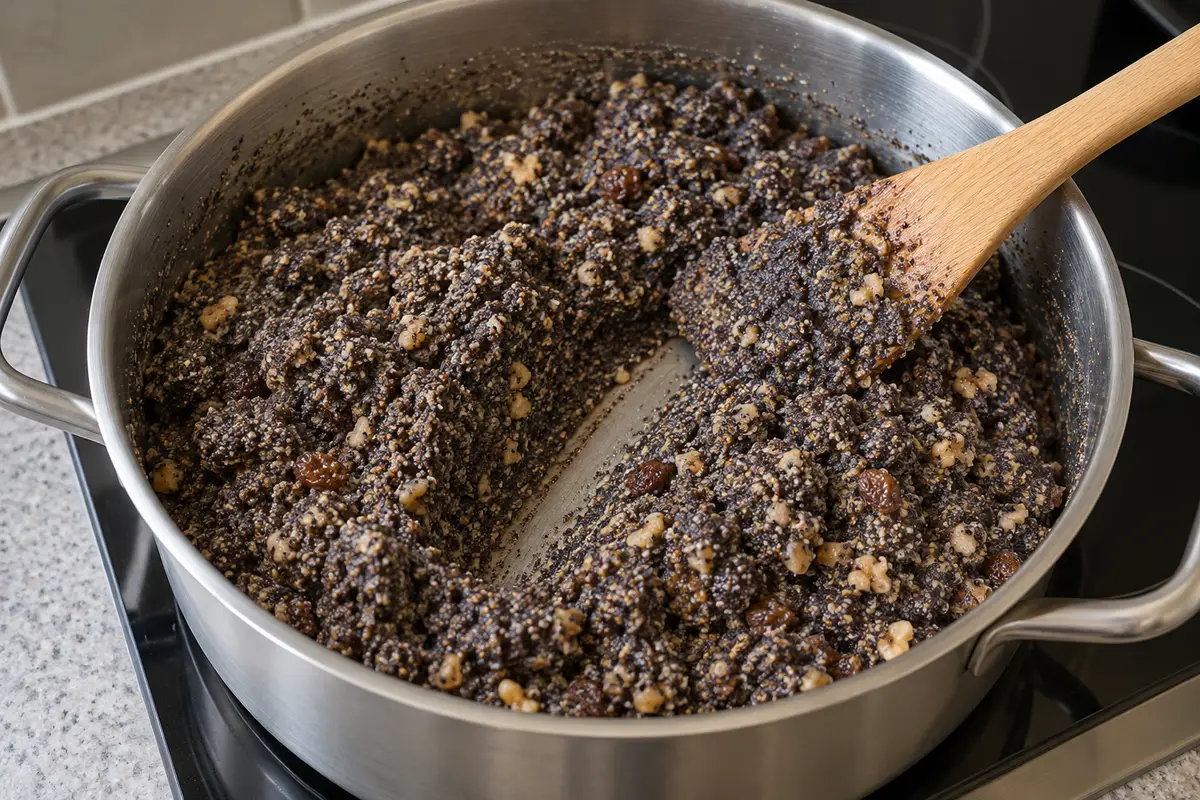
AI-generated Spread the filling in a wide, shallow dish in a layer no thicker than 2 cm and let cool for about 35–45 minutes, stirring twice, until completely cool with no warmth remaining. This happens during the dough's first rise; if the filling is still warm, wait before adding the whites and rolling. Take all 3 reserved egg whites out of the refrigerator and beat in a clean, dry bowl for about 3–5 minutes until stiff peaks form, then gently fold them into all the cooled filling with a spatula. The finished filling should stay thick, spread in an even layer and release no liquid; use all of it in the two rolls.
Gently deflate the risen dough by kneading it briefly, then divide into two equal portions. Weigh out the remaining 20 g flour for dusting and allow 10 g for rolling each portion; sprinkle it thinly over the work surface and rolling pin without adding any other flour. Roll each portion into a rectangle about 34 × 26 cm and about 4–5 mm thick, with a long side facing you. Brush excess loose flour off the dough and discard any flour left on the work surface when you finish; it is not part of the served poppy seed rolls.
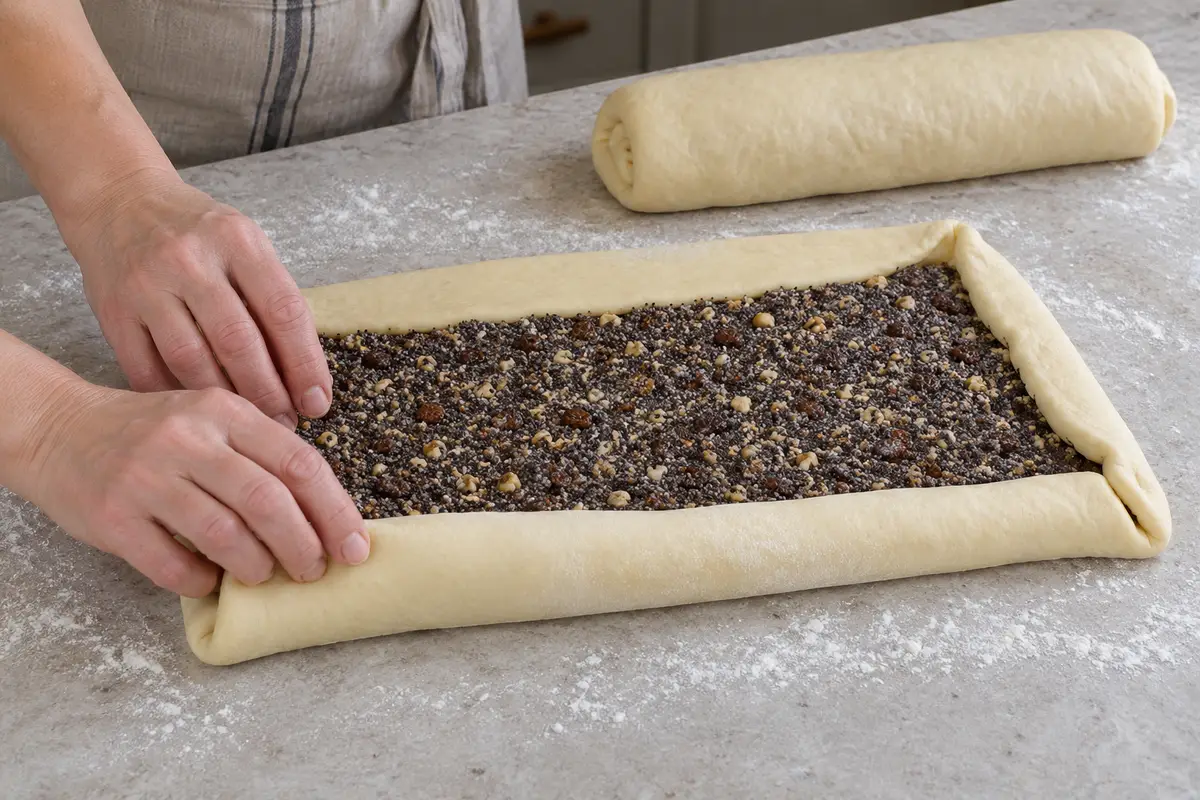
Divide all the filling into two equal portions and spread one evenly over each rectangle, leaving about 2 cm of bare dough along both short sides and about 3 cm along the far long edge. Fold both short sides inward over the filling to close the ends, then roll from the near long edge into a compact log without squeezing out the filling or stretching the dough until it tears. Brush flour off the bare edge, seal it by pressing gently against the roll, and place seam-side down. Make two closed loaves about 30 cm long in this way, with the filling evenly distributed in a spiral.
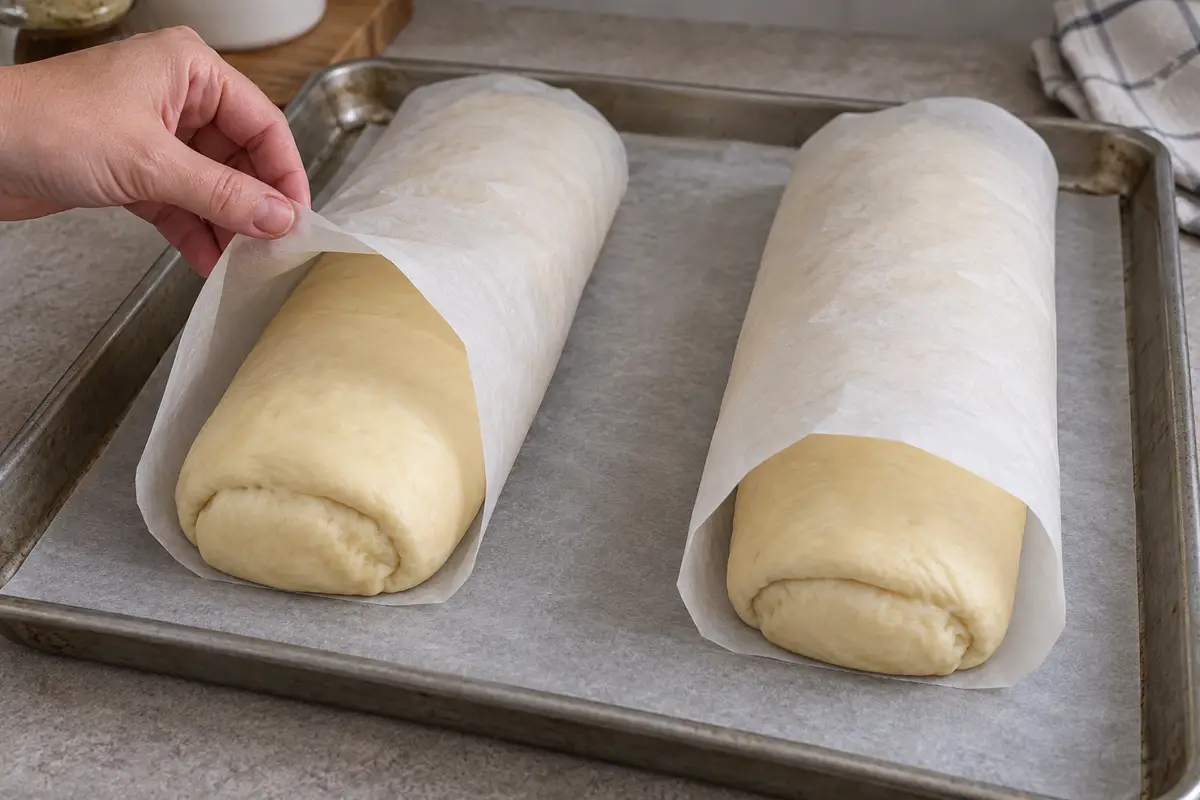
AI-generated Prepare two sheets of parchment paper, each about 45 × 40 cm, and loosely wrap each roll with the paper overlap underneath and the ends open. Leave about 1.5–2 cm of space between the top of the raw loaf and the paper so it can expand during rising and baking; do not tighten the paper and do not twist the ends closed. Place both rolls seam-side down on a baking sheet at least 40 × 35 cm, about 8 cm apart, cover loosely with a clean cloth and leave in a warm place for about 30–40 minutes, until the dough visible at the open ends is noticeably puffy. During the last approximately 15 minutes of rising, preheat a conventional oven (no fan) to 180°C and remove the cloth before putting the baking sheet in the oven; preheating overlaps this second rise.
AI-generated Place the baking sheet on the middle rack of the preheated oven and bake both rolls together for about 40–45 minutes at 180°C on the conventional setting. Keep the loose, open-ended parchment sleeves on throughout baking and do not open the oven for the first approximately 30 minutes so the dough has time to set its shape. Toward the end, the dough visible at the ends should be golden and springy, and a wooden skewer inserted into the dough layer near the end of a loaf must have no raw dough stuck to it; moist poppy seed flecks do not mean the yeast dough layer is raw. Remove the baking sheet when these signs are met, keeping the paper on for the first cooling stage.
Leave the poppy seed rolls on the baking sheet for about 15 minutes, then carefully unwrap the paper and transfer both loaves to a wire rack to cool without a cover for another 90–120 minutes, until even the centers are completely cool. Only then mix 150 g powdered sugar with all 30 ml lemon juice into a smooth icing, thick but able to run off a spoon. Spread all the icing in an even, thin layer over the tops of both rolls, dividing it equally between them, and leave without a cover for about 20–30 minutes until the surface is no longer sticky. Cooling completely before icing and slicing keeps the filling firm and the spiral clearly defined in each slice.
After the icing has set, cut each approximately 30 cm loaf into ten equal slices, using a sharp knife with a gentle sawing motion and wiping it between cuts. You will have twenty servings in total, each one slice with a visible spiral of dough and poppy seed filling; serve without any additional decoration.
Estimated nutrition

Rate this recipe
0 ratings
Comments