
AI-generated
Spandauer — Danish pastries with vanilla custard and icing
Log in or create a free account to save recipes.
Source: https://recipheon.com/en/recipes/desserts/spandauer-danish-pastries-with-vanilla-custard-and-icing
About this recipe
Spandauer are Danish pastries made with laminated yeast dough, vanilla custard and white icing. Roll and fold the butter-filled dough three times, chilling it after each turn to keep the fat in separate layers. The dough needs to be cold and the butter pliable: butter that is too soft will blend into the dough instead of forming flaky layers. Make the custard with milk, egg yolks and starch, and add it only after the pastries have risen. The recipe makes 16 pastries from 10 cm squares. Allow about 6–7 hours, including chilling, proofing, baking two batches and cooling before icing. Plan for an unhurried afternoon; the refrigerator rests are part of the process.
Ingredients
Dough and butter for laminating
330 g type 550 wheat flour: 300 g for the dough and up to 30 g for dusting; use only as much as needed, brush off excess before folding and discard it
150 ml cold whole milk (3.2% fat) for the dough
15 g fresh yeast
30 g superfine sugar for the dough
1 whole medium egg, size M, cold, for the dough
5 g salt
200 g unsalted butter (82% fat) for laminating the dough
Vanilla custard
250 ml whole milk (3.2% fat) for the custard
2 medium egg yolks, size M, for the custard; the whites from these eggs are not used in the recipe
45 g superfine sugar for the custard
20 g cornstarch
5 g natural vanilla extract
Egg wash and icing
1 whole medium egg, size M, for brushing the pastries; beat, apply a thin layer and discard any unused egg
80 g powdered sugar for the icing
15 ml water for the icing
Steps
Dissolve the yeast in 150 ml cold milk. Add 30 g sugar, the cold whole egg, 300 g flour and the salt. Knead for about 3–4 minutes, just until the dough is smooth and fairly firm; do not warm it with prolonged kneading. Flatten into a small rectangle, cover and refrigerate for 30 minutes. Reserve the remaining 30 g flour exclusively for lightly dusting the work surface when rolling.
During the first dough chilling period, whisk the 2 egg yolks with 45 g sugar, the cornstarch and 50 ml milk taken from the custard allocation. Heat the remaining 200 ml milk until almost boiling. Pour the hot milk into the yolks in a thin stream, whisking constantly, then return everything to the saucepan. Cook over medium heat, whisking vigorously, including across the bottom. Once the custard thickens and starts to bubble, cook for about 1 minute more. Take off the heat, stir in all the vanilla extract and immediately transfer the custard to a shallow dish. Cover with plastic wrap touching the surface and refrigerate until completely cold, about 60–90 minutes; this overlaps with rolling and chilling the dough. Keep the custard refrigerated until filling the pastries.
Pound the cold butter with a rolling pin between sheets of parchment paper into an even square about 15 × 15 cm. It should remain cool but bend without cracking and without a greasy, soft surface. Roll the chilled dough on a lightly floured work surface into a rectangle about 16 × 32 cm. Place the butter on one half, leaving a narrow border of dough. Fold the other half over it and firmly seal the edges to enclose all the butter. The package will be about 16 × 16 cm. The three turns come in the next step.
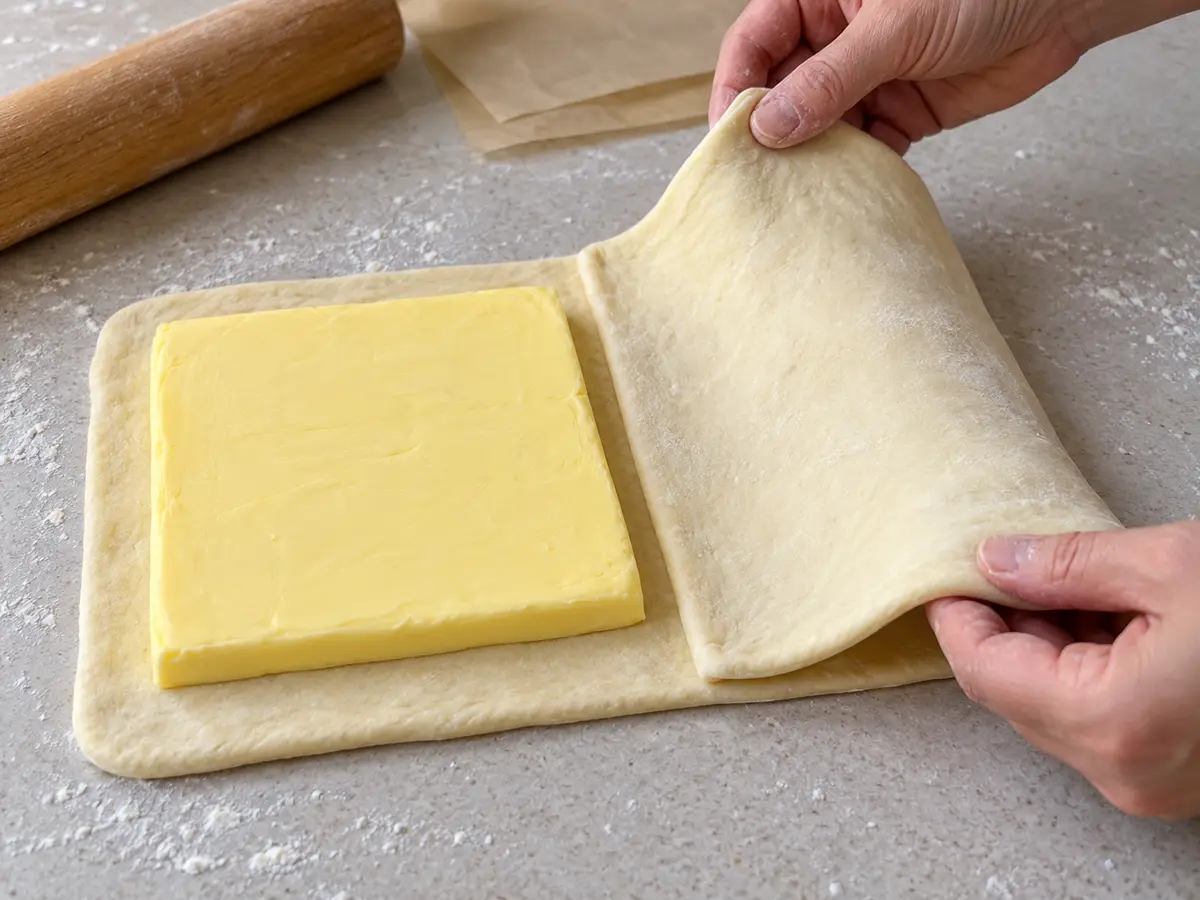
AI-generated Roll the package into a rectangle about 20 × 45 cm, applying even pressure without pushing out the butter. Brush off excess flour. Mentally divide the long side into three 15 cm sections: fold one outer section over the middle, then fold the other outer section on top. The package will be about 20 × 15 cm — this is the first letter fold. Cover and chill for 30 minutes. Give the dough a quarter turn, roll again to about 20 × 45 cm, brush off the flour and fold the same way; chill for 30 minutes after this second fold. Roll and fold a third time in the same way, then chill for another 30 minutes. Make 3 folds in total, each after rolling. If the butter softens or the dough shrinks back strongly, stop and chill for an additional 15–20 minutes instead of forcing it to roll out.
After the final chill, roll the dough into a square about 40 × 40 cm and about 4–5 mm thick. Use only enough of the reserved flour so the dough does not stick; brush off and discard any excess. With a sharp knife, cut the square into 16 pieces measuring 10 × 10 cm, without trimming or discarding the edges. Fold the four corners of each square into the center, overlapping them slightly, and press the join firmly, leaving room for the custard. Arrange 8 pastries, spaced apart, on each of two large baking sheets lined with parchment paper.
Cover the baking sheets lightly without pressing on the dough and leave for about 60–90 minutes at a cool room temperature of about 20–22°C. The pastries should become noticeably puffed and light, with visible layers around the edges. If they are still dense after this time, let them rise longer until they look as described. Do not put them near a heater or in a warm oven: the butter must not melt. Keep the custard in the refrigerator. Toward the end of proofing, preheat a conventional oven (no fan) to 200°C and beat the whole egg reserved for brushing.
After proofing, gently define an indentation in the center of each pastry without crushing the outer layers. Brush the tops lightly with beaten egg; do not flood the cut edges. Discard any unused egg. Stir the cold custard briefly until smooth again and divide all of it into 16 portions. Spoon one portion into each indentation, leaving the buttery border exposed. Put the first baking sheet straight into the oven and keep the second in the refrigerator while the first batch bakes.
Bake one sheet at a time on the middle rack for about 22–25 minutes, until the dough is deep golden and the bottoms are baked through and browned. A light golden crust on top alone is not enough — the lower layers should not be damp and raw. Transfer the second sheet directly from the refrigerator to the hot oven; bake for a few extra minutes if needed. Carefully move the baked pastries to a wire rack and let cool completely, about 30–40 minutes for each batch. The first batch cools while the second bakes.
Mix the powdered sugar with all 15 ml water to make a smooth, fairly thick icing. Divide all the icing among the 16 completely cooled pastries, making thin stripes or a ring around the custard. Do not ice warm spandauer, as the icing will run off. Leave for about 10 minutes to let the icing set, then serve.
Estimated nutrition

Rate this recipe
0 ratings
Comments