
AI-generated
Zserbó — Hungarian cake with nuts, apricots and chocolate
Log in or create a free account to save recipes.
Source: https://recipheon.com/en/recipes/desserts/zserbo-hungarian-cake-with-nuts-apricots-and-chocolate
About this recipe
Zserbó is a Hungarian cake of thin, buttery pastry sheets layered with apricot jam and finely ground walnuts, finished with a smooth chocolate glaze. This home version has four layers of yeasted shortcrust pastry and three equal layers of filling. Do not knead it like bread rolls: rub butter into flour, bring the ingredients together quickly and let the dough rest briefly for easier thin rolling. Ready-made sweetened apricot jam provides moisture and fruit flavor, so do not replace it with fresh apricots alone. Each jam layer receives an equal amount of nuts and sugar, keeping the cross-section regular so the filling does not collect in one place. Use all the dough and every scrap, without trimming off the baked edges. Add the glaze only once the cake has cooled completely, keeping it on the top alone. Make zserbó a day ahead if possible: overnight, the jam softens the layers, the flavors blend and the cake becomes easier to cut into small, even squares.
Ingredients
Four layers of yeasted shortcrust pastry
400 g all-purpose flour, type 550, all for the dough; no extra flour for dusting
200 g cold unsalted butter with 82% fat, cubed
60 g fine white sugar, including 10 g for the yeast milk and 50 g for the flour
12 g fresh baker's yeast
70 g milk with 3.2% fat, weighed, lukewarm and not hot
50 g beaten whole egg without shell, about 1 medium (M) egg
18 g raw egg yolk without white, about 1 medium (M) yolk; unused white is excluded from the recipe
3 g fine salt
Three apricot and walnut fillings
450 g ready-made thick sweetened apricot jam, smooth or with very small fruit pieces; do not thin with water
300 g raw shelled walnuts, unsalted; weight without shells
90 g fine white sugar for the nuts
Smooth chocolate glaze
160 g dark chocolate with about 60% cocoa, finely chopped
20 g unsalted butter with 82% fat for the glaze, in addition to the 200 g in the dough
Steps
Line a metal pan measuring 30 × 20 cm inside and at least 5 cm high with parchment, leaving handles on two sides. Do not grease with extra fat. Grind the nuts finely, but not to a paste; mix with their allocated 90 g sugar and divide into three portions of 130 g. Stir the jam with a spoon and weigh out three portions of 150 g. Do not reserve anything for decorating.
Combine all 70 g lukewarm milk with the 12 g yeast and 10 g sugar from the dough allocation, stirring until dissolved. Leave for about 10 minutes, until small bubbles appear. In a large bowl, mix the flour, remaining 50 g sugar and salt. Add the 200 g cold butter and quickly rub in with your fingers or a pastry blender until fine crumbs form. Do not heat the butter until liquid.
Add all the yeast milk, 50 g egg and 18 g yolk to the crumbs. Bring together briefly, just until a uniform soft dough forms; do not knead at length and do not expect an elastic membrane like bread dough. Gather all crumbs from the bowl. Divide everything into four equal portions of about 203 g, flatten, wrap and refrigerate for 30 minutes. This is shortcrust pastry lightly leavened with yeast, not fluffy yeast bread.
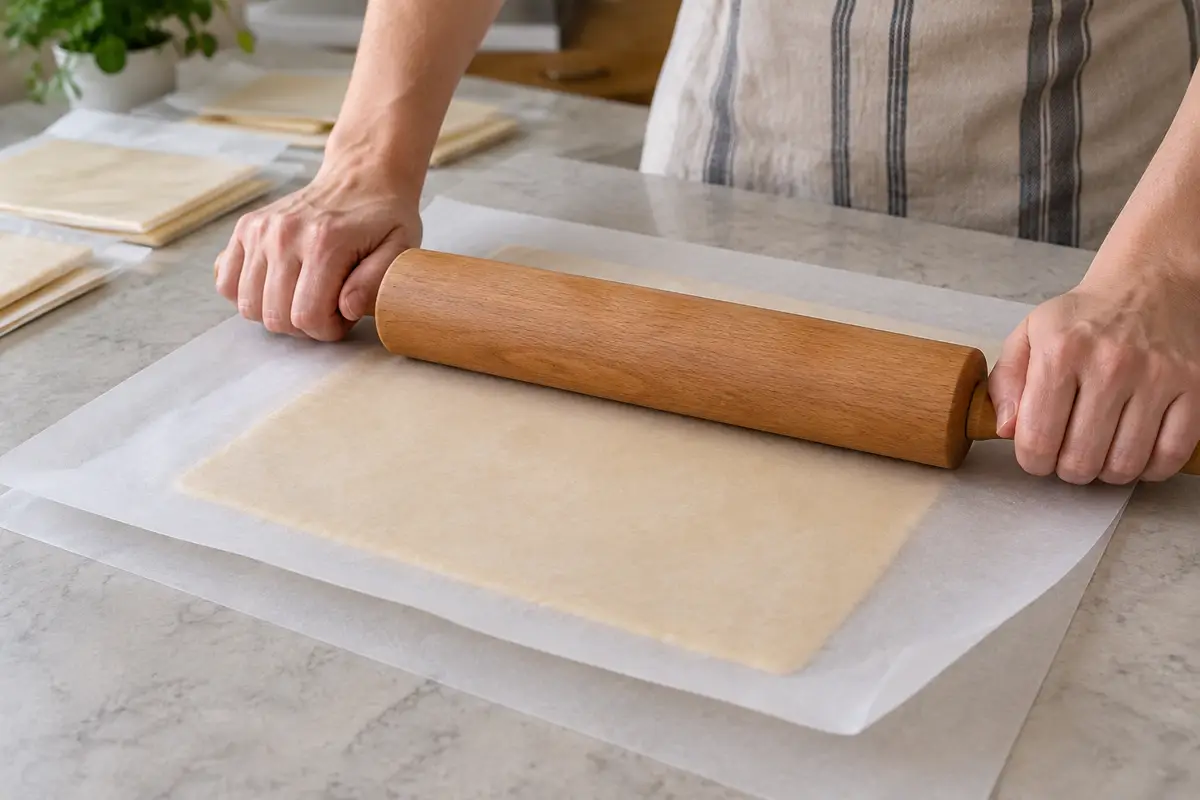
Take out the first portion. Roll between two sheets of parchment into a 30 × 20 cm rectangle about 3 mm thick. You can mark the dimensions on the back of the lower sheet. Move protruding pieces into missing corners and roll again: every scrap must stay in this sheet of dough. Do not dust with flour. Remove the top paper, invert the dough into the lined pan and gently peel off the other paper. Press any cracks together with your fingers.
AI-generated Spread one 150 g portion of jam thinly and evenly over the first dough sheet, almost to the edges. Scatter one 130 g portion of nuts and sugar over it and level gently with a spoon, without pressing down. Do not mix jam and nuts into a separate paste. Keep the surface flat so the next dough sheet does not sit on high mounds of filling.
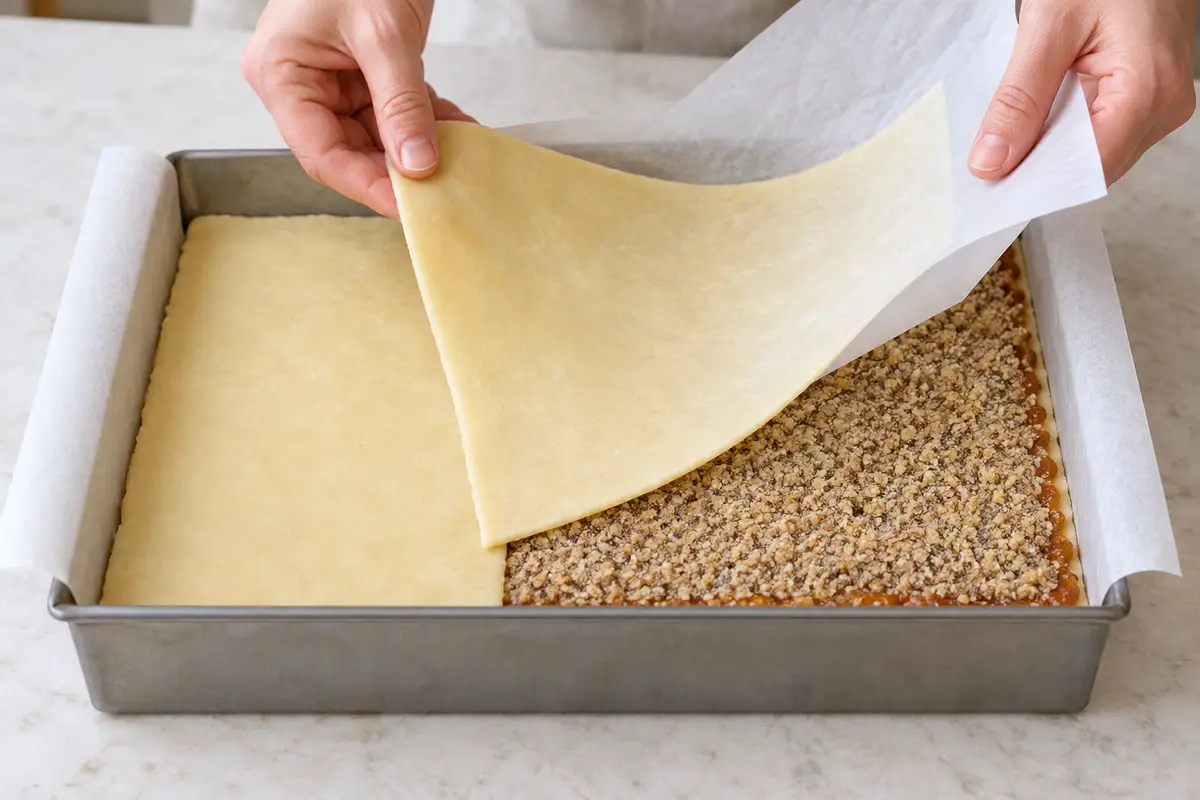
Roll the second dough portion between paper to the same 30 × 20 cm size, incorporating all its scraps. Transfer onto the first filling, peel off the paper and gently fit the edges without pressing hard. Spread the second 150 g jam and scatter the second 130 g nuts and sugar. Patch small tears with dough from this same portion; do not add extra flour or a separate sheet.
Roll and place the third sheet in the same way. Spread the last 150 g jam and scatter the last 130 g nuts and sugar, scraping all filling residue from the bowls. Roll the fourth portion and cover everything. The final structure is four thin dough sheets separated by three layers of jam and nuts. The top remains plain dough: do not brush with jam, egg or butter. Use all four portions without trimming the sides.
AI-generated Pierce the pastry in many places with a long thin skewer all the way to the pan bottom, about 3–4 cm apart, so steam can escape. Cover loosely and leave for 45–60 minutes at room temperature. The layers may rise a little, but do not wait for them to double in height. Toward the end of the rest, preheat the oven to 180°C with conventional top and bottom heat. Remove the cover before baking.
Bake on the middle rack at 180°C for about 40–50 minutes, until the top is evenly golden brown and the edges are clearly baked through. If the top darkens too quickly, cover loosely with foil and finish baking. Set the pan on a rack and leave for at least 2–3 hours, until completely cooled. Do not unmold and do not invert the hot, fragile cake. Prepare the glaze only once the center is cold too.
Put the 160 g chopped chocolate and 20 g butter for the glaze in a dry heatproof bowl. Set over a saucepan containing a little gently steaming water; the bowl bottom should not touch the water. Stir gently until smooth, then remove from the steam. Do not boil, do not pour water into the chocolate and do not add cream or oil. Leave for a few minutes so the glaze stays fluid but is not hot.
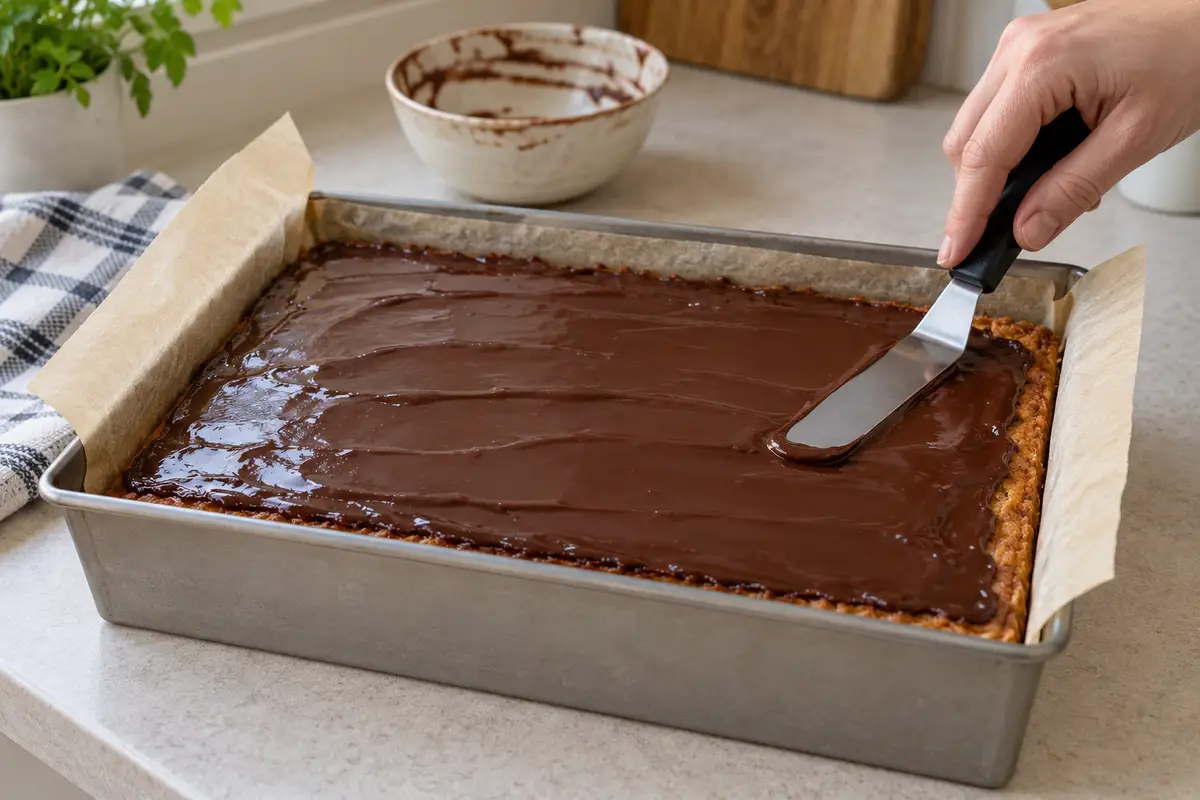
Keep the completely cold cake in the pan. Pour the fluid glaze over the top and spread thinly with a spatula across the entire surface to the edges; scrape everything from the bowl. The glaze should cover the top, not run down the sides. Refrigerate for about 45–60 minutes, until the chocolate no longer smears. Do not add chopped nuts, powdered sugar or other decoration.
AI-generated Once the glaze has set, cover the pan and refrigerate for at least 8 hours, preferably until the next day. Take out 20–30 minutes before cutting. Lift the cake using the paper and cut with a sharp knife into six strips along the 30 cm side and four along the 20 cm side: this gives 24 squares about 5 × 5 cm. Warm the knife in warm water and wipe dry. Serve the edge pieces too, without trimming them off. Keep covered in the refrigerator for up to 5 days.
Estimated nutrition

Rate this recipe
0 ratings
Comments