
AI-generated
Broa de milho — Portuguese corn bread
Log in or create a free account to save recipes.
Source: https://recipheon.com/en/recipes/breakfast/broa-de-milho-portuguese-corn-bread
About this recipe
Broa de milho is a rustic Portuguese bread with a pronounced corn flavor, a thick crust and a dense, pleasantly moist crumb. In this home version, finely ground yellow corn flour makes up most of the flour, while wheat flour helps the round loaf hold its shape. The key step is scalding the corn flour with freshly boiled water and letting the mixture cool before adding yeast. The dough stays softer and less elastic than ordinary wheat dough; there is no need to knead it to a perfectly smooth surface, and do not keep adding flour. A dusted bowl helps round the sticky mixture without greasing your hands. The loaf bakes directly on a baking sheet, and its surface cracks naturally during rising and baking. A long rest on a cooling rack lets the crumb set and makes slicing easier. The recipe makes one medium loaf for twelve slices, including the heels and all the crisp crust. This simple fresh-yeast bread is made in an ordinary home oven.
Ingredients
Corn flour scald
300 g finely ground yellow corn flour, dry and not precooked, not cornstarch or instant polenta meal
250 g freshly boiled water for scalding the flour, measured while boiling hot
Remaining dough ingredients
200 g type 550 wheat flour
100 g lukewarm water, divided into 50 g for the yeast and 50 g for the salt
15 g fresh baker's yeast
10 g fine salt
Shaping and loaf surface
20 g additional corn flour of the same fine grind for dusting the bowl, parchment and top; unused flour is excluded from the slices
Steps
Put 300 g corn flour in a large heatproof bowl. Pour in all 250 g freshly boiled water and immediately stir vigorously with a wooden spoon for about 2–3 minutes, working through dry patches and larger lumps. You should have a thick, moist mixture, not a runny porridge. Do not knead it by hand now, as it is hot. Scrape all the flour down from the sides; the weighed water stays in the scald, so do not pour any off and do not add oil.
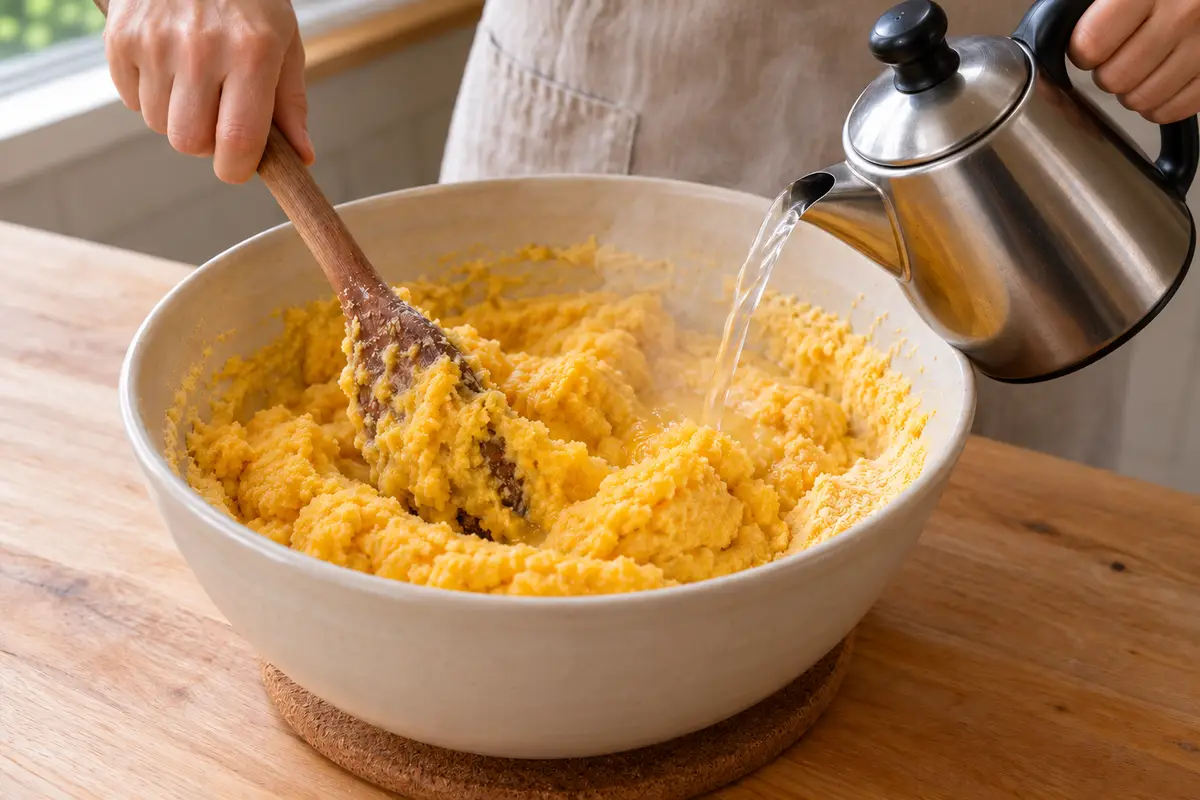
AI-generated Spread the scald more thinly over the bottom and sides of the bowl. Leave for about 30–45 minutes, stirring a few times, until cool or only barely lukewarm, including in the center. Only then prepare the yeast: dissolve all 15 g in 50 g lukewarm water. In a separate small bowl, dissolve 10 g salt in the remaining 50 g water. Both portions come from the measured 100 g water, in addition to the 250 g used for the scald. Do not add yeast to the hot mixture and do not heat the scald again.
Add the yeast with all its water and 200 g all-purpose flour to the cooled scald. Mix with your hand or a sturdy spoon, then add all the salt water. Knead in the bowl for about 8–10 minutes, folding the mixture over itself and working out larger lumps of scald. The dough should be uniform, soft and slightly sticky, but able to gather into one mound; it will not be as stretchy as all-wheat dough. Gather any residue into the mixture. Do not add flour from the dusting portion, extra water or fat.
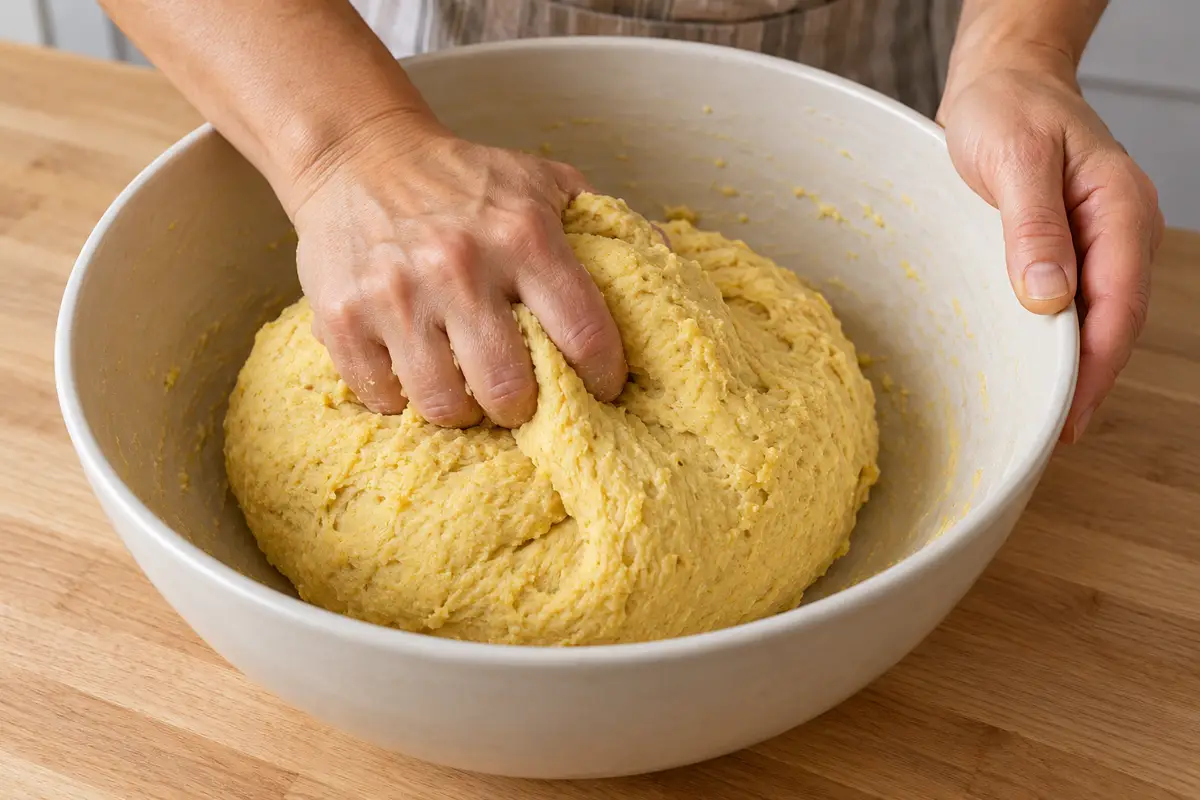
AI-generated Gather the dough into a rounded mound, leave in the same bowl and cover with a clean kitchen towel. Leave in a quiet place at room temperature for about 75–90 minutes, until the mixture has clearly increased in volume and become puffy. With this much corn flour, it may rise to less than double its volume; do not wait for the surface to collapse. In a cool kitchen, rising may take longer. Do not grease the bowl and do not place it on a hot radiator.
Weigh out the separate 20 g corn flour for shaping. Use some to dust a second, dry bowl with a rounded bottom, and a little to dust the parchment on a baking sheet. Transfer all the dough to the dusted bowl. Move it in short circular motions, using a scraper to help, so the mixture rounds up and takes on a thin coating of flour. Transfer to the parchment and flatten lightly into a domed loaf about 18 cm across and 5–6 cm high. Do not divide the dough and do not trim off scraps; gather them into the loaf.
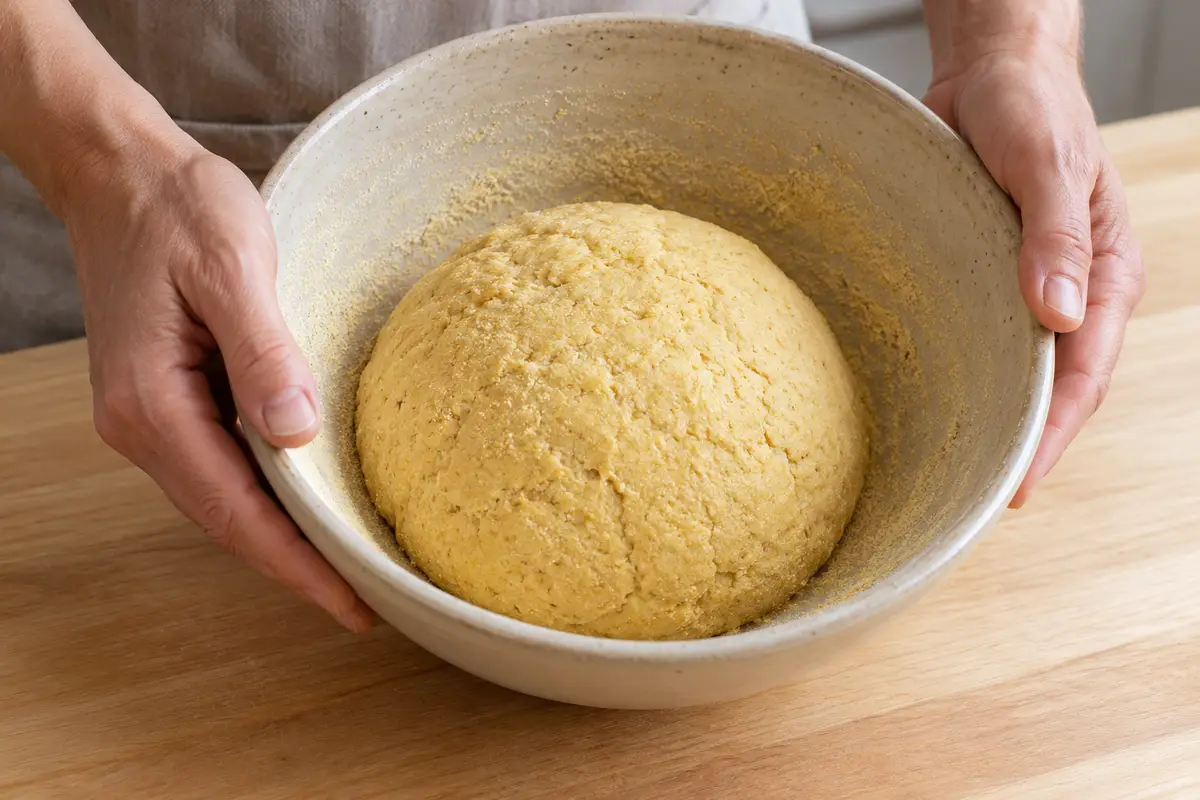
AI-generated Dust the top with a little of the same weighed flour, cover loosely with a kitchen towel and leave for about 25–35 minutes. The loaf should puff up a little, and fine surface cracks are desirable. Exclude flour left in the bowl and on utensils from the servings; do not force yourself to use it all. Meanwhile, preheat the oven to 220°C with conventional top and bottom heat. Remove the towel before baking. Do not score the loaf with a knife, do not brush with water or egg and do not add a separate topping.
Place the baking sheet slightly below the middle of the preheated oven. Bake at 220°C for about 45–50 minutes, until the crust is well browned, firm and cracked, and the bottom is dry. If the top darkens too quickly, cover it loosely with aluminum foil toward the end of baking. Carefully lift the loaf; tapping the bottom should give a hollow sound. If the bottom is still damp and soft, bake for another 5 minutes. Do not add a pan of water or extra olive oil to the oven.
Transfer the bread straight to a rack and cool without covering for at least 2 hours, until the center is no longer warm. The corn crumb stays dense and moist; cutting the loaf hot can make the center seem sticky and underbaked. Cut into twelve slices, including the heels and all the crust. Serve without extras as part of this recipe. Once completely cooled, store for up to 2 days in a paper bag or freeze tightly wrapped slices for up to 2 months.
Estimated nutrition

Rate this recipe
0 ratings
Comments