
AI-generated
Homemade Baguettes with a Crisp Crust — Overnight Dough
Log in or create a free account to save recipes.
Source: https://recipheon.com/en/recipes/breakfast/homemade-baguettes-with-a-crisp-crust-overnight-dough
About this recipe
Homemade baguettes made with overnight dough have a golden, crisp crust and an elastic crumb with irregular air pockets. A small amount of yeast and a long rest in the refrigerator let you spread the work over two days. Shaping needs the most attention: the dough should have a taut surface and a well-sealed seam, and it needs diagonal slashes and steam at the start of baking. Choose white wheat bread flour with about 11–12.5% protein. Three baguettes about 30–32 cm long fit together on an ordinary large baking sheet; cut in half, they make six portions. Allow about 20 hours for the whole process, including the overnight rise and cooling.
Ingredients
Dough and oven preparation
520 g dry white wheat bread flour, Polish type 650, with about 11–12.5% protein; 500 g for the dough and 20 g for dusting, with loose excess dusting flour left on the work surface and parchment
500 ml drinking water; 350 ml at room temperature for the dough and 150 ml for creating steam in the oven, this second portion does not go into the dough
2 g instant dry baker's yeast
10 g fine salt
Steps
In the evening, mix 500 g of flour, the instant yeast, and the salt in a large bowl, then pour in 350 ml of room-temperature water. Stir with a sturdy spoon until no dry flour remains; the dough will still be soft and slightly rough. Cover the bowl and leave for 20 minutes to let the flour absorb the water.
Turn the dough onto a clean work surface and knead for about 5–8 minutes: push it away with the heel of your hand, fold it over itself, and rotate it. Gather sticky pieces with a scraper without adding flour; the dough will gradually become smoother and more elastic and start to release from the work surface. Return it to the bowl, cover, and leave for 30 minutes at room temperature, about 22–24°C.
Slide a scraper under the edge of the dough in the bowl, stretch it gently upward, and fold it into the center; repeat from all four sides. Cover, wait 30 minutes, and fold the dough once more. Transfer it to a lidded container with room for at least twice its volume, mark the starting level, and refrigerate for about 14–16 hours. The container should keep the surface from drying out; the dough will slowly rise and develop bubbles while chilled.
The next day, take out the container and leave covered for about 60–90 minutes, until the dough softens, becomes airy, and reaches roughly one and a half times its starting volume. If it is still dense and distinctly cold, wait about 30 minutes more. Divide the reserved 20 g of flour into 15 g for the work surface and 5 g for the parchment. Lightly dust the work surface with some of the first portion, turn out the dough with a scraper, and divide into three similar pieces. Gently flatten each into a short rectangle, roll loosely into a log, place seam-side down, and cover with an inverted bowl or container for 20 minutes.
Working with one piece at a time, gently flatten a log into a rectangle about 18 cm long, removing only very large bubbles. Fold the upper long edge into the center and press the join with your fingertips, then fold the lower edge into the center. Fold the whole piece in half lengthwise and seal the seam firmly with the heel of your hand. Place seam-side down and roll from the center toward the ends to about 30–32 cm long, tapering the tips slightly. Use the remaining work-surface flour only where the dough sticks. If a log shrinks back strongly, leave it covered for 5 minutes while you work on the next one, then finish lengthening it without tearing the surface.
Place parchment rated for 230°C on a large flat board, sized to fit a baking sheet about 35 × 40 cm, and scatter the reserved 5 g of flour over it. Place the baguettes seam-side down with about 4–5 cm between them. Cover with an inverted deep baking pan so it does not touch the dough and leave for about 45–60 minutes, until the baguettes puff up and a shallow dent near an edge springs back slowly. At the same time, preheat a conventional oven (no fan) to 230°C with a flat baking sheet on the middle rack and a small metal roasting pan on the rack below; heat for at least 35 minutes. Just before the rise ends, bring the reserved 150 ml of water to a boil.
Uncover the baguettes just before putting them in the oven. With a very sharp small knife or a baker's lame, make three cuts about 5 mm deep on each loaf with firm strokes, running almost along its length at a slight diagonal; each cut should start beside the end section of the previous one. Hold the blade at an angle to the dough surface and use a smooth motion without sawing or pressing down on the whole loaf.
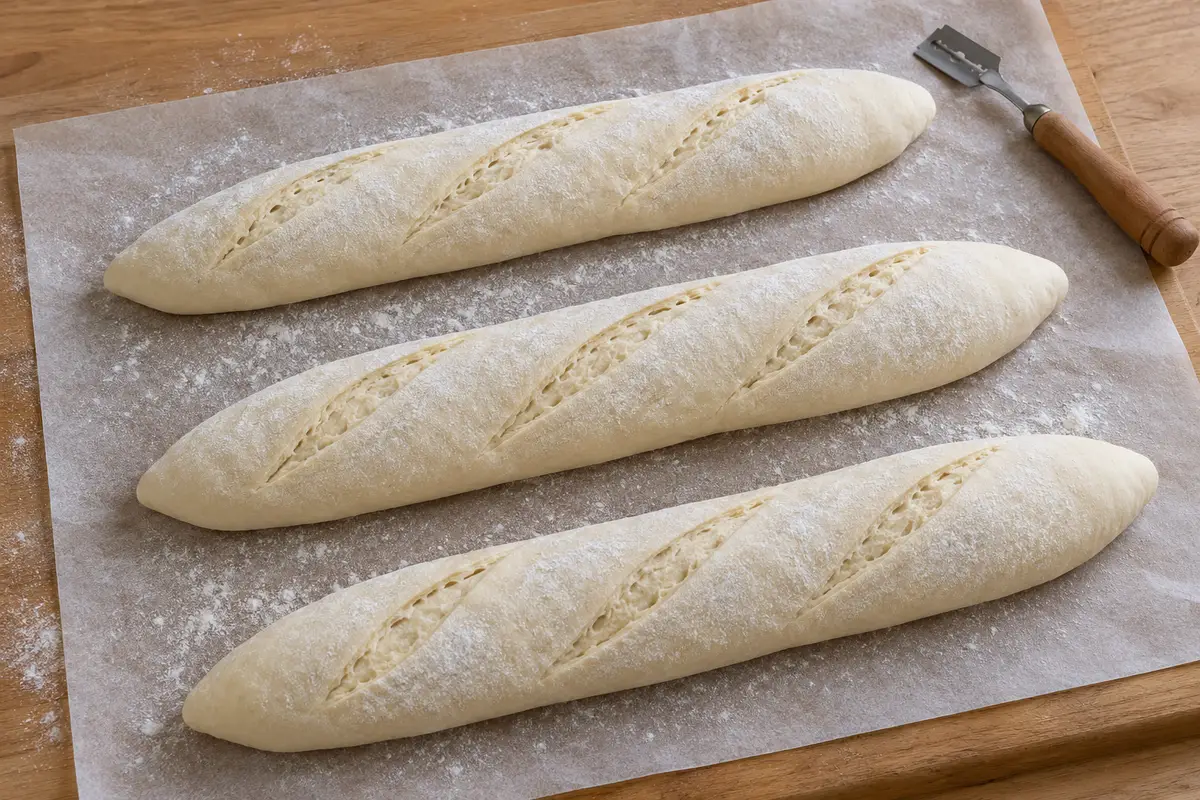
AI-generated Using oven mitts, take out the hot baking sheet and set it on a stable support. Slide the parchment with the baguettes onto it and return it to the oven immediately. Carefully pour 150 ml of boiling water into the lower metal roasting pan, protecting your hands and keeping your face away from the steam, then close the door. Do not use a glass vessel for steam, and do not pour water onto the oven floor. Bake for 15 minutes at 230°C, briefly open the door to release the steam, and bake for about 10–15 minutes more at the same temperature, until the crust is deeply golden, the cuts have opened, and the bottom is firm and browned. Leave the roasting pan in the switched-off oven to cool.
Move the baguettes off the parchment directly onto a wire rack and cool uncovered for at least 30 minutes so steam can also escape from the bottoms. Brush away loose flour underneath and slice when the centers are only slightly warm; the knife should not squash hot, moist crumb. Cut each baguette in half to make six portions, and serve as fresh as possible while the crust is still crisp.
Estimated nutrition

Rate this recipe
0 ratings
Comments