
AI-generated
Koulouri — Greek Yeasted Sesame Bread Rings
Log in or create a free account to save recipes.
Source: https://recipheon.com/en/recipes/breakfast/koulouri-greek-yeasted-sesame-bread-rings
About this recipe
Koulouri are Greek yeasted bread rings with a generous sesame coating, a lightly crisp crust, and a soft interior. Associated with Thessaloniki, this bread has simple ingredients; its character comes from the thin ring and sesame covering both sides. In this version, the shaped rings are briefly dipped in sugar water to help the seeds stick, then baked without boiling first. Leave large openings and seal the ends of the dough ropes carefully so the shape remains distinct after rising. The eight rings bake together on two sheets in a convection oven. Serve slightly warm, when the oven-toasted sesame is most fragrant and the crust is still gently crisp.
Ingredients
Dough and sesame coating
510 g dry white wheat bread flour, Polish type 650, with about 11–12% protein; 500 g for the dough and 10 g for light dusting, with loose excess not going into the baked rings
550 ml drinking water; 300 ml lukewarm for the dough and 250 ml for dipping before coating, with unused dipping liquid discarded
60 g fine white sugar; 35 g for the dough and 25 g for the dipping liquid, most of which does not remain on the rings
7 g instant dry baker's yeast
8 g fine salt
200 g raw hulled pale sesame seeds for coating; excess seeds that do not stick to the dough are not included in the finished rings
Steps
In a large bowl, mix 500 g of flour, the instant yeast, salt, and 35 g of sugar. Add 300 ml of lukewarm, not hot, water and stir until combined. Turn onto the work surface and knead for about 8–10 minutes, until smooth, elastic, and only slightly sticky; use a scraper to gather pieces sticking to the surface. Use the reserved 10 g of flour sparingly for light dusting during kneading and later shaping, rather than adding all of it to the dough.
Put the dough in a bowl and cover so the surface does not dry out. Leave for about 60–90 minutes in an undisturbed spot at about 22–24°C, until noticeably puffy and approaching twice its volume. In a cooler kitchen, judge by the dough's growth, not just the clock.
Gently turn the dough onto the work surface, flatten with your hand, and divide into eight similar pieces. Gather into short logs, cover, and leave for about 10 minutes so they stretch more easily. Meanwhile, dissolve the remaining 25 g of sugar in 250 ml of slightly warm water in a wide, shallow dish large enough for a whole ring. Spread the sesame on a second flat plate and line two large baking sheets, about 35 × 40 cm, with parchment paper.
Roll each piece with your hands from the center toward the ends into an even rope about 38–40 cm long and about 1½–2 cm thick. If the dough shrinks back, leave it covered for a few minutes while you work on the next piece. Overlap the ends by about 2 cm, pinch firmly, and roll the join lightly against the work surface to blend it in. Form a broad ring with an opening about 8–9 cm across; a small opening would easily close during rising.
Working one at a time, briefly dip each ring in the sugar water to wet both sides. Lift, let excess liquid drip off, then place straight into the sesame, pressing gently and turning so seeds also stick to the sides. Put four rings on each baking sheet, leaving about 3 cm between them and keeping the openings large. After coating all the rings, discard the remaining dipping liquid and remove the wet sesame left on the plate.
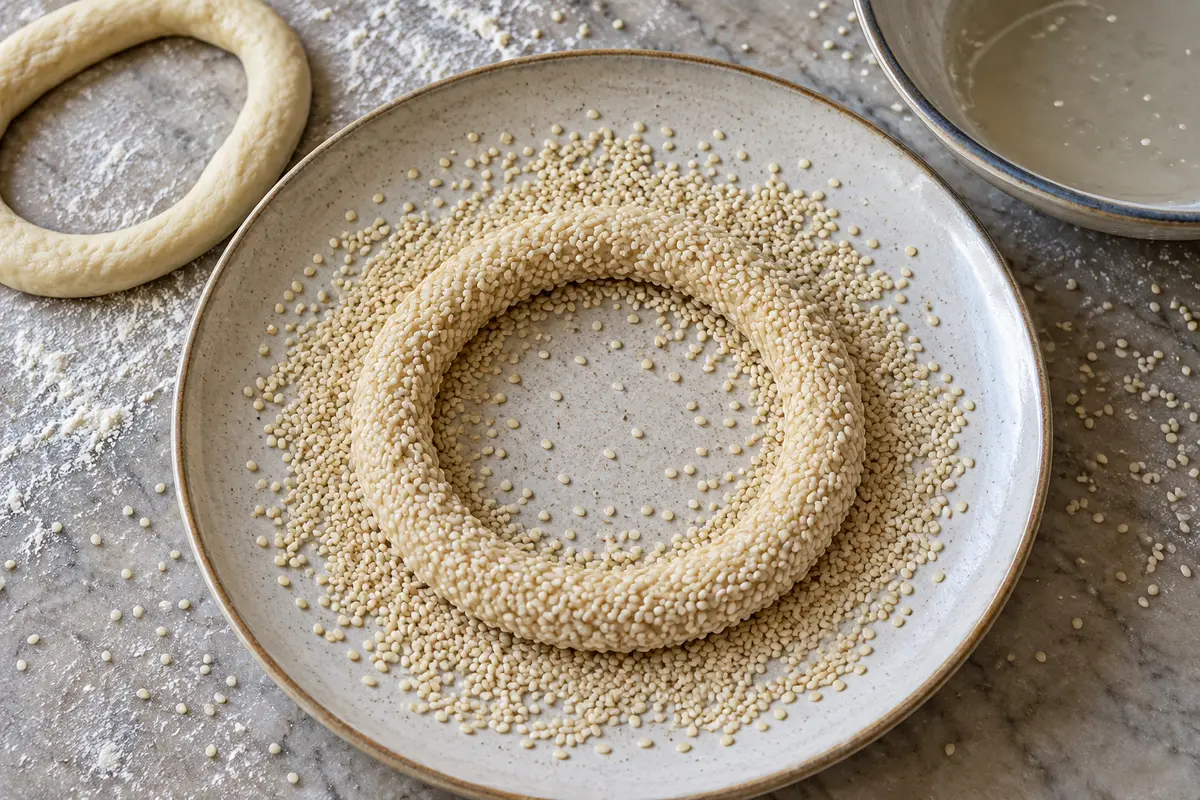
AI-generated Cover the sheets loosely with clean cloths and leave for about 20–30 minutes. The rings should puff up slightly and feel soft to a gentle touch, while their openings remain wide. From the start of this rest, preheat the oven to 190°C on the convection setting, arranging two rack positions with space between the sheets.
Put both sheets in the preheated oven, one just above and the other just below the middle, and bake for about 20–25 minutes at 190°C on the convection setting. After about 12 minutes, swap their rack positions and rotate them front to back so the rings brown evenly. Remove when the dough between the seeds is golden, the sesame is light gold, and the bottoms are dry and lightly browned; if one sheet reaches this stage first, take it out and give the other a few more minutes. Do not wait for the sesame to turn dark brown, as it may become bitter.
Move the rings off the parchment onto a wire rack and leave uncovered for about 15 minutes. Serve slightly warm, one ring per portion; the crust should be gently crisp and the interior soft and elastic.
Estimated nutrition

Rate this recipe
0 ratings
Comments