
AI-generated
Pão de Deus — Portuguese Buns with Coconut Topping
Log in or create a free account to save recipes.
Source: https://recipheon.com/en/recipes/breakfast/pao-de-deus-portuguese-buns-with-coconut-topping
About this recipe
Pão de Deus are Portuguese yeast buns with a soft, buttery interior and a sweet coconut topping. The dough, enriched with milk and eggs, needs an undisturbed rise; the butter is added only after initial kneading, once the dough becomes elastic. The topping is made from dry, unsweetened shredded coconut bound with egg, milk, and sugar. After a short rest, it should be moist and thick enough to stay on the buns. Add it gently after the final rise, without pressing down on the puffy dough. The recipe makes ten buns, baked together on two sheets. The finished coconut is lightly golden and set, while the buns remain fluffy inside; let them cool on a rack before serving.
Ingredients
Dough and coconut topping
510 g dry white wheat bread flour, Polish type 650, with about 11–12% protein; 500 g for the dough and 10 g for light dusting, with loose excess not going into the baked buns
270 ml cow's milk with 3.2% fat; 230 ml for the dough and 40 ml for the coconut topping
200 g raw whole chicken eggs without shells, about 4 size M eggs; 100 g for the dough and 100 g for the coconut topping
60 g soft unsalted butter with 82% fat
150 g fine white sugar; 70 g for the dough and 80 g for the coconut topping
7 g instant dry baker's yeast
7 g fine salt
150 g dry, unsweetened, finely shredded coconut
Steps
Lightly beat the measured 200 g of eggs without shells and divide into two equal portions; cover the 100 g reserved for the coconut and refrigerate. Warm 230 ml of milk until lukewarm, not hot. In a large bowl, mix 500 g of flour, the instant yeast, 70 g of sugar, and salt. Add the milk and 100 g of eggs and stir until combined. Turn onto the work surface and knead for about 5 minutes, until the dough begins to become uniform and elastic.
Add the soft butter in three batches, folding and kneading each time until the fat is absorbed. After adding all the butter, keep kneading; this stage takes about 8–12 minutes in total, and the initially smeary mixture should come together again into a smooth, soft, elastic dough. Use a scraper to help, and use the reserved 10 g of flour sparingly for dusting now and during later shaping. A small piece of finished dough should stretch gently into a thin membrane before tearing.
Gather the dough into a ball, put it in a bowl, and cover thoroughly. Leave in a warm, undisturbed spot at about 24–26°C for roughly 1½–2 hours, until nearly doubled and noticeably puffy. Enriched dough rises more slowly than plain bread dough, so if it is still dense, let it rise longer.
Turn the dough onto a lightly floured work surface, gently flatten, and divide into ten similar pieces. Tuck the edges of each piece underneath, then round it with your hand into a smooth ball with the seam joined on the bottom. Put five balls on each of two large parchment-lined baking sheets, about 35 × 40 cm, leaving at least 5 cm between them. Cover loosely and leave for about 45–60 minutes until noticeably puffy and a shallow dent near an edge springs back slowly.
Once the buns have been rising for about 30 minutes, preheat the oven to 170°C on the convection setting. Mix the reserved 100 g of eggs with the remaining 80 g of sugar and 40 ml of milk, add the shredded coconut, and combine thoroughly with a spoon. Leave for about 10 minutes so the dry coconut absorbs moisture, then stir again. The mixture should be moist, clumpy, and thick enough for a spoonful to hold its shape, with no liquid separating out.
When the buns have risen, divide all the coconut mixture into ten similar portions. Spoon onto the center of each bun and gently spread into a rounded cap about 1 cm thick, leaving a narrow border of dough visible at the edge. Do not press hard, and do not spread the mixture down to the paper, so the buns retain their air and the coconut does not run onto the sheet.
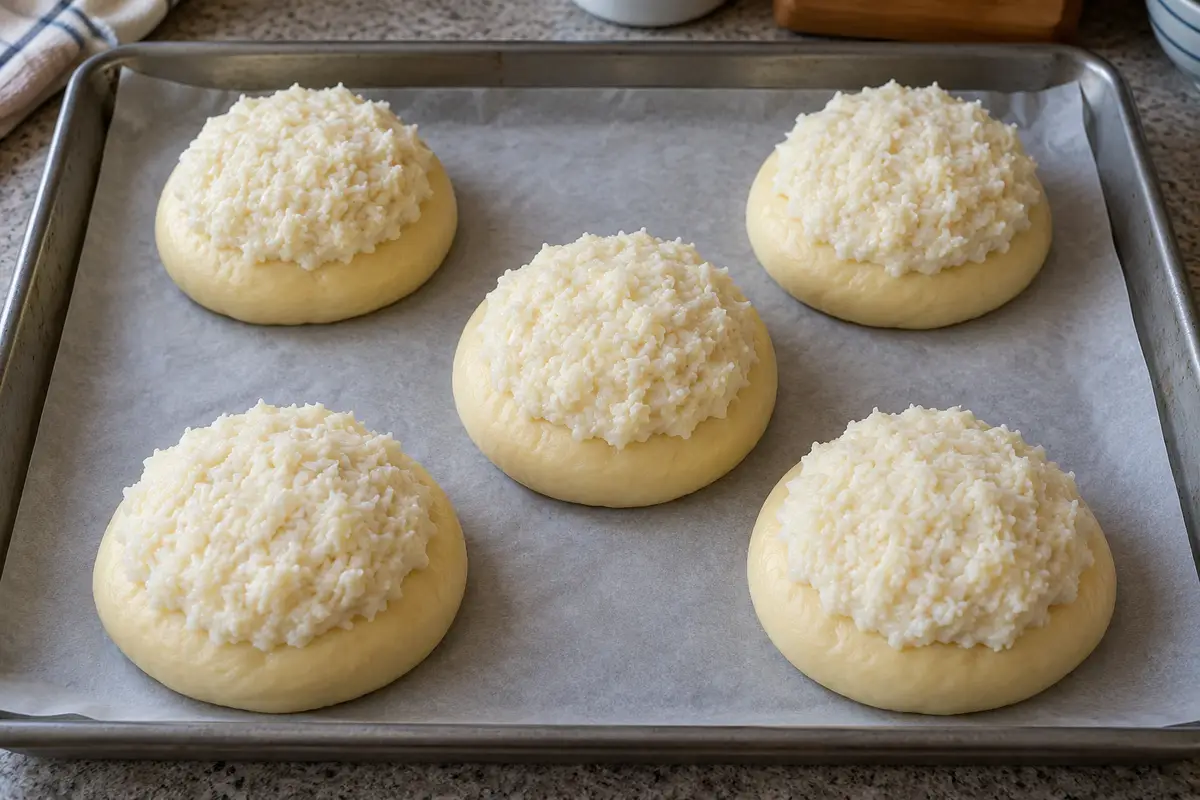
AI-generated Put both sheets in the preheated oven on racks just above and below the middle. Bake for about 20–25 minutes at 170°C on the convection setting, swapping rack positions and rotating the sheets front to back after about 12 minutes. The buns should have golden sides and lightly browned bottoms, and the coconut topping should be set with light-gold tips on the shreds, without the wet sheen of raw mixture; a skewer inserted from the side into the center of a bun should come out without sticky dough. If the coconut browns faster than the bread, loosely cover the tops with foil and bake for a few more minutes; remove whichever sheet is ready first.
Leave the buns on the sheet for about 5 minutes, then transfer gently to a rack. Cool for about 20–25 minutes more so the coconut layer firms up and the centers are no longer hot. Serve one bun per portion, slightly warm or cooled.
Estimated nutrition

Rate this recipe
0 ratings
Comments