
AI-generated
Slovenian Bread with Caraway and Coarse Salt
Log in or create a free account to save recipes.
Source: https://recipheon.com/en/recipes/breakfast/slovenian-bread-with-caraway-and-coarse-salt
About this recipe
This round Slovenian yeast bread has a scored grid, caraway seeds and coarse salt. It has a soft, porous crumb, thinner edges and a browned, egg-glazed crust. Stretch the dough by hand and cut the lines all the way through to the base so the baked bread breaks easily into pieces. This home version uses a moderate amount of salt and fresh yeast. It tastes best while still warm, after a short rest on a rack. One loaf, making eight servings, takes about 2 hours 30 minutes, including rising and cooling.
Ingredients
Dough and Topping
515 g wheat flour, type 550: 30 g for the yeast mixture, 470 g for the dough and up to 15 g for dusting; remove any unused dusting flour from the work surface
300 ml lukewarm water: 50 ml for the yeast mixture and 250 ml for the dough
20 g fresh baker's yeast
6 g sugar
13 g salt: 8 g fine salt for the dough and 5 g coarse sea salt for the top
1 size M egg, about 50 g without the shell, for brushing; discard any unused beaten egg
2 g whole caraway seeds
Steps
Crumble the yeast into a small bowl and add all the sugar, 50 ml lukewarm water and 30 g flour. Stir to make a thick yeast mixture and cover. Leave in a warm place for about 10–15 minutes, until it has visibly expanded and bubbles cover the surface. The water should feel pleasantly lukewarm to the touch, not hot.
In a large bowl, combine 470 g flour with 8 g fine salt, then add all the yeast mixture and the remaining 250 ml water. Mix, turn out onto the work surface and knead for about 8–10 minutes, until smooth, elastic and soft, but not stiff. If needed, use small amounts of dusting flour from the reserved 15 g; do not add it all at once. Remove any unused flour from the work surface.
Put the dough in a bowl, cover and leave in a warm place for about 45–60 minutes, until doubled in volume. Judge by its appearance as well: rising may take longer in a cool kitchen. During the second half of the rise, preheat the oven to 220°C on the conventional (no-fan) setting. Line a flat baking sheet with a usable area of at least 35 × 40 cm with parchment paper.
Transfer the risen dough to the prepared baking sheet and stretch it by hand into a round about 30 cm in diameter. Leave the center thicker, about 2 cm, and flatten the edges to about 1 cm; the dough should not touch the sides of the baking sheet. If it springs back strongly, let it rest for about 5 minutes, then finish shaping. With a sharp knife, make 7 straight parallel cuts about 4 cm apart: one through the center and three on each side. Repeat perpendicular to these, cutting a grid all the way through to the base of the dough, but do not separate the round into individual pieces.
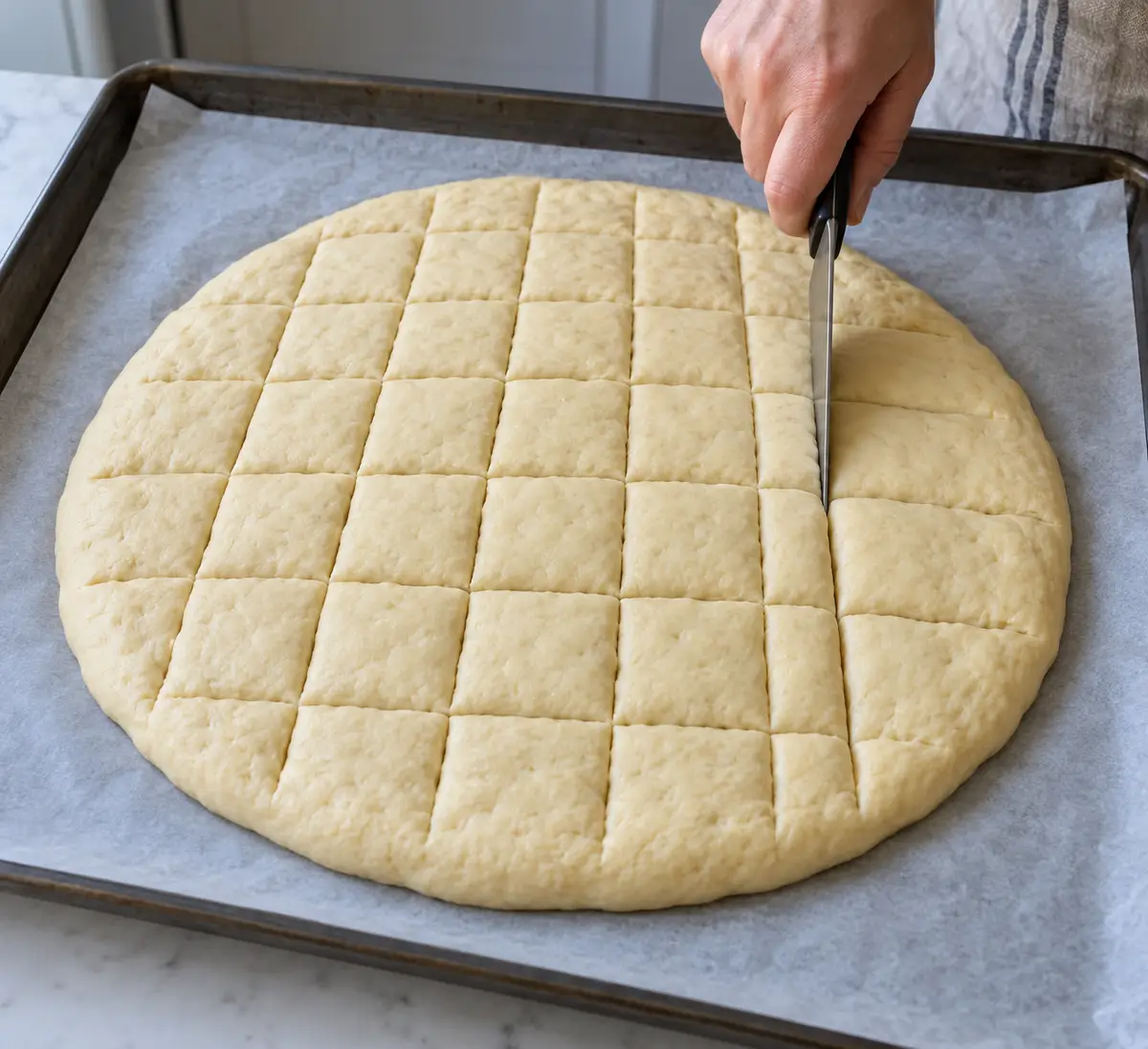
AI-generated Beat the egg thoroughly and brush a thin layer over the surface of the round. Sprinkle all the caraway evenly over it, then gently brush the top with a second thin layer of egg to hold the seeds in place. Sprinkle the top with 5 g coarse salt. Discard any unused egg; do not pour it into the cuts and do not add it to the dough.
Put the baking sheet on the middle rack of the fully preheated oven and bake for about 20–25 minutes, until the crust is evenly golden brown and the base is dry and lightly browned. If the base is still pale and soft, bake for a few more minutes. Transfer the bread to a rack and leave for about 15 minutes; the crumb should be soft and porous, without a sticky layer of raw dough. Serve while still warm, breaking pieces along the scored lines and dividing the whole loaf into eight servings.
Estimated nutrition

Rate this recipe
0 ratings
Comments