
AI-generated
Homemade Butter Croissants
Log in or create a free account to save recipes.
Source: https://recipheon.com/en/recipes/desserts/homemade-butter-croissants
About this recipe
Homemade butter croissants have a golden, crisp crust and a light interior separated by thin layers of dough. They are made from yeast dough repeatedly folded with butter, without filling or a topping. The key is to keep the two components similarly pliable: the butter should be cool but flexible, and the dough should roll out without tearing. Butter that is too hard cracks inside the dough, while soft butter smears and sticks the layers together. An overnight rest in the refrigerator and breaks between folds make the work easier, so spread the preparation over two days. The final rolling is done in two smaller portions, each yielding six croissants. After an unhurried rise, bake the croissants on two baking sheets, one after the other, and serve after cooling. The full recipe makes twelve.
Ingredients
Dough and Lamination
530 g dry all-purpose flour made from wheat, with about 11–12% protein and without raising agents, divided: 500 g for the dough and 30 g for light dusting; discard any loose, unused dusting flour
300 ml cold cow's milk (3.2% fat)
300 g unsalted cow's milk butter (82% fat), divided: 50 g softened for the dough and 250 g cool for lamination
50 g superfine white sugar
10 g fine salt
7 g instant dry yeast to mix directly with the flour
Egg Wash Before Baking
1 raw size M egg, about 50 g edible weight without the shell, for lightly brushing the croissants; unused beaten egg is not served
Steps
In a large bowl, mix 500 g flour, 50 g sugar, 10 g salt, and 7 g instant yeast. Add 300 ml cold milk and 50 g softened butter, then knead by hand for about 10 minutes until the dough is smooth and springy; it does not need to be as fully extensible as bread dough. Cover the bowl and leave at room temperature for about 45 minutes so the dough puffs slightly; do not wait for it to double in volume. Meanwhile, prepare the butter for lamination as described in the next step.
Place 250 g cool butter between two sheets of parchment paper and tap gently with a rolling pin to flatten it into a square about 20 × 20 cm with an even thickness. If it is too hard and cracks, leave it on the counter for a few minutes, then gently even it out again. Wrap in the paper and refrigerate overnight along with the dough; during lamination, the butter should be cool but bend slightly without crumbling.
After the rest, gently flatten the dough into a rectangle about 20 × 30 cm, wrap tightly in plastic wrap, and refrigerate for about 12 hours. The next day, take the butter out about 5–10 minutes before using it, keeping the dough cold. The butter should yield to light pressure but should not be soft or shiny; the dough and butter should offer similar resistance to the rolling pin.
Lightly dust the counter and rolling pin with flour from the reserved 30 g; use this allowance sparingly for all subsequent rolling, and brush off any loose excess with a dry pastry brush. Roll the cold dough into a rectangle about 22 × 42 cm and place the butter square in the center, leaving dough borders along the sides. Fold both short ends of the dough over the butter so they overlap slightly in the middle, then gently seal the join and side edges. You will have an enclosed, nearly square packet with the butter completely covered by dough; do not press the butter through the surface.
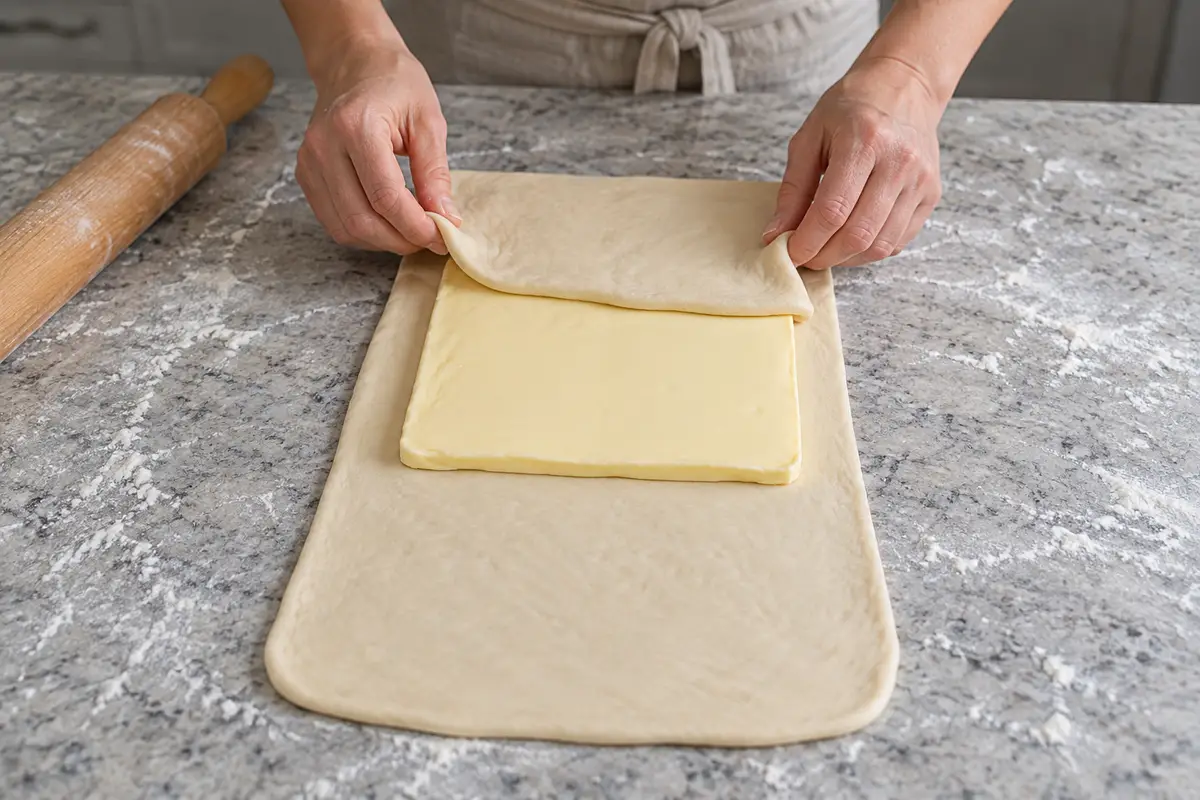
AI-generated Roll the packet with gentle strokes from the center toward the ends into a rectangle about 22 × 60 cm, with its length extending away from you. Fold the bottom third toward the center, then fold the top third over it, like a letter; the packet will measure about 22 × 20 cm. Wrap and refrigerate for about 30 minutes. If the butter becomes soft or starts coming through the dough during rolling, stop and chill the packet for about 15 minutes before continuing; if the butter is hard and cracks, wait a few minutes with the dough on the counter and roll more gently.
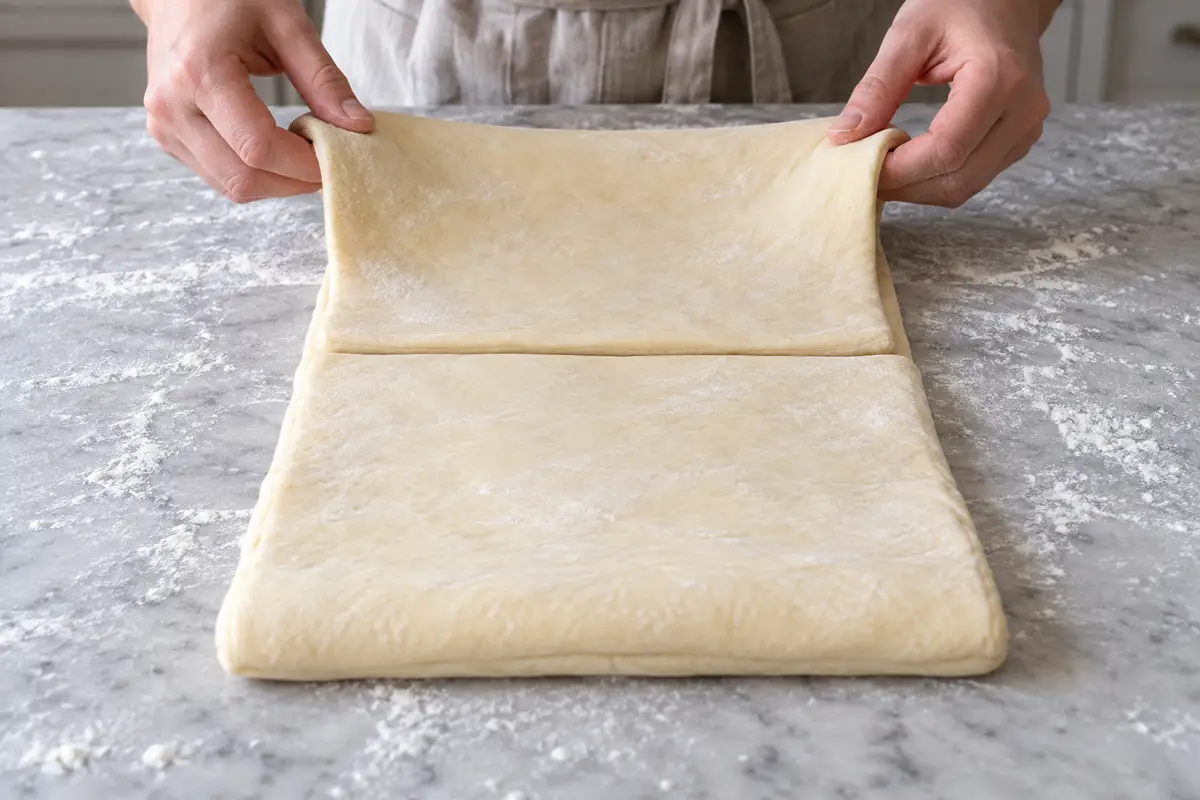
AI-generated After chilling, turn the packet a quarter turn so the closed folded edge is on your right, then roll again from the center into a rectangle about 22 × 60 cm. Fold into thirds exactly as before, wrap, and chill for about 30 minutes. Roll and fold once more in the same way, again starting with a quarter turn and the folded edge on your right, then chill for another 30 minutes. You will make three letter folds in total, not counting the initial enclosure of the butter.
Use a sharp knife to cut the chilled packet into two equal portions without kneading, and leave one wrapped in the refrigerator. Roll the other on a lightly dusted counter into a rectangle about 28 × 36 cm and about 5 mm thick, evening out the shape with the rolling pin without trimming the edges. Transfer to parchment paper on a tray, cover, and chill, then roll the second portion in the same way. Both rectangles should rest in the refrigerator, the last one for about 45 minutes, so the butter firms up again and the dough shrinks less when cut.
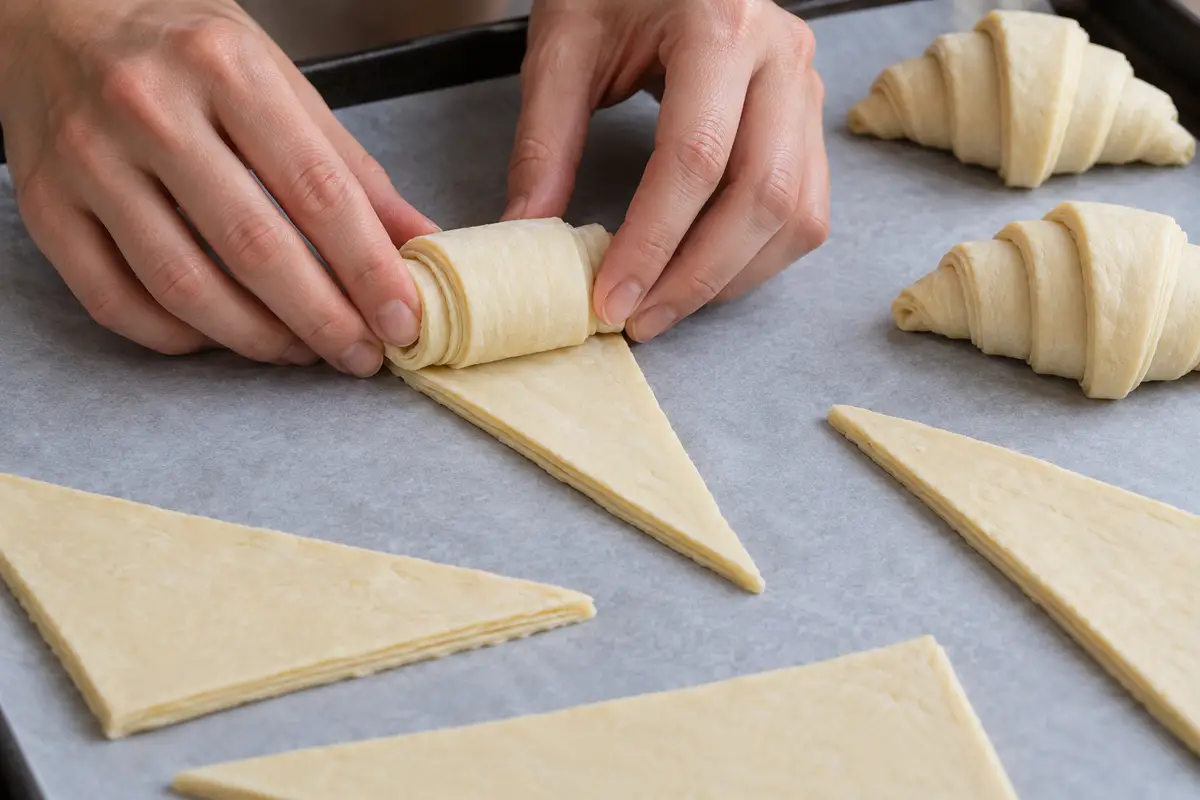
Work with one cold rectangle at a time: divide the 36 cm side into three equal sections to make rectangles about 12 × 28 cm, then cut each diagonally into two triangles. These are initially right triangles; hold the wide base, about 12 cm long, and gently shift and stretch the tip toward its midpoint so the shape becomes more nearly isosceles, without compressing the layers. Roll loosely from the base to the tip, gently spreading the ends of the base, and place seam-side and tip-side down on two large parchment-lined baking sheets, six per sheet with several centimeters between them. Shape the second portion in the same way; use the entire rectangles without setting aside scraps to make twelve croissants.
AI-generated Loosely cover the baking sheets with plastic wrap so it does not touch the dough, and leave for about 2–3 hours in a draft-free spot at room temperature, about 21–24°C. The croissants should noticeably increase in volume, show visible gaps between the layers, and wobble slightly when the baking sheet is gently moved. Do not place them in a heated oven or near a radiator, because the butter may leak out before baking. Toward the end of the rise, about 20 minutes before baking, preheat a conventional oven (no fan) to 200°C.
Once both baking sheets of croissants have risen, cover the second sheet and refrigerate it while the first bakes to slow further rising. Beat the egg with a fork and brush a thin layer over the tops of the first six croissants, avoiding the exposed cut edges of the layers so they do not stick together. Cover the remaining beaten egg and refrigerate it for brushing the second sheet just before baking.
Bake the first sheet on the middle rack for 10 minutes at 200°C, then reduce to 180°C and bake for another 15–20 minutes. The croissants should be deeply golden, with distinct dry layers on the sides and browned bottoms; pale tops and soft sides need further baking. Remove the first sheet, set the oven back to 200°C, and wait about 5 minutes for it to return to temperature. Take the second sheet out of the refrigerator, brush the croissant tops with the remaining egg, and bake the same way: 10 minutes at 200°C and 15–20 minutes at 180°C; both sheets take about an hour of baking in total, including the brief reheating between them.
Transfer the baked croissants to a wire rack, uncovered, so steam does not soften the crust. The last sheet needs about 30 minutes of cooling, while the first is already cooling as the second bakes. Divide into twelve servings of one croissant each and serve whole or cut open once the inside is no longer hot.
Estimated nutrition

Rate this recipe
0 ratings
Comments