
AI-generated
Kransekake — Norwegian Almond Ring Tower
Log in or create a free account to save recipes.
Source: https://recipheon.com/en/recipes/desserts/kransekake-norwegian-almond-ring-tower
About this recipe
Kransekake is a tower of progressively smaller almond rings joined with white icing. The rings have a lightly golden surface and a springy, slightly chewy center. This home version makes twelve rings shaped on paper templates, without special molds. Finely ground full-fat almonds, powdered sugar, and egg whites form a firm dough that needs thorough chilling before rolling. Evenly thick ropes and carefully joined ends help the rings keep their shape. Assemble the tower only when the rings are completely cold: icing joins each layer, while baking the rings too dark dries out their centers.
Ingredients
Almond Rings and Icing
400 g raw blanched almonds, very finely ground and full-fat, not defatted almond flour
560 g powdered sugar with no added starch, divided: 400 g for the dough, 10 g for dusting, and 150 g for the icing
120 g pasteurized liquid egg whites, divided: 100 g for the dough and 20 g for the unbaked icing
5 ml lemon juice for the icing
Steps
Have ready two flat baking sheets with a usable surface of about 30 × 40 cm, parchment paper, a bowl, a kitchen scale, a ruler, a drawing compass, a pencil, cooling racks, and a piping bag with a small round tip. Mix the ground almonds with 400 g powdered sugar, gradually add 100 g pasteurized egg whites, and knead for 3–5 minutes until the dough is firm and pliable with no dry crumbs. Do not whip the egg whites into a foam. Flatten the dough, cover tightly, and refrigerate for at least 2 hours; prepare the templates during this time.
Draw twelve circles on parchment paper with diameters of approximately 3.8; 4.8; 5.7; 6.7; 7.6; 8.6; 9.5; 10.5; 11.5; 12.4; 13.4; and 14.3 cm, measured along the centerline of each dough rope. Position two circles side by side on each sheet, leaving at least 3 cm between the rings you will form and room along the baking sheet edges; turn the paper drawing-side down. Divide the chilled dough into twelve progressively larger portions: the first should weigh about 31 g and each subsequent portion 8 g more; add any remaining dough to the last portion. Keep the portions you are not yet working with covered in the refrigerator.
Preheat the oven to 180°C on the convection setting, with space for two baking sheets below and above the middle. Lightly dust the work surface with 10 g powdered sugar and roll the portions into even ropes about 1.4–1.5 cm thick, with lengths of 12, 15, 18, 21, 24, 27, 30, 33, 36, 39, 42, and 45 cm in order. Curve them along the template lines on the reversed paper, firmly join the ends, and smooth each seam without narrowing the rope. Prepare the first four rings, two on each baking sheet; take the remaining portions out of the refrigerator only to shape the next batch, and briefly warm any firm dough in your hands without adding liquid.
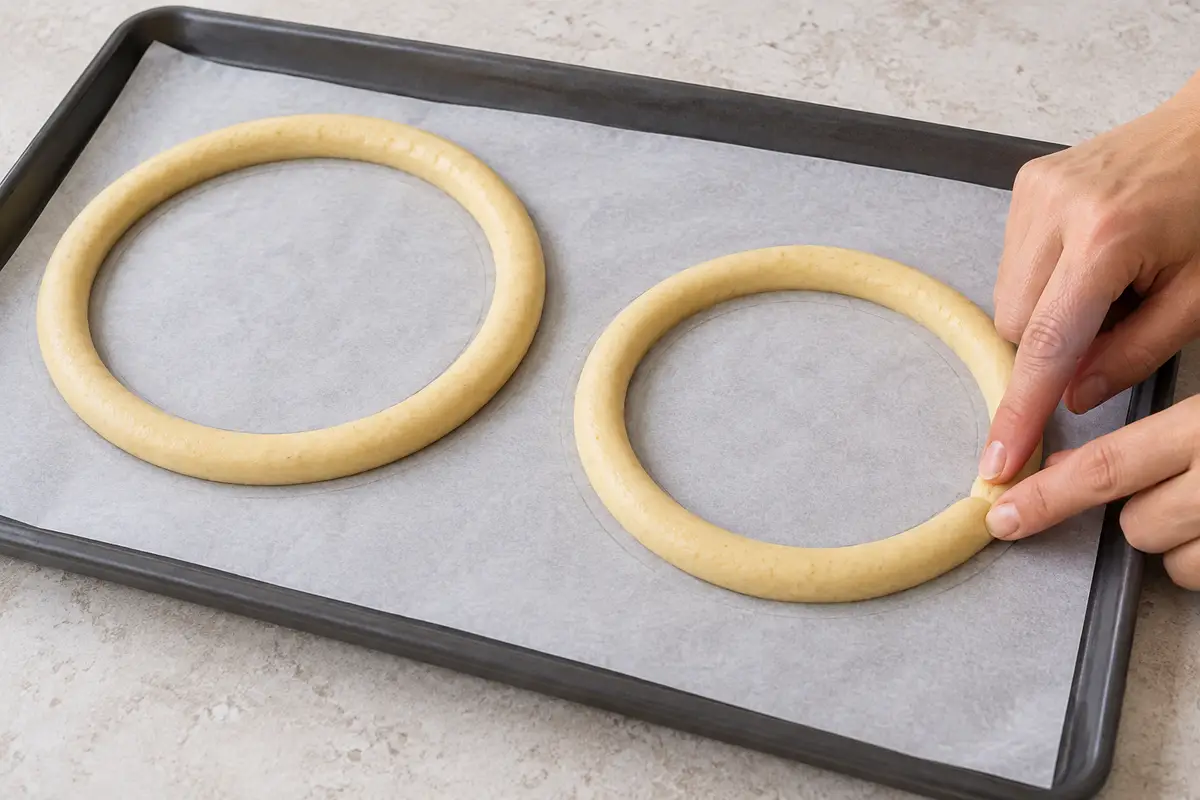
AI-generated Bake four rings at a time on two baking sheets for 12–15 minutes at 180°C on the convection setting; halfway through, swap the sheets between oven racks and rotate them from front to back. The rings should rise slightly, remain round, and have a pale, lightly golden surface without a dark brown crust; if their surfaces still look wet and raw, bake for another 2–3 minutes. Prepare the next portions while the rings bake and place them on cooled baking sheets with the reversed templates, keeping the gaps between them. Bake all twelve rings in three batches; the baking itself takes about 40–45 minutes, or about an hour including changing and briefly cooling the sheets.
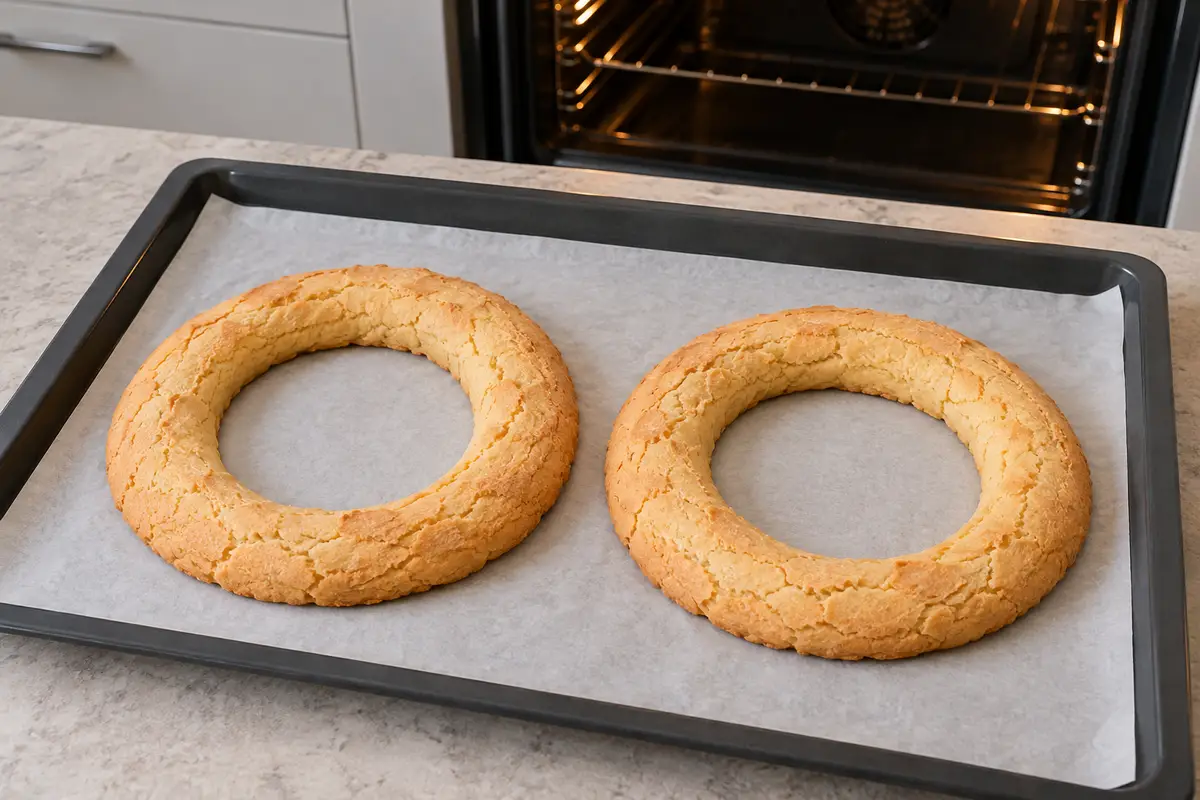
AI-generated Slide the parchment with the baked rings onto a cooling rack and leave them to cool completely; the last batch needs at least 45 minutes, longer if it is still warm. Warm rings are fragile, so do not peel them off the paper and do not stack them into a tower. Once cold, carefully separate the rings from the paper and arrange them by size, from largest to smallest.
Mix the remaining 150 g powdered sugar with 20 g pasteurized egg whites and the lemon juice, then beat for 3–5 minutes until the icing is smooth and thick. It should pipe into a thin line that stays defined and does not spread immediately. Transfer the icing to the piping bag with the small round tip.
Place the largest ring on a flat serving platter and pipe a thin zigzag of icing over its top. Set the next, slightly smaller ring on it, center it, and press gently without breaking the ring; repeat until all twelve layers are stacked. The icing should join the rings where they touch; use the remaining icing for visible white zigzags without flooding the surface. Assemble slowly, keeping the tower upright.
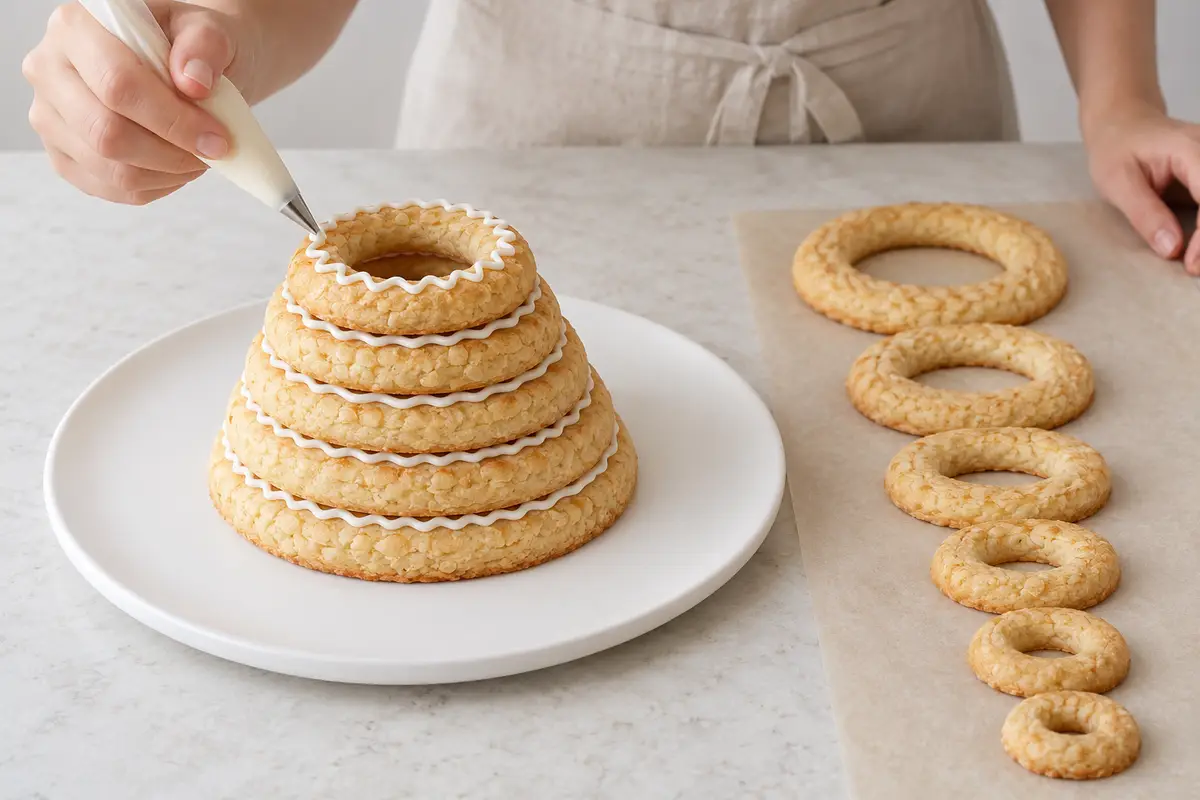
AI-generated Leave the assembled tower undisturbed for at least 1 hour, until the icing is firm and the joins are stable; wait longer if needed. To serve, remove the rings from the top and break them into smaller pieces. The whole tower makes about 16 dessert servings.
Estimated nutrition

Rate this recipe
0 ratings
Comments