
AI-generated
Homemade Szczecin meat pastries
Log in or create a free account to save recipes.
Source: https://recipheon.com/en/recipes/snacks/homemade-szczecin-meat-pastries
About this recipe
These homemade Szczecin pastries are deep-fried yeast dough rolls with a tender meat filling. A golden brown crust covers fluffy dough wrapped around pork and onion. This is a home interpretation of the Szczecin specialty traditionally made in special machines, not a reproduction of any particular snack bar's recipe. Here, all the filling is cooked in a pan first, finely chopped and thoroughly chilled. The final frying therefore cooks the dough and warms the prepared filling, rather than cooking raw meat enclosed inside. The simple dough uses water and fresh yeast with little sugar, so it does not brown too quickly. Each pastry is shaped from its own portion, firmly sealed along the length and at both ends, then deep-fried in small batches. The recipe makes twelve larger pastries; the second six wait briefly in the refrigerator so they do not overproof while the first six fry. They are best freshly made, after brief draining and cooling, while the crust is crisp and the filling pleasantly warm.
Ingredients
Cooked meat filling
300 g raw ground pork with about 9–10% fat, without bones or skin, without seasoning or other additions
150 g peeled onion
6 g peeled garlic
15 g refined rapeseed oil for the filling
60 g water for simmering the meat; the liquid stays in the filling after partial evaporation
4 g fine salt
0.8 g ground black pepper
0.5 g dried marjoram
Water-based yeast dough
500 g type 550 wheat flour
280 g lukewarm water
15 g fresh baker's yeast
10 g fine white sugar
8 g fine salt
30 g refined rapeseed oil for the dough
Shaping and deep-frying
20 g additional type 550 wheat flour for light dusting; unused flour is excluded from the servings
1500 g refined rapeseed oil for deep-frying; most stays in the pot and does not belong to the servings
Steps
Chop the onion very finely and crush the garlic. Heat the 15 g oil for the filling in a frying pan. Add the onion and cook over medium-low heat for about 7–8 minutes, stirring, until softened and lightly golden. Add the garlic and stir for about another 30 seconds. Do not pour off the oil; everything in the pan goes into the filling.
Add the raw meat and break into small pieces with a spatula. Cook for about 8–10 minutes, stirring frequently. Add the salt, pepper, marjoram and all 60 g water. Cover and simmer over low heat for another 10 minutes, stirring halfway through. Uncover and cook for 2–4 minutes, until no separate pool of liquid remains. The filling should stay moist. The meat is fully cooked now, before shaping; do not put a raw mixture inside the dough. Keep all the fat and reduced juices.
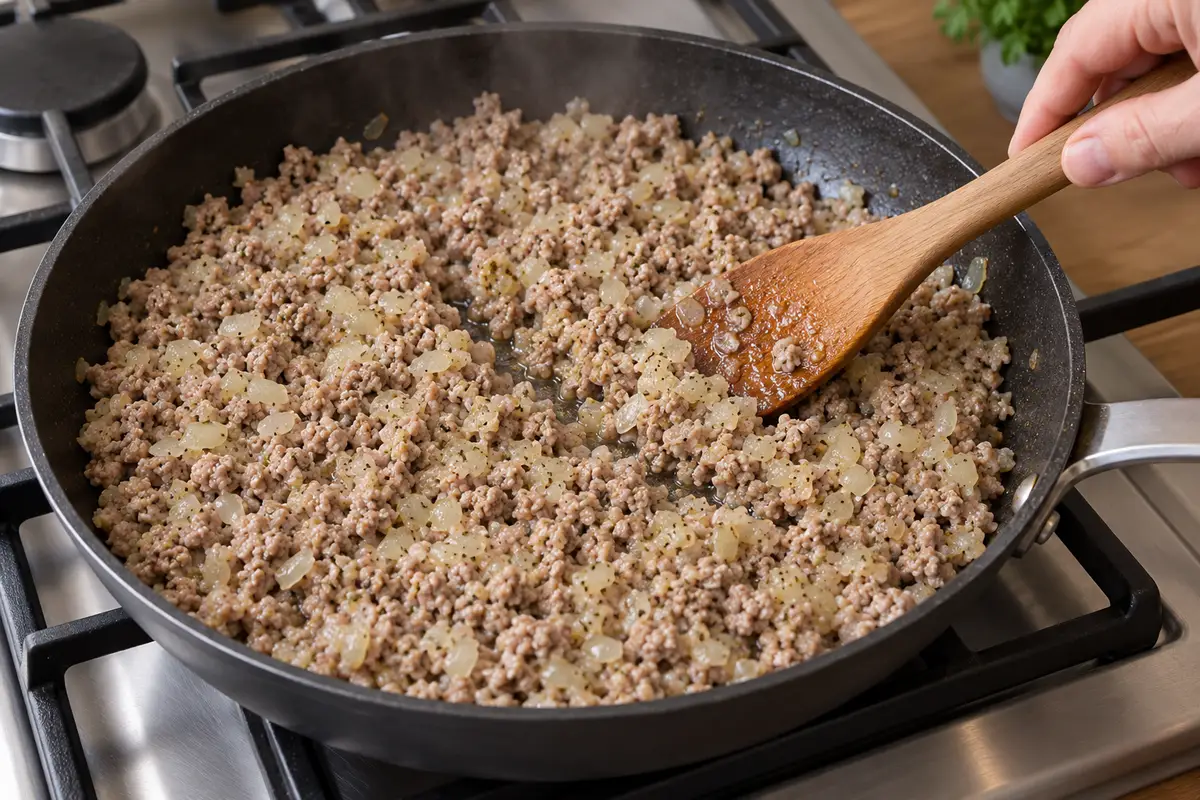
AI-generated Scrape all the filling out of the pan. Briefly process in a food processor or chop very finely with a knife; it should be fine and cohesive, without large meat lumps, but not runny. Spread in a shallow dish, cool for about 20–30 minutes and refrigerate for about 30 minutes, until completely chilled. Do not drain on paper towels and do not pour off the fat. Prepare the dough meanwhile. All the filling will be used in twelve pastries.
Dissolve the yeast and sugar in all 280 g lukewarm water. In a bowl, mix 500 g flour with 8 g salt. Add the yeast water, mix and knead for about 5 minutes. Pour in the 30 g oil for the dough and knead for another 7–10 minutes by hand or with a dough hook on low speed. The dough should be smooth, soft, elastic and slightly sticky. Gather all residue into the dough. Do not add more water and do not add flour from the separate shaping portion.
Gather the dough into a ball, leave in the same bowl without extra greasing and cover. Leave at room temperature for about 60–75 minutes, until nearly doubled in volume. In a cool kitchen, rising may take longer. Do not put the bowl on a hot radiator. The filling must be cold before shaping, not just slightly cooled; keep it refrigerated and do not take it out until the dough has risen.
Prepare two trays for six pastries each. Weigh out the separate 20 g flour for sparing dusting. Deflate the dough and divide into 12 equal pieces of about 70 g. Divide all the cold filling into 12 equal portions too. Roll each dough piece into a rectangle about 13 × 10 cm and 4–5 mm thick. Use only a thin layer of the weighed flour. Exclude the rest from the pastries; do not cut off scraps and do not discard any dough.
Put one portion of filling in the center of a rectangle as a log about 9 cm long, parallel to the longer edge. Keep the edges clean. Fold the short ends of the dough inward, then wrap the longer sides around the filling. Firmly seal the long seam and both ends. Shape a straight log about 10–11 cm long and place seam-side down. Repeat with all the dough and filling, six pastries on each tray. Do not brush with egg and do not coat in breadcrumbs.
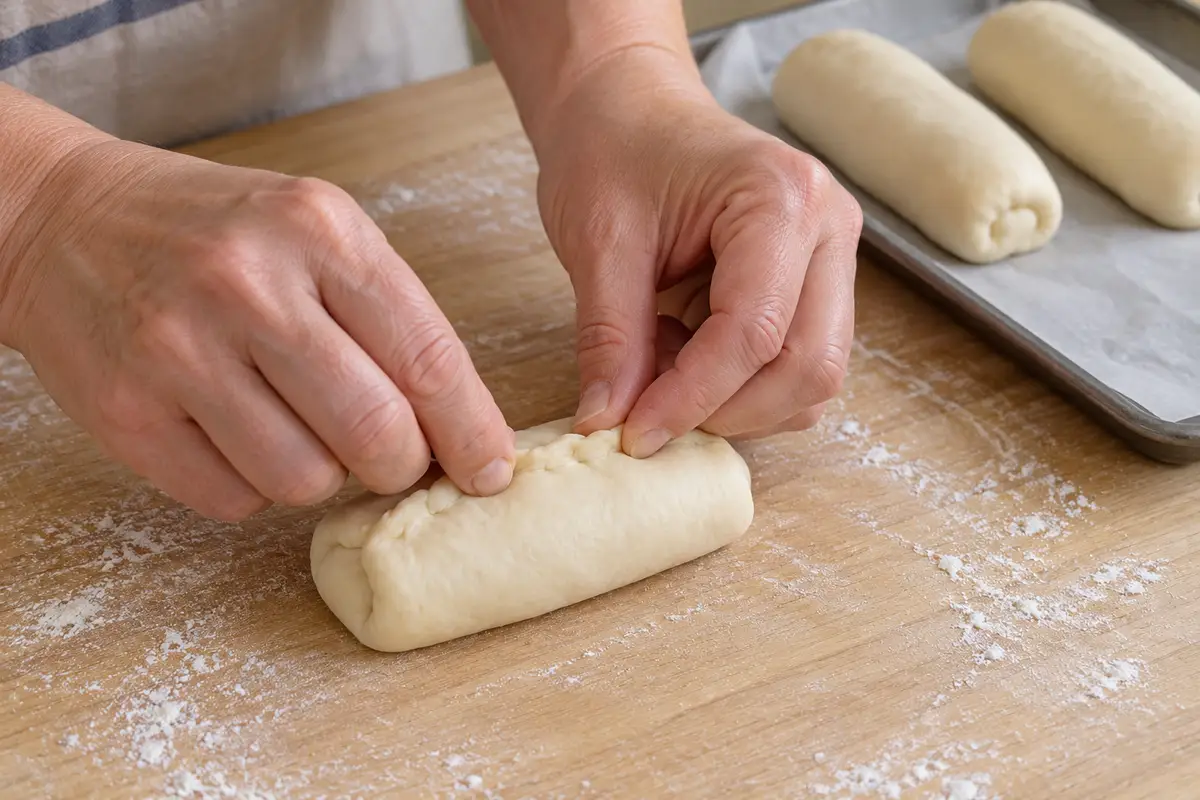
AI-generated Loosely cover the first tray and leave for about 25–35 minutes, until the pastries puff up slightly; do not wait for them to double. Immediately cover and refrigerate the second tray. You will take it out just before frying the first six, then let it proof separately. This way, the last pastries do not wait a long time by the stove after rising. Prepare a metal slotted spoon, tongs, a rack and paper towels.
Pour 1500 g oil into a dry, tall pot about 22 cm across: the oil should be about 4–5 cm deep and not reach more than one-third of the pot's height. Heat over medium heat to about 170–175°C. Without a thermometer, use the completely dry handle of a wooden spoon: small, lively bubbles should gather around the submerged end. The oil must not smoke. Do not test it with water and do not cover the pot while frying.
Take the second tray out of the refrigerator. Fry the first six in two batches of three. Shake off loose flour and carefully lower the pastries into the oil with a slotted spoon, seam-side down; do not drop from a height. Fry for about 7–8 minutes total, turning with dry tongs every 2 minutes, until evenly golden brown. Leave room for them to float freely. Let the oil heat up again between batches; reduce the heat if the crust darkens quickly.
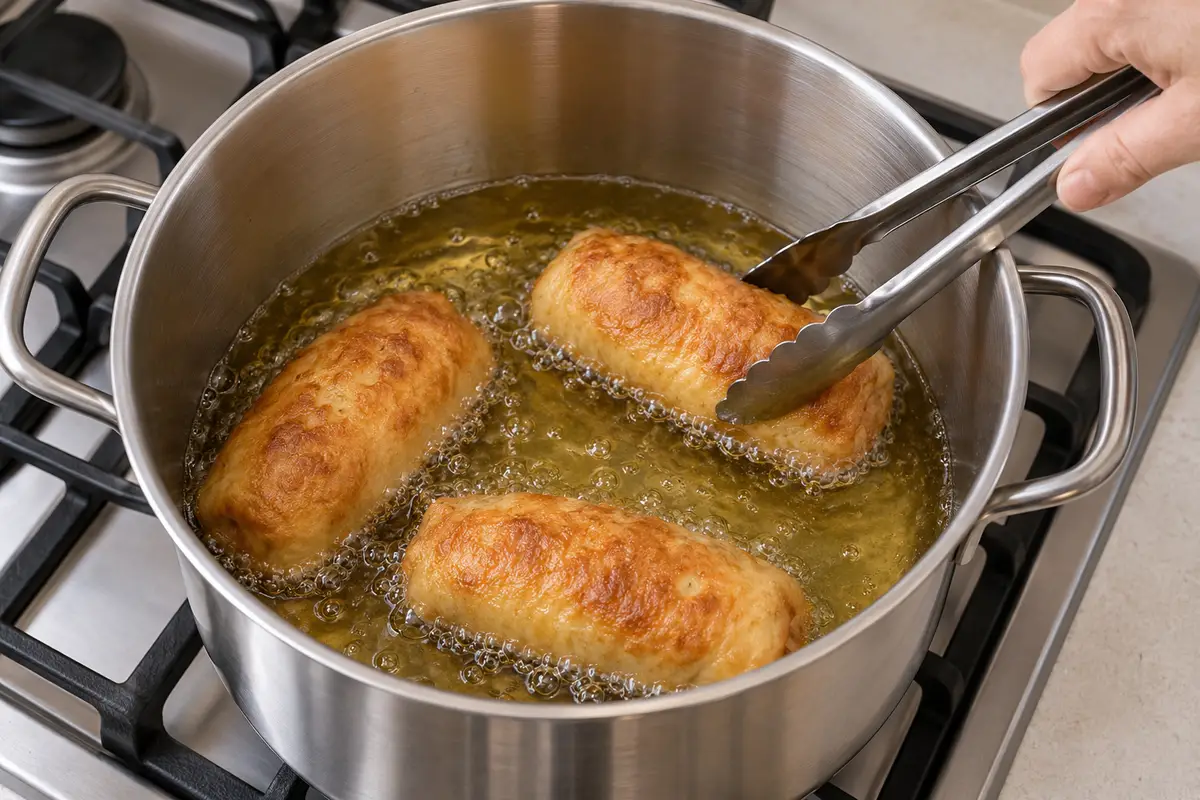
AI-generated Let the first pastry cool for 2 minutes, then cut it open: the dough next to the filling should be fluffy, without a raw sticky layer. If sticky, bake both halves for 8–10 minutes at 180°C, and fry later pastries for 1–2 minutes longer over lower heat. Fry the second six in two batches like the first, after 25–40 minutes out of the refrigerator, once slightly puffy. If you need to wait longer, turn off the burner and reheat the oil before frying. Keep watch over the hot pot.
Lift pastries out with a slotted spoon, drain briefly over the pot, then place on paper towels for 1–2 minutes and transfer to a rack. Cool for at least 5 minutes before eating, as the filling is hot. Serve plain; one serving is one of the 12 pastries, including the one cut open to check. Oil left in the pot and on paper towels does not belong to the servings. They are best fresh; once completely cooled, refrigerate for up to 2 days. Reheat for about 10–12 minutes at 180°C.
Estimated nutrition

Rate this recipe
0 ratings
Comments